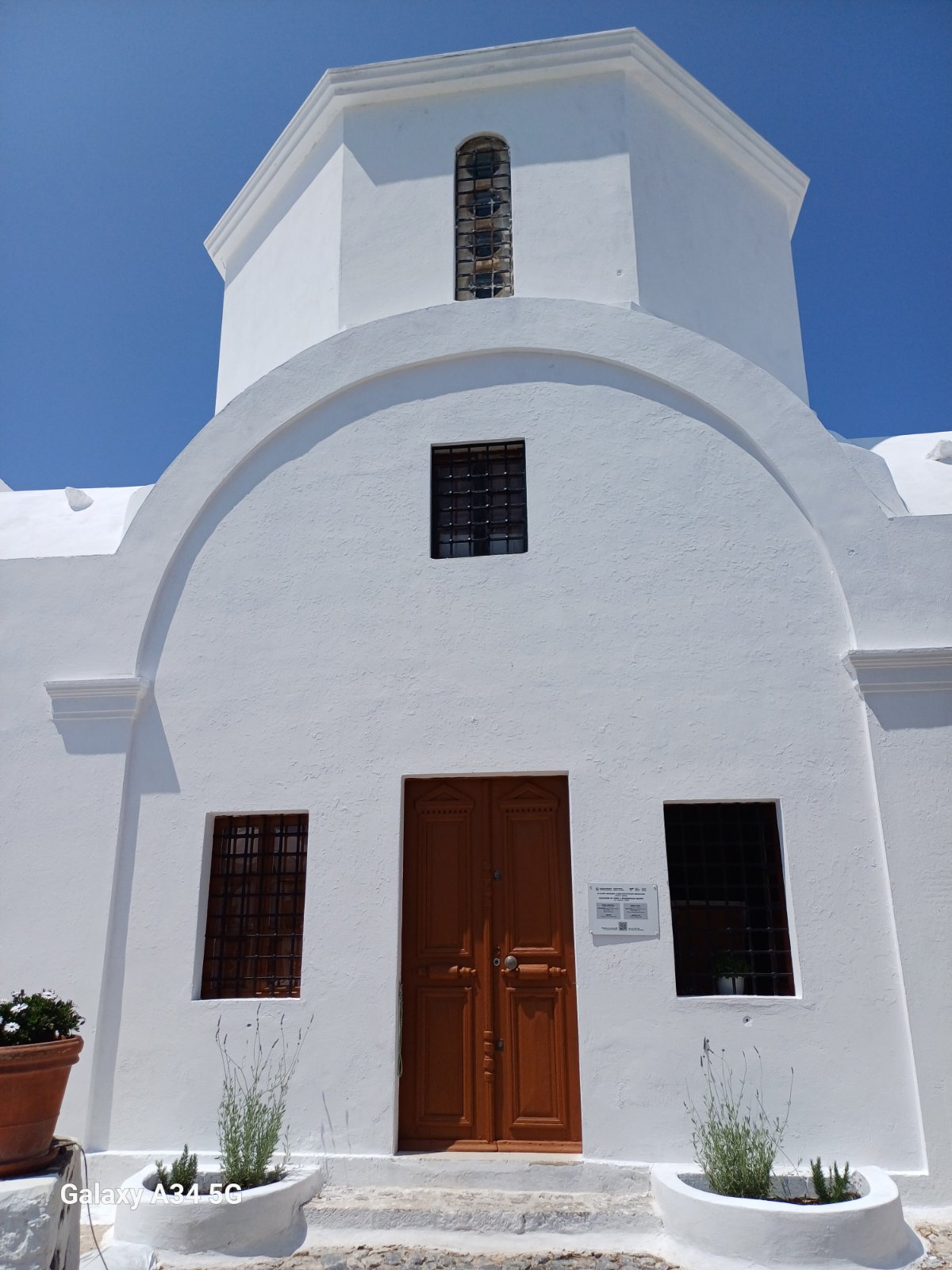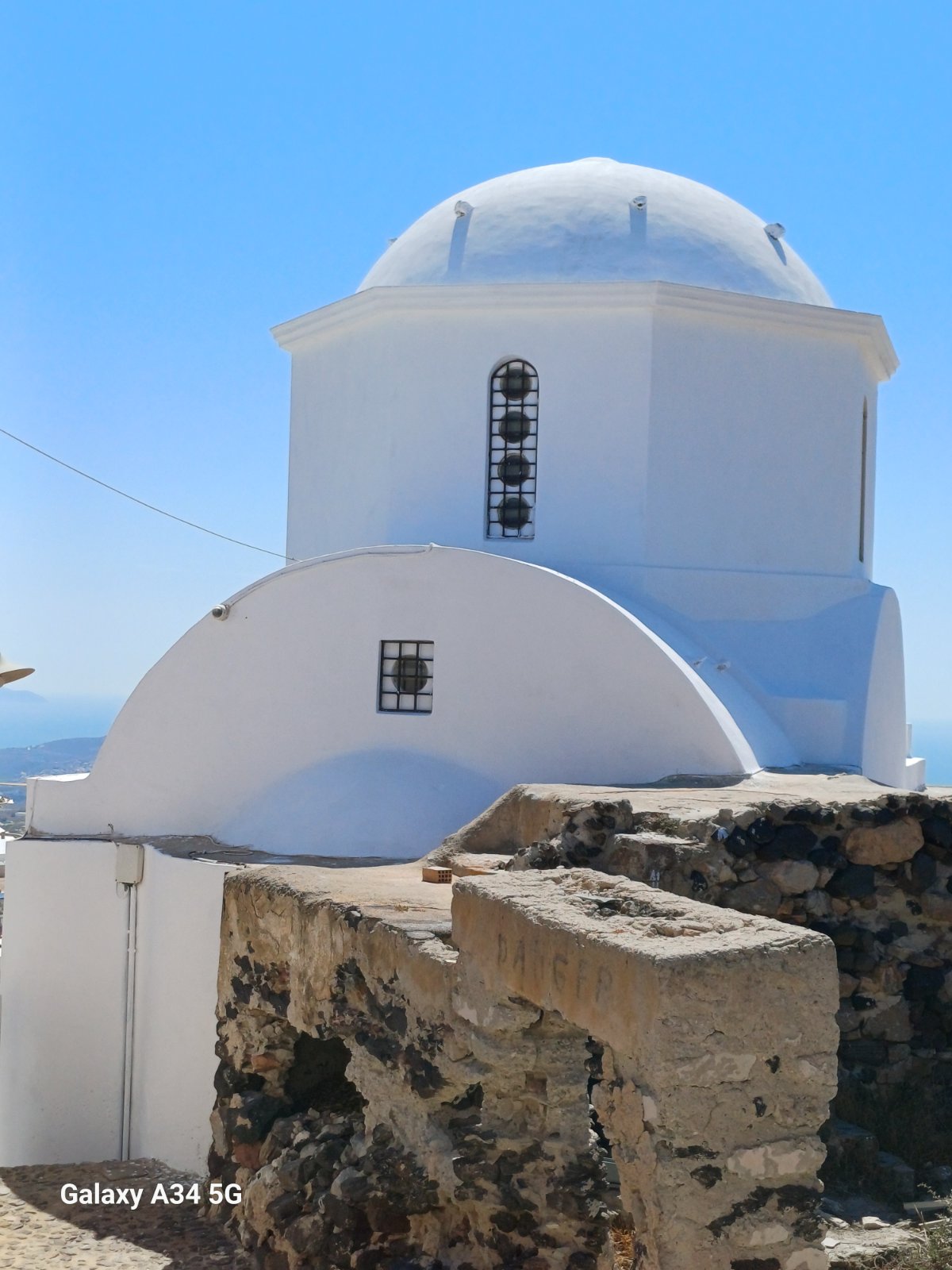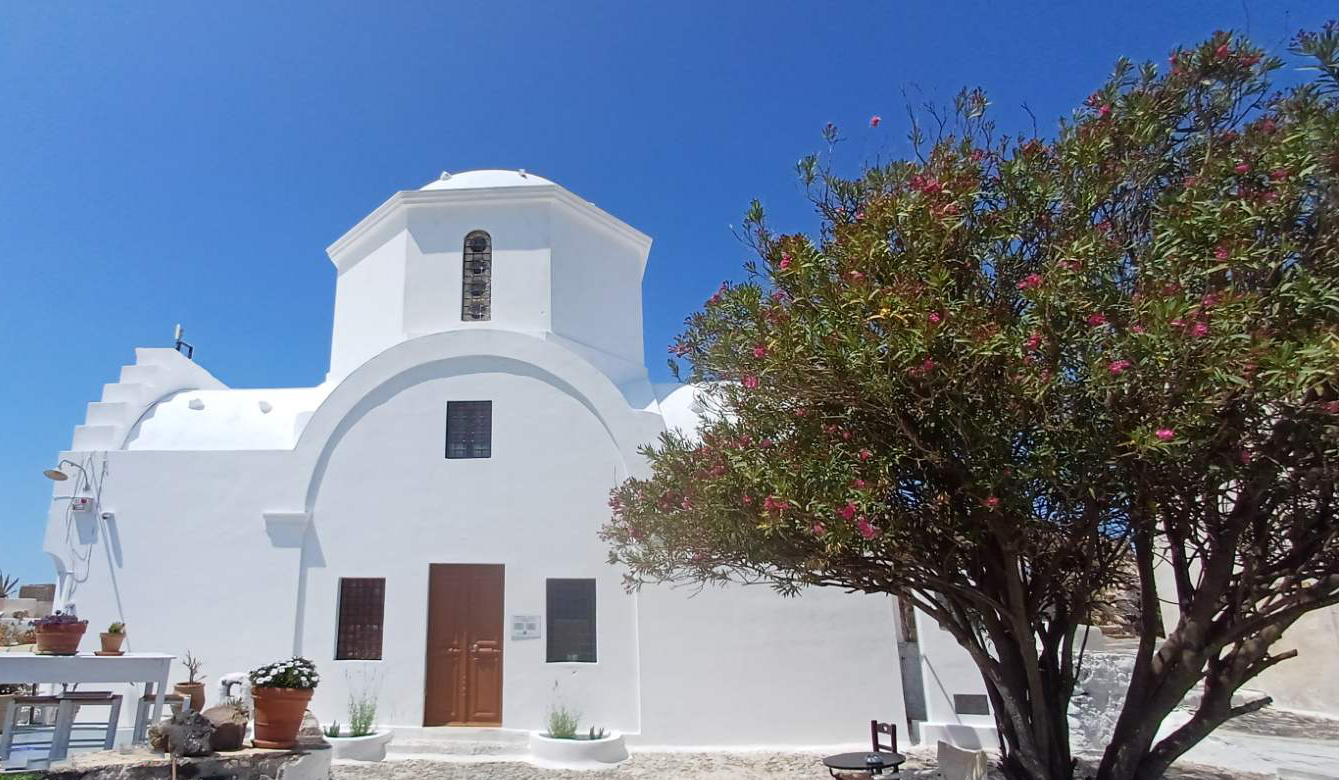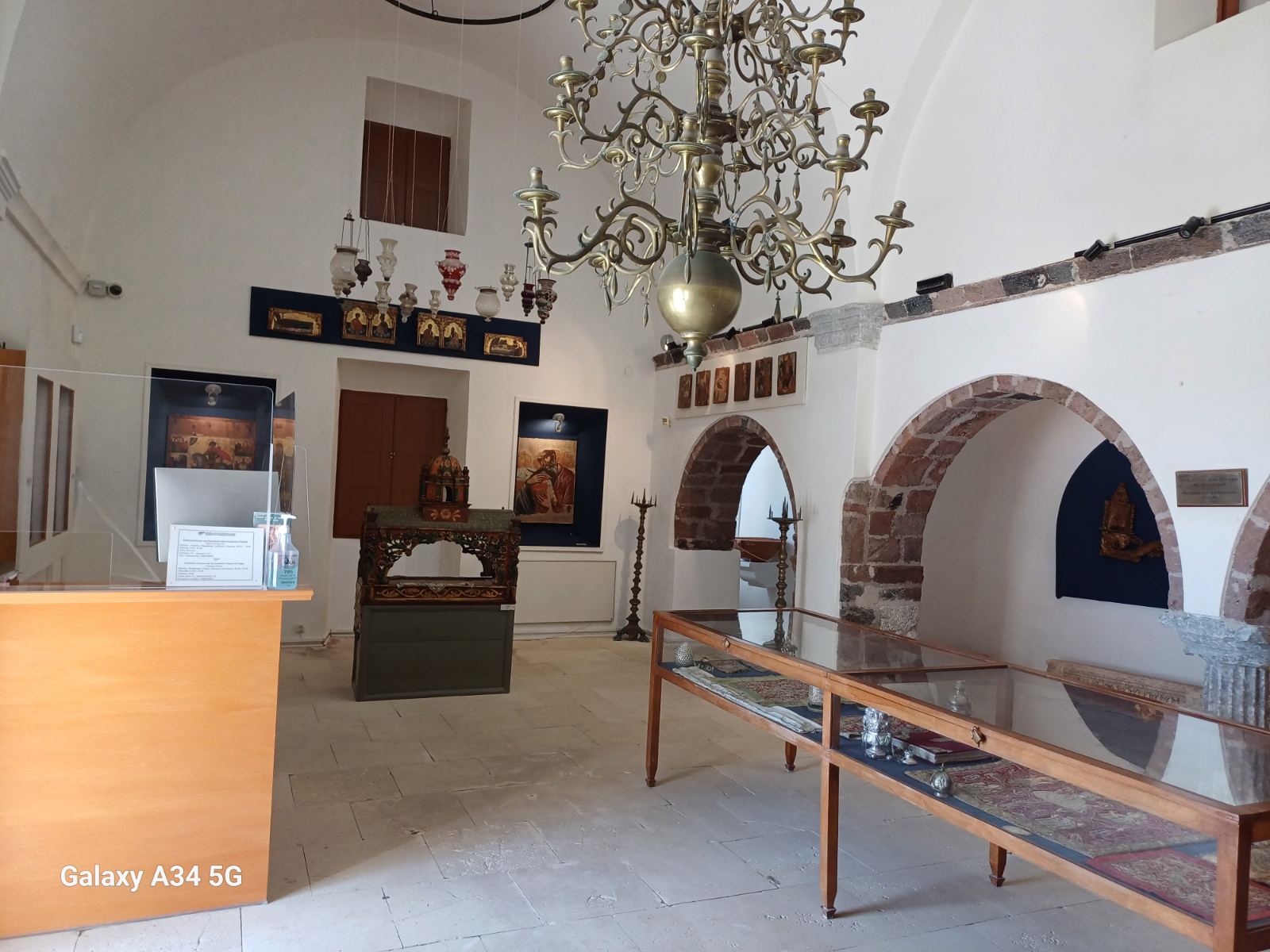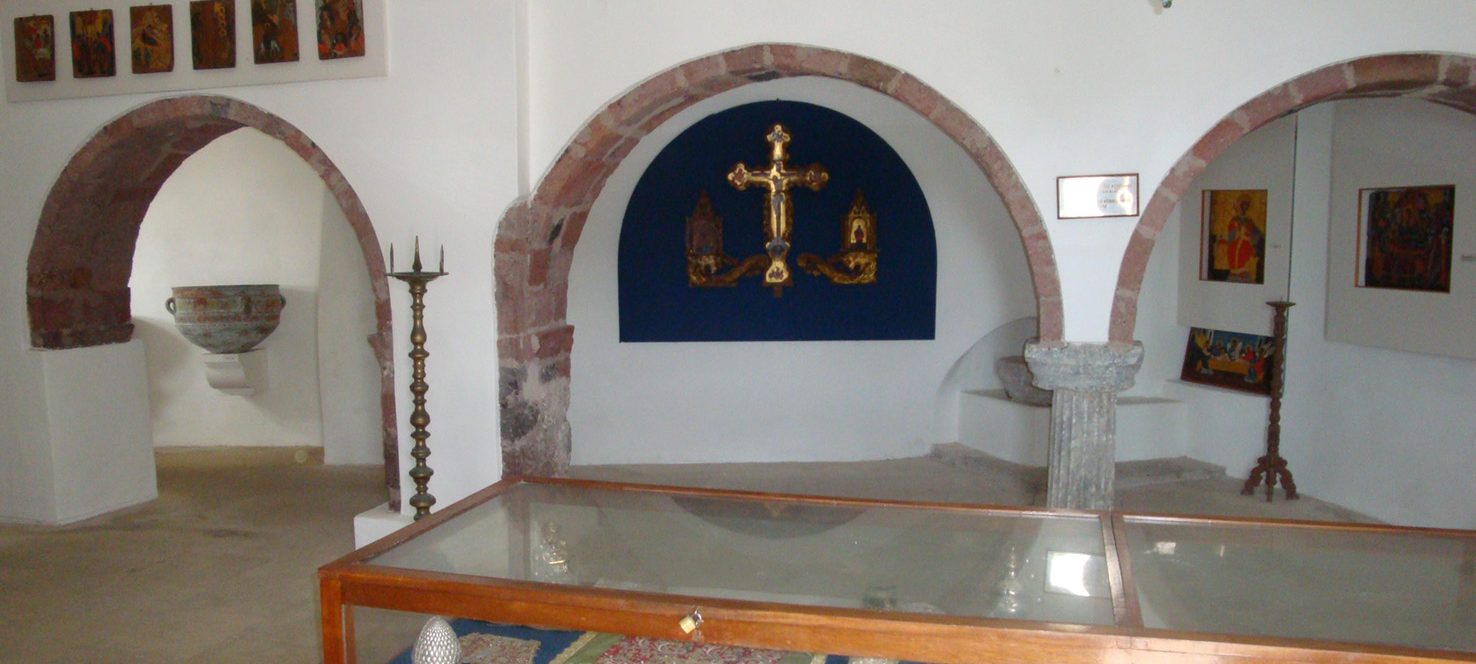


The collection of icons and ecclesiastical relics is housed in the church of Agia Triada, formerly the catholicon of a nunnery. Renovated according to a founding inscription in 1664, it was again seriously damaged in the earthquake of 1956, being rebuilt in 1975. The church is located high in the Kasteli of Pyrgos, one of the five Venetian castelia of Thera, those fortified settlements established in the medieval period in strategic positions on the island. A more recent foundation than the Kastelia of Skaros, of Agios Nikolaos in Oia, and of Emporio and Akrotiri – as the name given to it, Kainouriobourgo (New Town), suggests – it was probably built at the end of the 15th century. The densely-packed construction and the perimeter formed by the arrangement of the houses give it its fortified character: the external-facing walls of the houses form a defensive enclosure. A place of residence for all the inhabitants of the settlement, it also functioned as the administrative centre of the area and the seat of the Orthodox bishop. The first mention of the Kasteli of Pyrgos is in 1584, in a list of the islands of the Cyclades and their castles, where it is recorded under the name Nymbourgo. Its heyday is placed in the 17th century, a time when most of its churches were founded, such as the Presentation of the Virgin Mary, Agios Georgios, Agios Iakovos and Agia Triada.
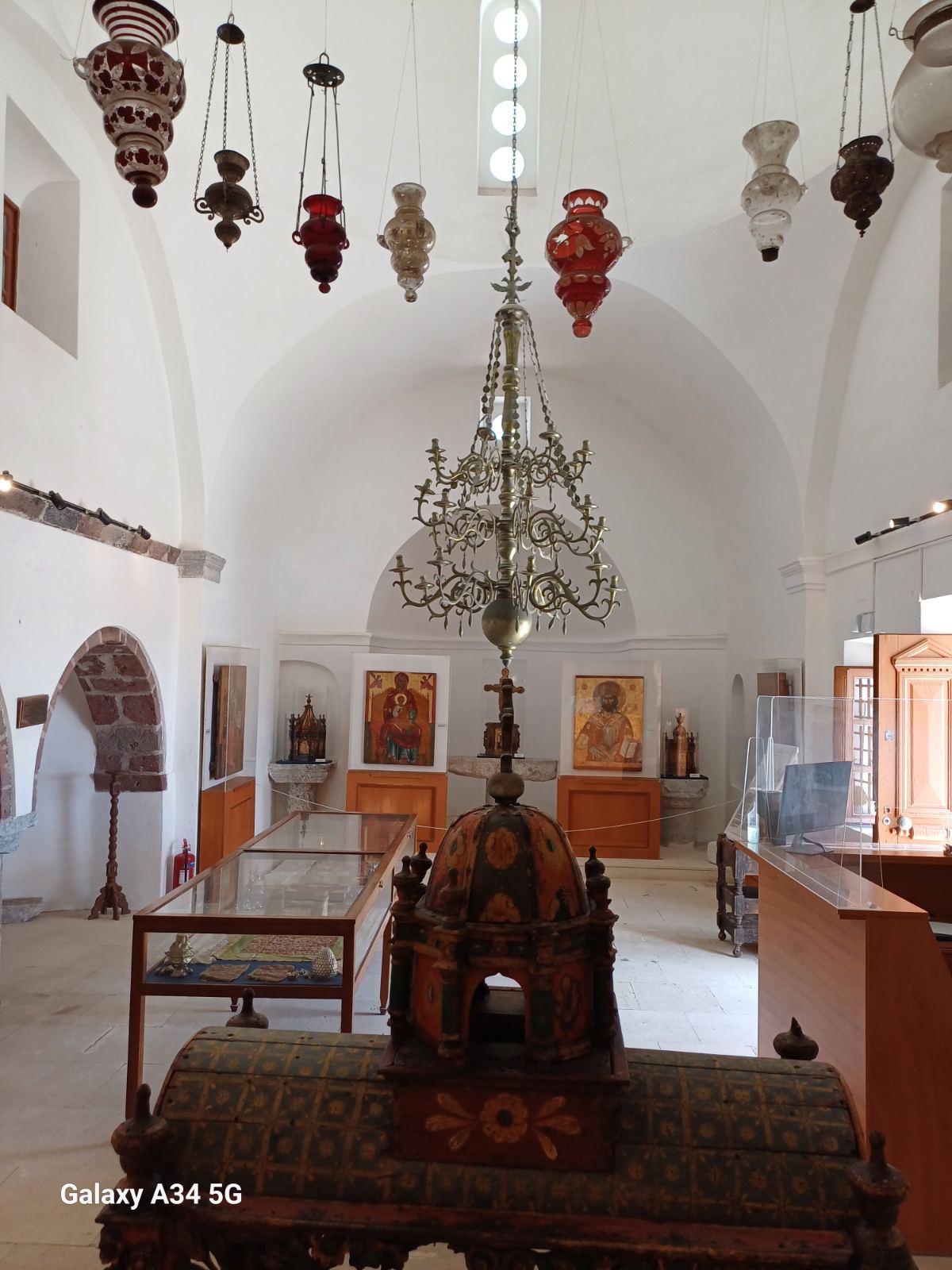
The Collection housed at Pyrgos includes icons and ecclesiastical relics that come mainly from the above monuments. It was formed immediately after the 1956 earthquake, by the then president of the Pyrgos Association of Thera, Liza Patinioti. In 1997, the 2nd Ephorate of Byzantine Antiquities, with the assistance of the Holy Metropolis of Thera and the Community of Pyrgos, undertook its re-exhibition.
The icons of the Collection date from the 16th, but mainly are from the 17th to the 18th centuries AD. They are works by local iconographers who practised on the islands of the Cyclades, as well as by Cretan painters, whose output spread throughout the Aegean. The earliest icon in the exhibition dates back to the 16th century and depicts Saint George in that type of an equestrian saint created in Crete in the 15th century, along with scenes from his life. According to the residents’ testimonies, the icon comes from the homonymous church of Kasteli.
Two other important works in the Collection belong to the Cretan painter Victor, active in the second half of the 17th century and whose works were widely distributed. The despotic icon depicts Christ enthroned as the Great High Priest. The icon probably comes from the central church of Kasteli, that is the nearby one of the Presentation of the Virgin Mary, and bears part of the signature of the hagiographer By the hand of Vic… The subject of the second signed icon by Victor is the Dormition of the Virgin Mary, as it was developed in the 15th century in Cretan iconography, but with a small and rare peculiarity in the depiction of the figure of Christ, who is bending over his mother. This icon comes from the church of Faneromeni in the homonymous area south of the settlement of Pyrgos, from where several icons and objects in the Collection originate.
The signed icons of the Collection include yet one more, with a multifaceted representation of the Divine Liturgy, in which the Holy Trinity is surrounded by angelic forces celebrating the Divine Liturgy. The icon is signed by the Cretan iconographer the Priest Emmanuel Skordilis, known from his works on many islands, but also from his famous workshop in Melos.
The Collection is complemented by carved-wood works of art, such as crosses, bread baskets and an Epitaphios, a work of folk art from the 19th century, as well as ceramics, parts of iconostases, liturgical books, church utensils, vestments and embroideries, from which last is worthy of mention a ‘podea’, an embroidered cloth that was placed under the icon of the Virgin Mary in the church of the Presentation. The exhibition space also contains ancient architectural members (spolia) in second use that were probably used in the construction of the original church, but were not included in the church’s reconstruction, as well as the aforementioned founding inscription of 1664.