

On its two exhibition floors, the Museum of Prehistoric Thera houses two independent but complementary exhibitions, dedicated to the culture developed on the island of Santorini during prehistoric times. Inaugurated in 2000, the first sets out to present a framework, through various exhibits, of the course Thera followed in prehistoric times, a dynamic and creative one that made this, the southernmost island of the Cyclades, one of the most important Aegean centres during the 18th and 17th centuries BC. The second, opened in 2021, primarily concerns itself with the remarkable wall paintings, a monumental artistic expression of Aegean culture; it thus highlights the wealth of unique wall painting existing throughout the Aegean as revealed in the prehistoric city of Akrotiri.
The main exhibition, with which a visit to the museum begins, is divided into four sections. The first two, of an introductory nature, are concerned with the history of research on prehistoric Thera and with the geology of the island respectively. They are followed by the section that presents the story of the island from the Late Neolithic Age (mid-5th millennium BC) to the beginning of the Late Cycladic I period (mid-17th century BC). The exhibition concludes with a section dedicated to the heyday of the prehistoric city of Akrotiri in the Late Cycladic I period, a heyday that was violently interrupted by the volcanic destruction of the island and the subsequent burial of the city under volcanic deposits, probably at the end of the 17th century BC. This last section is presented by developing individual themes, such as the urban and architectural form of the city, its character, the systems of recording and measuring goods, the development of the monumental art of fresco painting, the wealth of exquisitely shaped and decorated ceramics, the interaction of the arts of vase and fresco painting, jewellery and the complex web of relations existing between the city and the island with the outside world.
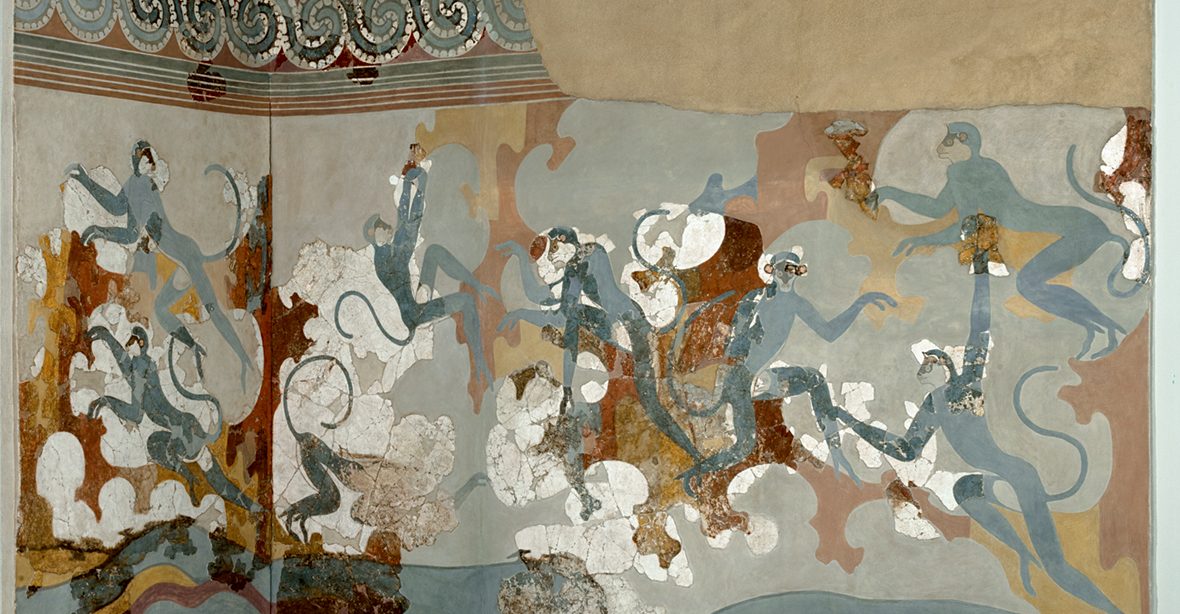
Neolithic and Early Cycladic pottery, Early Cycladic marble figurines and vases, Middle Cycladic pottery as well as samples of stone tools and early Cycladic bronzework from various sites on Thera and the Christiana islets constitute the exhibits through which the course of prehistoric Thera is presented up to the period when the city at Akrotiri flourished. The various aspects of the life and culture of the city’s inhabitants during its heyday are brought to life by a variety of finds, in an excellent state of preservation, such as plaster casts of furniture, household items, bronze vessels, tools, objects that testify to the practice of metalworking, seals, clay tablets with Linear A script, pots of a standardized shape and decoration that indicate ways of managing goods, fresco ensembles (wall-paintings of ‘Women’, ‘Papyrus’, ‘Monkeys’) and fragments of more of the same, domestic and imported ceramics of both practical and ceremonial use, as well as objects that testify to the cosmopolitan mentality of the inhabitants of this prehistoric city.
The exhibits come mainly from the excavations of the Archaeological Society of Athens in the prehistoric city of Akrotiri, but also from the old excavations of the German Archaeological Institute at the site of Potamos, from excavations of the Ephorate of Antiquities of the Cyclades at various sites in Santorini and the Christiana islets, as well as from collections of later traditional materials.
The exhibition ‘Theran Murals. The Treasure of the Prehistoric Aegean’, develops the theme of the main exhibition dedicated to the monumental art of mural painting. It presents a further 28 of the numerous wall-paintings recovered from the buildings of the prehistoric city of Akrotiri, so revealing to us all their iconographical programs.
Two such ensembles are set up for comparison: on the one hand is the entire iconographical program of the private building known as ‘Western House’ (rooms 5 and 4) and on the other a part of another program of the public building, known as ‘Xesti 3’ (room 3, on the ground floor and on the first floor). The last are representatives of the largest mural ensemble in the Aegean to date. The exhibition brings out the multiple aspects of monumental painting – from the architectural, iconographic, functional, aesthetic and ideological points of view.
The presentation of the four sets of frescoes in their original arrangement, in positions reproducing their original ones, without scenographic interventions and so exactly as they were designed by the prehistoric painter, allows the viewer to directly perceive the content and aesthetic values of these Theran masterpieces. Among them are the well-known frescoes of the ‘Fishermen’, the ‘Priestess’, the Miniature Frieze, the ‘Ikria’, the ‘Worshippers’, ‘Naked Boys’, ‘Saffron Gatherers’ and the ‘Goddess of Nature’.
The exhibition is complemented by a section dedicated to the conservation, restoration and reconstruction of the murals. This is a demanding exercise, requiring long-term and complex labour that lies between the discovery of the murals in the prehistoric city of Akrotiri, usually in the form of thousands of fragments, and their exhibition in the museum.
As vehicles for expressing the perceptions and trends of the day, with their representations that surprise in their variety (being works of different groups of craftsmen), the Theran murals exemplify the high level that the art of wall-painting had reached on Thera during the heyday of the prehistoric city of Akrotiri. They offer a wealth of information about the outward-looking and prosperous Theran society of the Late Bronze Age.
The building of the Museum of Prehistoric Thera, designed by architect Ioannis Koumanoudis, was erected in the 1970s, on a plot of land donated to the Ministry of Culture by the Nomikeio Hotel belonging to the late Theran Evangelos Nomikos. His intent was to establish a local museum to house the finds from the nearby excavations of the prehistoric city at Akrotiri.