

During historical times, in the Geometric or early Archaic period, it seems that the four main settlements of ancient Kea were set up, which would evolve into the cities of Ioulis, Karthaia, Korisia and Poiessa. Fortified, and equipped with acropolises and temples, their remains are impressive and dominate the landscape of Kea (or Tziotiko, in the local parlance).
Ioulis, birthplace of the great late Archaic lyric poets Simonides and Bacchylides, is the only one of the four cities that has been continuously inhabited from antiquity to the present day. On the site of the ancient acropolis was set the medieval Castle; there too, in more recent times, the beautiful mansions of the important families of Kea, such as the Pangaloi, were built.
The two western cities, Korisia and Poiessa, seem to have ceased to function as cities during the Hellenistic period, being incorporated into Ioulis and Karthaia respectively. In Korisia in particular, part of its cemeteries has been excavated, in the area of the current settlement, whence comes, among other things, the impressive Kouros of Kea, today in the National Archaeological Museum.
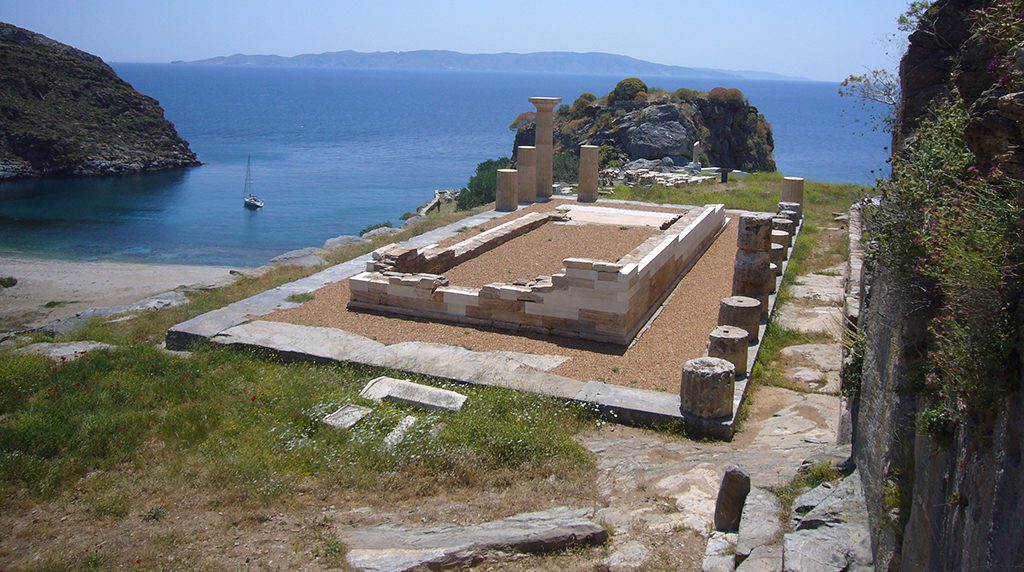
However, we have more information about Karthaia, where excavations have been carried out as well as many years of work in managing the exemplary promotion and conservation of the area. In the region with the characteristic toponym ‘Poles’, in southeast Kea, an impressive monumental complex developed, now preserved in an exemplary manner within the natural landscape and protected from modern human interventions.
The temple of Apollo – today partially collapsed – was built around 530 BC and the so-called temple of ‘Athena’ a little later, at the turn of the 6th to the 5th centuries BC. In Classical times, a monumental propylon was built on the megalithic terrace of ‘Athena’. The function of ‘Building D’, of public character, has not yet been precisely determined. In the middle of the 4th century BC, the stone theatre of Karthaia was also built, which in Roman times was incorporated into a bath-house.
In the area of the city have also been identified cobblestone streets – stepped or even inclined, fountains and tanks for securing water, parts of houses, while during the late Roman times, shortly before the abandonment of the city in the 6th/7th centuries BC, Christian cemeteries were established over the temples.
In Karthaia, one can enjoy the impressive ruins within their ancient landscape that has been preserved intact to this day. The crops being grown, the springs, the paved paths that are the only way of access – an echo of the ancient road network – make the visitor’s experience truly unique.
The restoration, conservation and promotion works of the archaeological site were carried out within the framework of the 3rd CSF (2002-2008) and the ESPA (2010-2015) by the respective Scientific Committees of the TDPEAE and the DIPKA, chaired by Prof. E. Simantoni-Bournia. The project to highlight ancient Karthaia received a Europa Nostra award in 2017.
Karthaia has been systematically excavated by the University of Athens and the National Research Foundation during the 1980s-1990s (Dr. L. Mendoni) and also during the years 2009-2010 (Prof. E. Simantoni-Bournia).