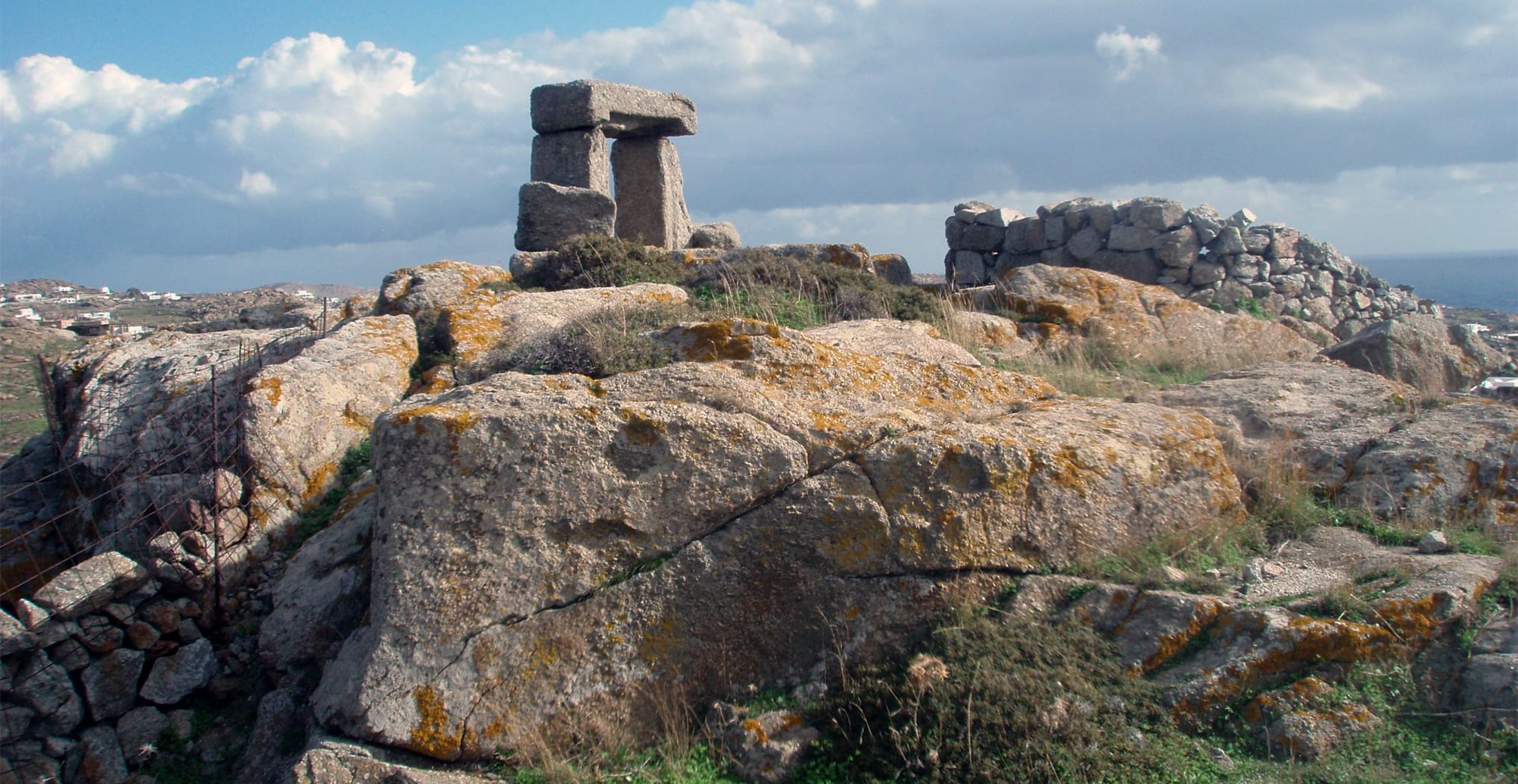


Mykonos has an area of 86.125 sq.km and a coastline of 89 kilometres. Its characteristic landscape displays rocky granite outcrops that resemble modern sculptures but made by wind and rain, the limited cultivable meadows with their borders naturally marked out, the combination of plain and mountainous landscape, the seasonal streams with their rare flora and migratory birds. All are elements of the island’s uniqueness that led to the issuing of protection orders, such as the declaration of the island as a Place of Outstanding Natural Beauty (Ministry of Culture G/848/40/4-3-1980 – Government Gazette 329/B/30-03-1980 (7)).
Despite these rulings, the uncontrolled construction and the pressures that the island is under from the reckless development of exploitative tourism seriously threaten the unique environment of the island. However, elements of the natural landscape – on account of which the island became famous and became a global tourist destination – are still preserved. The beaches of Elia, Kalo Livadi and Kalafatis still retain their natural beauty. In addition, the environment at the beaches of Myrsini, Fokos, Merchia, Lia and Kavo Fragkia in the northeast and southeast of Mykonos are still almost virgin.
The ecosystems of the northern coasts of the island in Moroergo, Lemonitra, Maou as well as the wetlands of Choulakia and Rema Panormou are also of interest.
Geologically, Mykonos is dominated by the presence of granitic rocks (granites – granodiorites) that comprise over 60% of the terrain, followed by alluvial deposits (gravels, sandy and clayey deposits) laid down by water from the watersheds and rivers. Igneous rocks, changed under pressure, and to a lesser extent andesites and pyroclastic rocks exist too.
The rocky clusters found at the top of the hills of Mykonos are, according to mythology, the tombs of the Giants who were killed by Hercules during the Gigantomachy.
Mykonos, the eponymous hero of the island, was the son of Anios, king of Delos.
Ajax, son of Oileas, the king of the Locrians, also died on the island during his return from Troy. Punishing him for raping Princess Cassandra in the temple of the goddess Athena during the fall of Troy, the gods first sank his ship and then cast him into the deep by cutting in two a rock on the Gyres islets (located at the entrance to Panormos) he had climbed to save himself. The price the Locrians paid for their king’s sacrilege was heavy indeed. They had to send two young virgins from the best families of Locris to serve as priestesses in the temple of Athena in Troy. This tradition lasted for over a thousand years until the goddess was satisfied.
Since ancient times, the tomb of the king of Locrians, Ajax, was considered through oral and mythological tradition to be located on the low but prominent hill in the centre of the beach of Ftelia: this is still a characteristic landmark in the geographical relief of the area. In reality, however, the mound covered the ruins of an organized settlement of the Late Neolithic I-II period 5000-4500 BC, which was excavated (1995-2003) by the University of the Aegean. With the investigation of the settlement, a human presence on the island was certified as early as the 5th millennium BC.
Prehistoric sites have also been identified in other places throughout the island, such as the remains of the Early Cycladic settlement investigated by the Service of Antiquities of the Cyclades/Archaeological Society at Diakofti or the prehistoric settlement at the site of Divounia. From later in the prehistoric period and especially from the periods with Minoan and Mycenaean influences, interesting finds of decorated pottery come from the excavations carried out by the Service in the 1980s at the school of Mavros in Chora and recently from the excavations carried out by EFAKYK in the core of the ancient castle of Chora.
However, the most important find of this period is the discovery and investigation of the Mycenaean tholos tomb at Angelika (late 15th-14th centuries BC), a monument that, in addition to the movable finds (ceramics, gold necklaces, seals made of semi-precious stones), also provides important data on the funerary architecture in the Cyclades. In keeping with the echo of the mythological traditions about the burial of Ajax in Mykonos, the finds of the archaeological research confirm the strong Mycenaean presence on the island.
During the 6th century BC, Mykonos is mentioned as a dipolis (with two city-states) by Skylax. One is located in Chora, the other on the Palaikastro hill of Ano Mera. After the Persian wars, the island joined the First Athenian League. At that time, the poverty of the island was considered proverbial: the island paid a tax to the alliance of only 1.5 talents (about 39 kilos of silver), while during the Second Athenian League it was only 1 talent (26 kilos of silver).
During ancient times, the island was known for both its cereals and its wine, as can be seen from the symbols used in coinage (grapes and barley grains) but also as is evidenced today by the mills that are found predominantly in the two main settlements of the island and the stone threshing floors scattered throughout the island.
In the Hellenistic period, that is, from the death of Alexander until the Roman conquest, the island participated in the Koine of the Islanders, an alliance founded in 314 BC by Antigonus the One-Eyed and his son Besieger) Demetrius Poliorcetes (the Besieger), successors of Alexander the Great. These two kings of Asia Minor organized an extensive fortification programme on the islands to use them as bridgeheads for their intervention in central Greece. Hoplites from Mykonos are said to have participated in the expeditionary force of Antigonus during his campaign in the Peloponnese in 312-311 BC. The control of the Koinon changed hands several times – from the Macedonians to the Ptolemies and back – until 220 BC, when the organization weakened and is no longer mentioned in the epigraphical testimonies. It was re-established by the Rhodians in 200 BC, who at that time were at the height of their prosperity due to their increased commercial activities throughout the eastern Mediterranean.
Despite the regular presence of the Rhodian fleet, pirate raids gradually increased after the destruction of Delos in 88 BC. The successive wars, pirate raids and the economic bleeding-out of the islands from heavy taxation combined with a lack of interest in the Cyclades, due to the shift of the centres of power after the Roman conquest, forced the islands to resort to external borrowing either from Roman bankers or from large religious sanctuaries. However, they were unable in many cases to meet their taxes. Isolation and degradation spread to a certain extent, though many Cycladic islands were chosen as places of exile for Roman politicians. The conquerors in some cases removed important works of art from public spaces to decorate the market-places of Rome. During Nero’s reign, works of art were removed from the agoras of Mykonos and Andros.
During the last period of prosperity before the Roman conquest and the destruction of Delos, Mykonos was in the shadow of its resplendent neighbour, Delos, but was the most immediate source of supplies to the sacred island in agricultural and livestock products. Furthermore, we know that the Delian sanctuary owned areas in west Mykonos (the Diakoftis peninsula) for raising herds and growing agricultural products.
A network of ancient agricultural installations with towers has been identified throughout the island and especially so in its western part. These towers, in addition to protecting the population, ensured surveillance of the seas and ensured an alert communication between themselves in case of raids. The remains of such constructions, here in better and there in more fragmentary condition, can be found in Halara, Lino, Kosomitis, Portes, Agios Lazaros, Ornos and Glastros.
In the 2nd century AD , the economic poverty continued. The islands now belonged administratively to the Province of Asia. Considerable efforts were made by Roman representatives to stimulate the economy of the islands and finally the situation stabilized somewhat in the 3rd century AD when the emperor Diocletian included the Cyclades in the Province of the Islands. However, Delos, Kea, Kythnos, Mykonos, Serifos and Syros were included in the Province of Greece-Achaia and later became a diocese with its seat in Delos.
Manolis Psarros – Angeliki Koumna Archaeologists EFAKYK
Bibliography: Chatzidakis, P.I.C. (1994) Ένας μυκηναϊκός θολωτός τάφος στη Μύκονο, Εφημ. Μυκονιάτικη 65, 1-15. Chatzidakis, P.I.C. (2002) Η αρχαία πόλη της Μυκόνου ξανάρχεται στο φώς, Εφημ. Μυκονιάτικη 294, 2. Kakridis, I.Th. (1986) Ελληνική Μυθολογία, volumes 3 & 5, Athens ed. Athens Publishing House. Tsakos, K. (1998) Δήλος-Μύκονος οδηγός Ιστορίας και Αρχαιολογίας, ed. Esperos, Athens. Ragkavis, Alex. (1888) Λεξικόν της Ελληνικής Αρχαιολογίας, in Athens, ed. Konstantinidou. Nigdelis, P.M. (1990) Πολίτευμα και Κοινωνία των Πόλεων των Κυκλάδων κατά την Ελληνιστική και Αυτοκρατορική Εποχή. Thessaloniki: Aristotle University of Thessaloniki, School of Philosophy, Department of History and Archaeology-Enyaleis Bequest. Olalla, P. (2001) Μυθολογικός Άτλας της Ελλάδας. Athens: Road Publications