

The locations of the workshops in the ancient city are located close to the old walls to the south and east, lying within the city. The rescue excavations to date in the area have proven that the workshop area operated for a long time. This is confirmed both by the excavation of the ceramic kilns in the Skiada plot, and workshops in the Emm. Sarris plot at Tholos. In addition, very close to Floga, an ancient sculpture workshop has been discovered and is being excavated, and a little further on, another workshop facility exists in the Agapitos Bizas plot.
These workshops turned out products mainly in clay or marble, and from all time periods. Of those of clay, the output is very diverse. It concerns vessels of all types and uses, larger or smaller utilitarian, both plain and black-painted, and architectural pieces of clay, such as mudbrick and tiles. Other small clay objects of daily use are known, such as loom weights, lamps, cult and votive (for dedication) objects like figurines. The products of the workshops of Paros improved trade and so made the society of the ancient city economically robust.
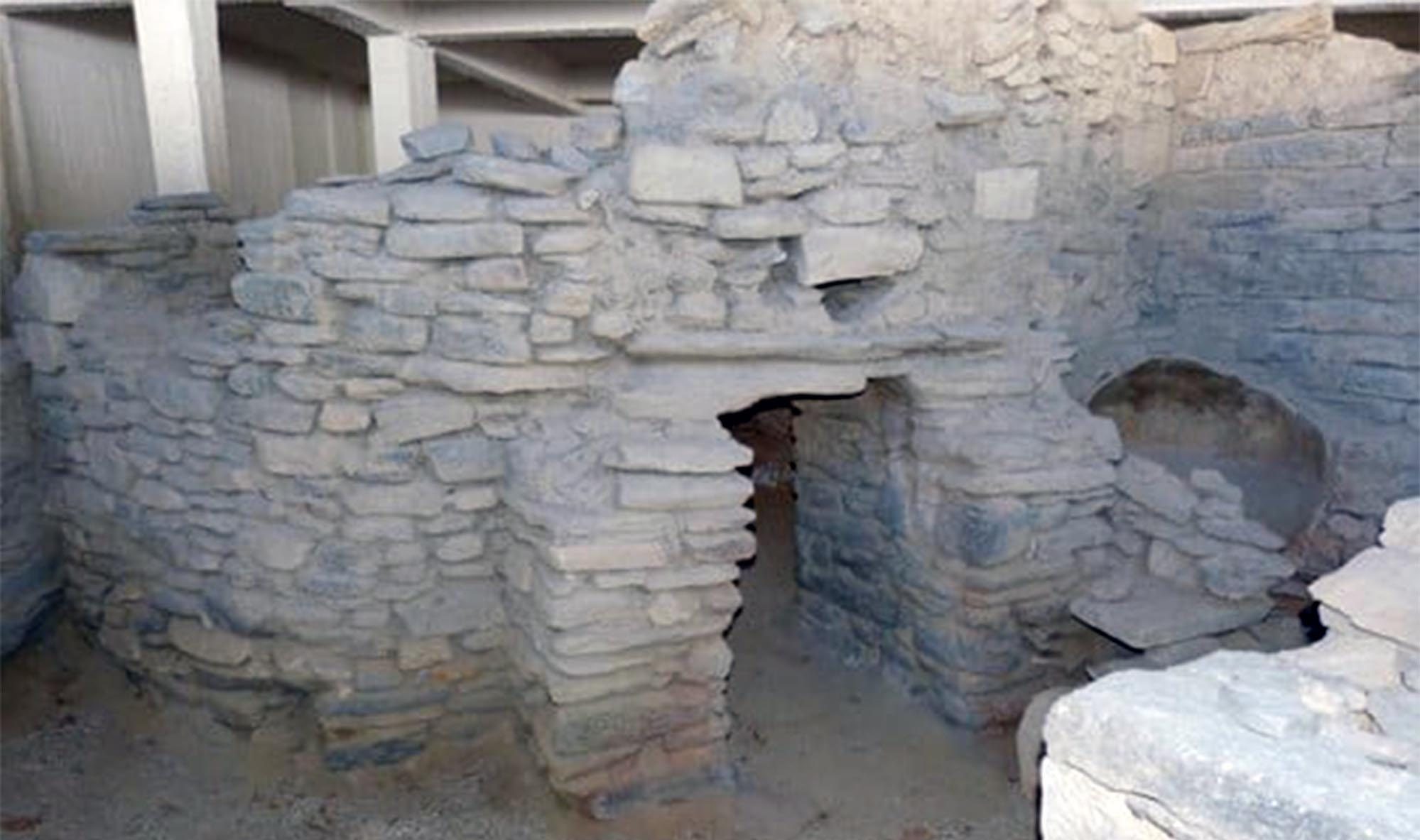
The ceramic kilns and potteries on the Skiada and Sarri plots
Both large and small kilns are involved, located now in the basement of the property allegedly owned by Skiada, preserved in very good condition. Pottery production from this workshop began in Classical times and continued through in the Classical times. Also in the same area were discovered a clay-levigation tank, part of a large house from the Classical to Late Hellenistic periods, as well as workshop complexes. The kilns were installed in this location after the city had expanded to the southeast, over the top of an older cemetery from the Geometric and Archaic periods. A few burials were found during the excavation, clear evidence of an extensive cemetery. In general, the wider area is the artisanal neighbourhood of the ancient city. In addition to the kilns, workshop complexes were developed, as is demonstrated by the excavation at the Sarri plot: here there are four sites for disposing of ceramic discards and wasters, yielding important ceramic material from the Classical, Late Classical to Late Hellenistic periods.
Sculpture workshop at the site of Floga
The site of the ancient sculpture workshop is located southeast of the city, at Floga, approximately 160 m west of the ancient wall-line of Paros and around 150 m east of the pottery and other manufacturing areas discovered on the plots of I. Skiadas and Emm. Sarris, at Tholos. During the systematic excavation carried out since the early 1990s, extensive workshop facilities have been discovered: more than one area appears to have been dedicated to sculpting activities. This is demonstrated by the large quantity of marble chips and part-finished statuettes. In addition, there was also a pottery workshop in the same area, since all kinds of ceramic material have been identified.
In the southeastern part of the site, Building A has been unearthed, in which a weaving workshop probably operated, as indicated by the significant quantity of loom weights found in and around the building. It may also have been used as a residence, as indicated by the utilitarian pottery found at the site. Building A consists of two rooms A1 and A2, which are separated by a corridor and communicate directly with an outdoor area to the north, while to the east of the outdoor area a third room (A3) has come to light, but of a later period. In the corridor between rooms A1 and A2, an oinochoe was found, with twenty-five coins that constitute a ‘hoard’.
Extensive work complexes were also uncovered on the A. Biza plot on the Paroikia-Pounta ring road. Among the important finds of the excavation, another ‘hoard’ stands out, with 11 silver coins of Parian mintage from the 5th century BC.