

Temple of Athena (Castle Hill)
On the hill of the castle, the foundations of the temple of Athena Poliouchos (the Protector) are preserved. It is a Doric amphiprostyle temple in antis, with six columns in the porch and six in the back chamber. Its width is 16.50 m; the length is uncertain, however, as only its back chamber survives; three-quarters of the temple has sunk together with the western side of the hill into the sea. The date is around 530-525 BC (during the tyranny of Lygdamis). Parts of the foundation and the marble superstructure of the temple are built into the south side of the church of Agios Konstantinos, while the marble frame of the door, measuring 3.76×5.96 m, is built into the castle.
The construction of the castle by the Venetians (1260 AD) caused the destruction of the ancient buildings on the hill, since the castle was built almost entirely of marble architectural members of earlier temples and public buildings. Due to this destruction, we only know from inscriptions and a few embedded spolia of the existence both of temples, such as those of Zeus and of Demeter, and of public places, such as the theatre and the agora. A typical case of this reuse is the castle tower, for the construction of which have been utilized a number of column drums and sections of the epistyle from a building in the ancient agora; in the interior is incorporated a marble circular building of the 4th century BC, dedicated to the goddess Hestia.
Residential complex of the Hellenistic period (site Kastrovouni)
The residential core of the city is located at the site of Kastrovouni. Three residential building complexes have been discovered, that communicate with the streets.
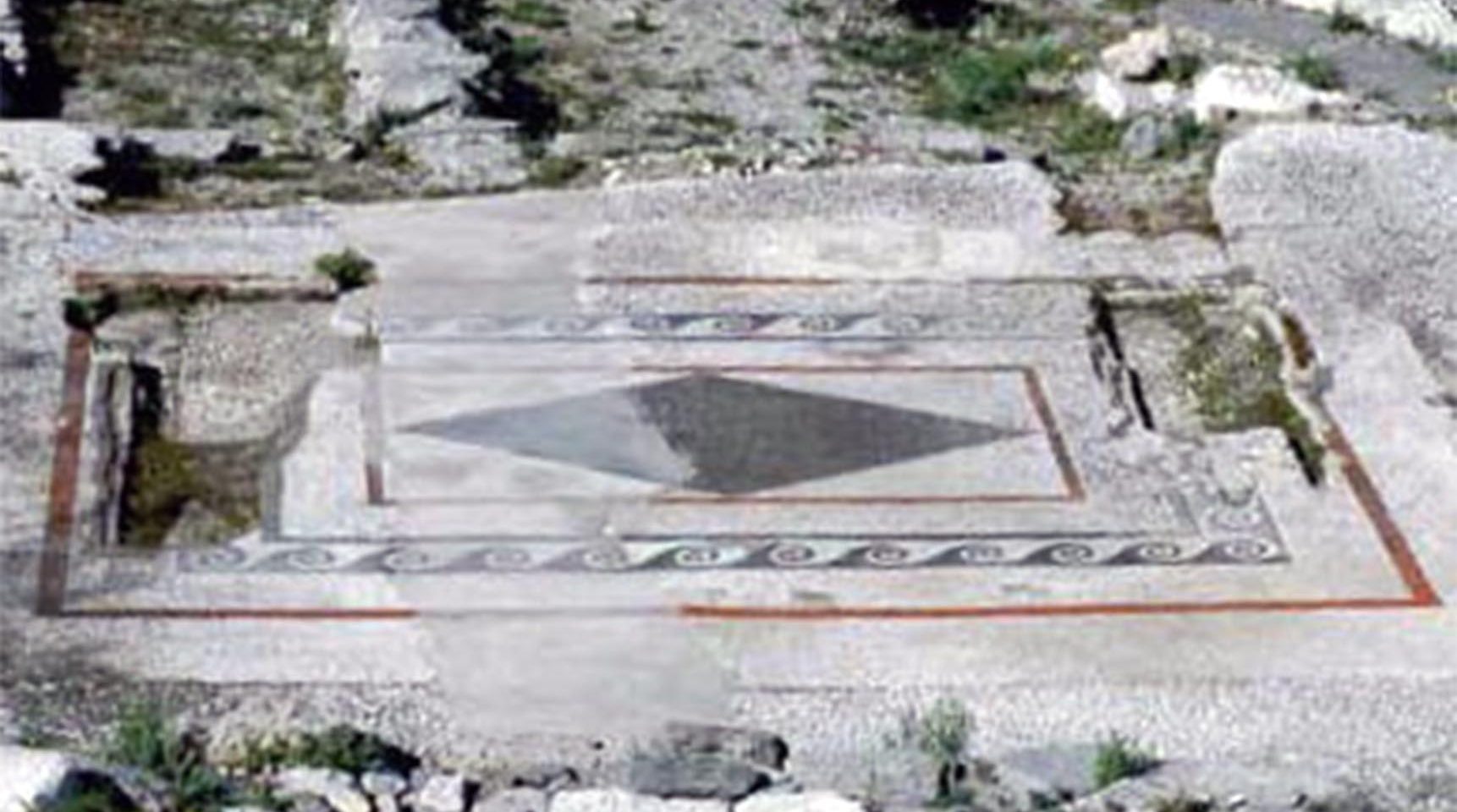
Their rooms had mosaic floors. Of interest is a room with a mosaic floor decorated in a series of bands, two red and one with a spiral meander of blue tesserae: these frame the central motif that bears a rhombus of blue tesserae. The room is identified with an andron, the banqueting room, and dates to the Hellenistic period. Under the Hellenistic floor, an older pebble floor with similar decoration survives, an element that testifies to the long use of the house, from the 4th to the 2nd centuries BC. A special find is a statue – the torso of a naked male – found built into the wall of a well of the complex, in a second use.
Roman house
At the site of Tholos, in Paroikia, in the basement of a property allegedly owned by Maounis, a rescue excavation was carried out during construction-work in the early 1970s. According to the dating of the pottery, it is part of a Roman house that was discovered, with its architectural remains preserved in fairly good condition. Of all the finds, the most impressive is the doorway, which is flanked by two monolithic marble rectangular panels in the form of pilasters or a frame, and linked to the marble staircase that led to it. From the choice of construction material used for many parts of the house, namely marble, and the very likely existence of an upper floor, we may understand that this house belonged to an official personage.