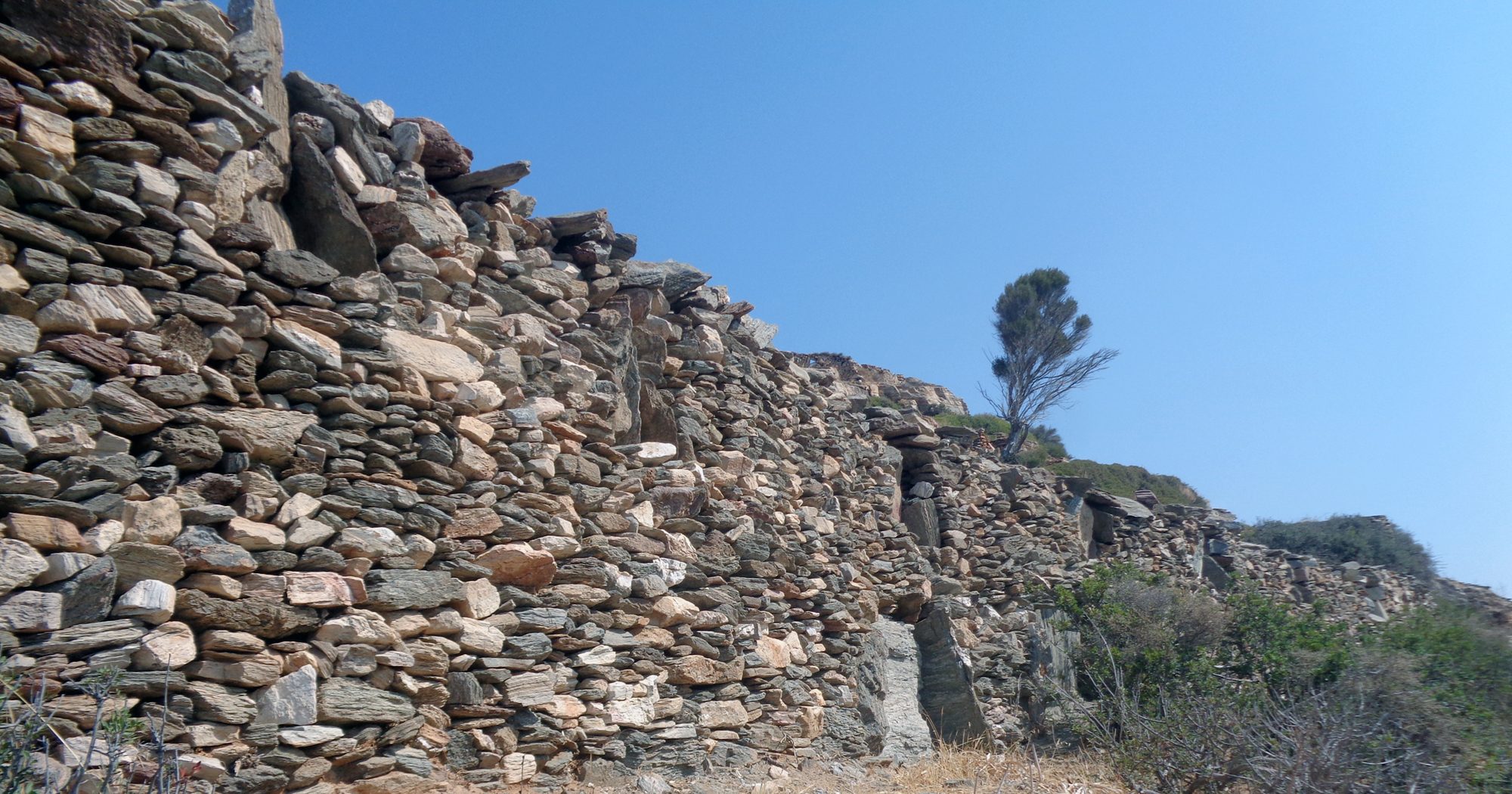


The dry-stone walls, as the word itself suggests, are in general ones of rough field-stones made without mud or mortar, and so ‘in the dry’. They can be retaining walls, that is, placed to hold up the edges of fields, when they are termed terraces (or aemasies and lourides in Greek). They can define the two sides of paths, enclose fields, and mark the edges of courtyards.
Such structures are found wherever stone is abundant and cultivable soil is scarce. There, in order to survive, people had to struggle hard to tame the stony and largely barren terrain. By constructing all these dry-stone walls, they achieved two ends. First they kept the soil in the fields, so that it did not blow or wash away downslope with the rain. And second they cleared the fields of excess stone, making the land cultivable. Further, as barriers, they kept the animals away from the sown fields or enclosed them in pens for milking.
They are not, of course, native only to Kythnos. They appear on many other islands of the Cyclades and not only there, but also to areas outside Greece, wherever stone is abundant: Cyprus, Italy, Spain, Croatia, Slovenia, and so on.
Some dry-stone walls of Kythnos and of other islands (like Andros) are made with great care, almost with an eye for their aesthetics, one could say. This is so because at regular intervals, large stone slabs or large stones are placed between the smaller ones to create a kind of ’embroidery’ effect, a beautiful visual impact. However, of special interest in the case of Kythnos is their good state of preservation. They had the luck to escape reckless tourist development, and so to survive until today when laws and special studies have hesitantly begun to protect them.
They comprise perhaps the main feature of the island’s countryside: the first thing that the landscape of Kythnos impresses on its visitors, and which enchants many. It is therefore worth making the effort to protect them and to hand them down to future generations, because they are yet in danger of disappearing.
The reasons why this is so are the following:
- First of all, the abandonment of the ‘land’, of agricultural pursuits. The walls were built and maintained over the centuries through continuous repairs, because they performed a functional role, vital for the survival of the community. The present generation has other priorities and needs and cannot appreciate or feel the effort that went into their construction. It neither knows how, nor is able to repair them, if necessity demanded.
- Then, uncontrolled tourist development. In Greece, there are no specified uses the land can be put to. So tourist accommodations can be run up in any corner of the island, and roads continually be opened to serve these places (let us not forget that we live in the era of convenience and speed).
- Ignorance about their ‘age’, their dating and their value in general. Compared to other monuments, these are ‘cheap’ (lacking monetary value) constructions, which are furthermore difficult to evaluate archaeologically, and to date accurately.
In recent years, however, research has progressed. Rural landscapes with their churches, huts, dry-stone walls and terraces have been dated to the Middle Ages and even to Late Antiquity. This ancientness is something that requires we show even more care towards the ‘stone land’ [a term used by Manolis Glezos in his book The Awareness of the Stone Land, Dardanos Publications, Athens 1979].
Of the dry-stone walls of Kythnos in particular, the opinion has been expressed (if with reservations) that some sorts at least – careful observation shows that there is not a single type on the island – are medieval. For those who find it difficult to believe this, I would recommend that they at least accept the observation that these are, according to archaeological law, ‘monuments’, because, in all likelihood, they were made over 100 years ago, before 1922. And are therefore protected.
I do not myself know the modern history of Kythnos very well, but I do not think that dry-stone walls were being built in the 20th century – only repaired. Nor could they all have been built in the 100 years before that. It took so much work, so many hands and so much time to build this entire ‘network of dry-stone walls’ on the island, that it is impossible that one century would have been enough. Some may indeed of course have been built then. But the Kythnians have always been farmers and shepherds, and their survival is inextricably linked to the dry-stone walls, dependent, we could say, on them. So why shouldn’t they be older?
One tool for dating the built countryside and its landscape are the small churches that are stand scattered about in it. Usually around the small churches there were cells and arable fields, and the small churches served the needs of the farmers of a region. We can therefore say with a considerable degree of certainty that the dry-stone walls are at least as old as the churches. This can constitute a ‘chronological tool’, so long as religious piety has not had time to alter their history and transform them into modern buildings of no historical value.
In Kythnos, many rural churches date to the 17th and 18th centuries and it is feasible that the rural landscape around them dates back to the same era. However, if the Church of the Taxiarchis in Velidi is mid-Byzantine, as in my opinion is a high probability, then why should not the beautiful dry-stone walls that define the path connecting Taxiarchis in Velidi with Merichas also be Byzantine? In the same way, the idea has been expressed that the dry-stone walls in the vicinity of the castle of Oria are as old as the castle.
Institutional protection of dry-stone walls.
- For their protection, there is first of all the archaeological law. However, a lot of work is needed, even among archaeologists, to learn in principle to recognize them as monuments and to protect them.
- The Art of Dry-stone Walling has been registered since 2015 in the National Register of Intangible Cultural Heritage and since 2018 in the List of Intangible Cultural Heritage of Humanity (UNESCO, 2003).
- For Kythnos, specifically, the presidential decree of Sifounakis ‘Categorization as a place of special natural beauty in the island of Kythnos…’ (Government Gazette 931/ 24-10-2002), article 8.7a prohibits the ‘demolition, any kind of destruction or alteration of traditional buildings in settlements, as well as those found in the countryside…’
- At a global level, discussions have begun on bestowing an equal attitude to all achievements of human creation (ICOMOS)
The Ephorate of the Cyclades is aware of the value of these humble dry-stone structures, treats them with respect, and, with the help of the law, makes an effort to preserve them wherever and however it can.
Sigala Z Maria, 28/5/22