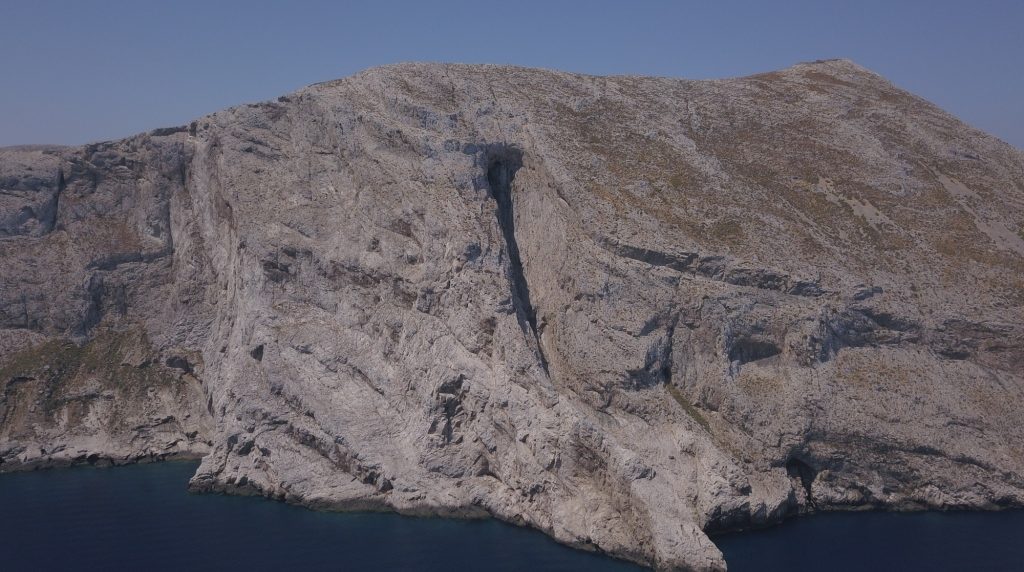


Folegandros, between Melos and Sikinos, with an area of approximately 32 sq.km, ranks nineteenth in size among the Cyclades. The island is not characterized by any significant rocks or minerals to be exploited nor does it have noteworthy natural bays and abundant water sources. However, despite the shortcomings in its natural resources, which to some extent explain the general paucity of archaeological remains and ancient written testimonies, the island boasts important archaeological sites.
The earliest habitation on the island has been identified on the rocky northern peninsula of Kastello, located between the bay of Agios Georgios in the east and that of Ligaria in the west. On this now inhospitable rock lie the remains of a small settlement that has been dated by surface finds to the Early Cycladic II period (c. 2600-2300 BC). The remains of the settlement have been subjected to the relentless wear and tear of the sea and the erosion of the rock for millennia. Although the site has not been excavated, surface sections of many walls of circular and rectangular buildings can be made out, and perhaps even a section of a wall that seems to have offered protection from the landward side.
During historical times and until the construction of the post-Byzantine Kastro/Castle, the core of habitation on Folegandros was the now uninhabited Palaiokastro, on the slope above today’s Chora, where the imposing church of the Virgin Mary stands out. Since the time of the abandonment of the settlement in Palaiokastro and the relocation to the area of Kastro, the remains of the old city have been extensively robbed of their stones. However, the scattered surface remains testify to the existence of a walled ancient city. Also preserved are part of a revetting wall within the modern cemetery, remains of a large rainwater cistern and a tower probably belonging to the fortification system of the ancient city. Dating to the 4th century BC, they testify to a prosperous building period.
The most exceptional archaeological monument of the island is without a doubt the so-called Chrysospilia. Located low (altitude approx. 25 m) down an extremely steep slope to the northeast of Palaiokastro, its (cult?) use dates from the 4th century BC to Late Antiquity. An admirable creation of the ancient Folegandrians is the construction of stone steps at an extremely steep point of the terrifying access to the cave.
The port of the ancient city of the island, at least during the Roman, late Roman and early Byzantine times, was certainly at Livadi Bay. Chiefly on the peninsula, between Livadi Bay to the south and that of Pountaki to the north, a significant settlement seemingly existed, judging by remains of ancient walls and abundant surface pottery.
Tania Panagou, archaeologist, Ephorate of Antiquities of Cyclades