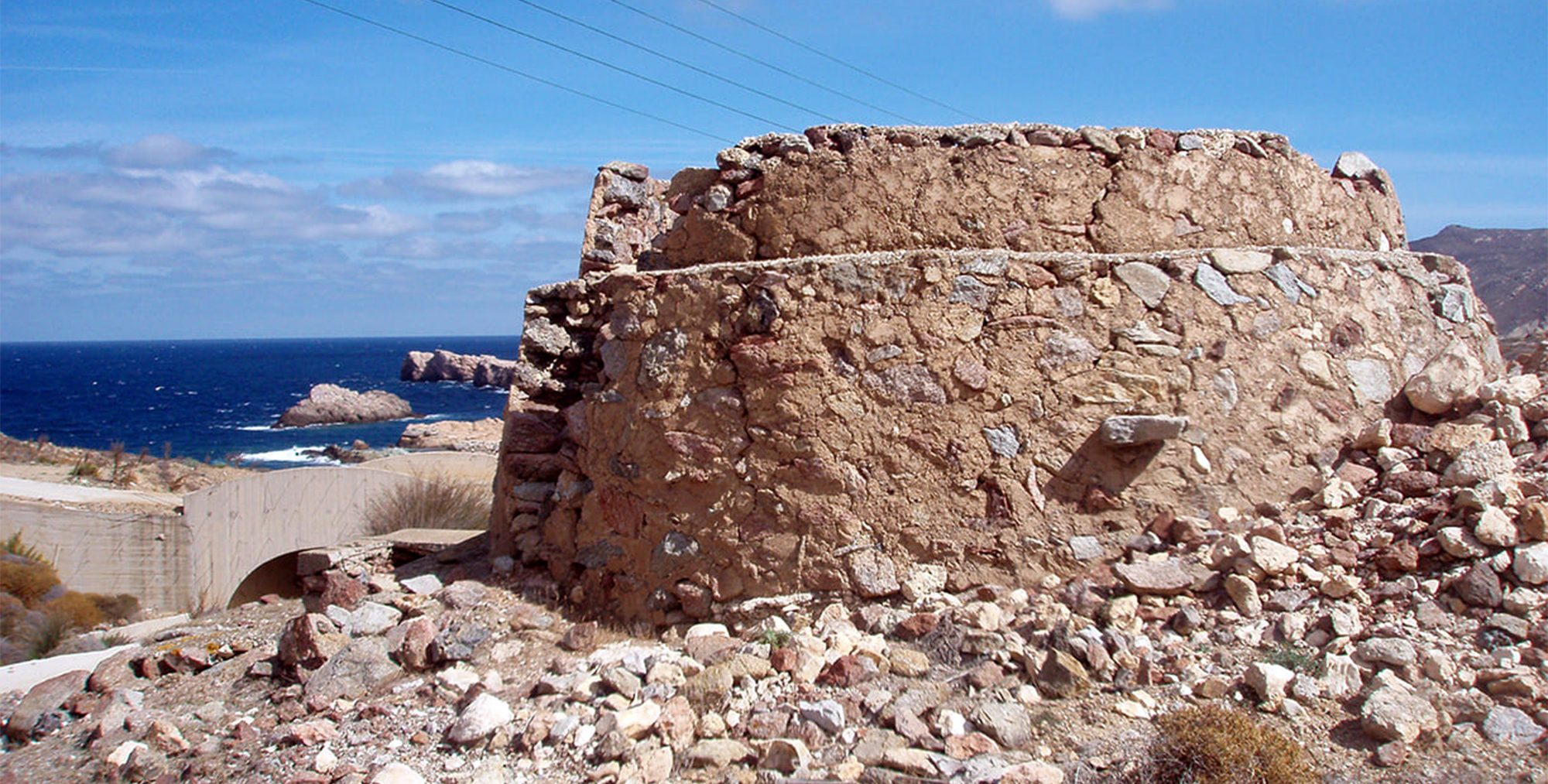


Before the Christmas holidays of 2021, we found ourselves in the remote north-east of Mykonos observing again with our own eyes the houses, workshops and other amenities (crushing-grinding mills and loading platforms of the old Mycobar mines in the locations of Ag. Paraskevi, Alonaki or Traomandra). This time the facilities piqued our interest more and we asked the locals for information, but we also traversed on foot areas of the island where mining had taken place in the past.
In addition, we also conducted a brief research on the internet where we found rich information which together what we collected, we present here.
Initially, the first mining was limited to the areas of Ag. Sostis, Merchia and Ai Lias Anomeritis for the extraction of iron, galena (silver-bearing lead) and baryte. The exploitation of the deposits was begun by the Italian Company of Spyridon Despositos and Loudovico Depian in 1898 which ceded the said areas to the French company of Serpieris in 1908 (French Company of the Lavrio Mines). Many Mykonians found work during these difficult years, but the mining ceased in 1915.
Much later, after the civil war, more interest was expressed in northeast Mykonos where three main baryte veins were identified. The initial lease of these areas was made in 1954 by the American company Magcobar, based in Houston, Texas, which then assigned its exploitation to Mycobar, Mining Company S.A. whose senior personnel numbered both Greeks and Americans. Although exploitation seems to have rested completely with the main American company and the product was exported directly to America on exploitative terms, the workers and middle personnel all came from Mykonos.
Thus, the 300 or so Greeks who worked in the galleries and on the construction sites were able to support their families in the even more difficult years following World War II and the Greek Civil War.
Initially, the residents enthusiastically accepted the establishment of the mines. However, many died prematurely from the difficult conditions of the exhausting work – either in the galleries (and so from respiratory diseases) or on the loading ladder built at Cape Loulos, in the bay of Kalo Livadi. Before the construction of the ladder, the cargo ships of Mycobar sent small barges (known as ‘slippers’) to take on cargo at Divounia to be transferred to the larger ships that were moored in the offshore shipping lanes.
Those miners who did not live in Ano Mera had to get up at the break of day and walk 2, 3 and 4 hours to reach the mines from their homes in Chora, Platys Gialos and other areas of Mykonos. However, despite the long and hard working hours, many scholars believe that the operation of the mines gave the locals the opportunity to experience new technologies and opened them to new stimuli. This exposure provided alternatives to the monopoly exercised by the agricultural economy then prevailing on the islands: a way of life that due to the conditions of the Aegean required hard labour for no profit.
So prompted, the Mykonians, introduced to an alternative modus vivendi in the new technological and industrial developments, put them to good use in the tourism developing in the 1960s, so raising their standard of living.
In contrast, when making a general assessment of the mining activities of the 19th and 20th centuries in the Cyclades and the impacts or benefits that they brought to the island society, other scholars believe that the scales lean heavily towards total exploitation. We might here quote a small pertinent excerpt from the article by the professor of urban planning N. Belavilas (Source: https://www.dimokratiki.gr/…/anekmetalleftos…/): It is remarkable how a hyper-intensive economic activity, such as that of the exploitation of mineral wealth, which lasted a century, left no trace of prosperity. The islands that hosted it changed, the places were altered. However, the settlements and their societies did not develop, the people did not progress, life did not improve as they expected. None of the profits from the promising industrial development of the 19th century and the interwar period remained on the islands.
Manolis Psarros – Ag. Koumna, Archaeologists of the Cyclades Archaeological Society.
Main sources. With rich photographic material, drawn mainly from the interview of the researcher Mrs. Dimitra Loizou-Voulgaraki on the internet:
https://www.facebook.com/dimitra.loizou.voulgaraki/
and additionally:
https://www.ribandsea.com/…/3312-ta-anenerga-metalleia…
http://giannisserfanto.blogspot.com/…/blog-post_6531.html).
Further information about the baryte mines was provided by the Keeper of Antiquities of Mykonos, Mrs. Fraskoula Pateraki and the old fishermen – residents of the houses in Divounia, Mykonos.