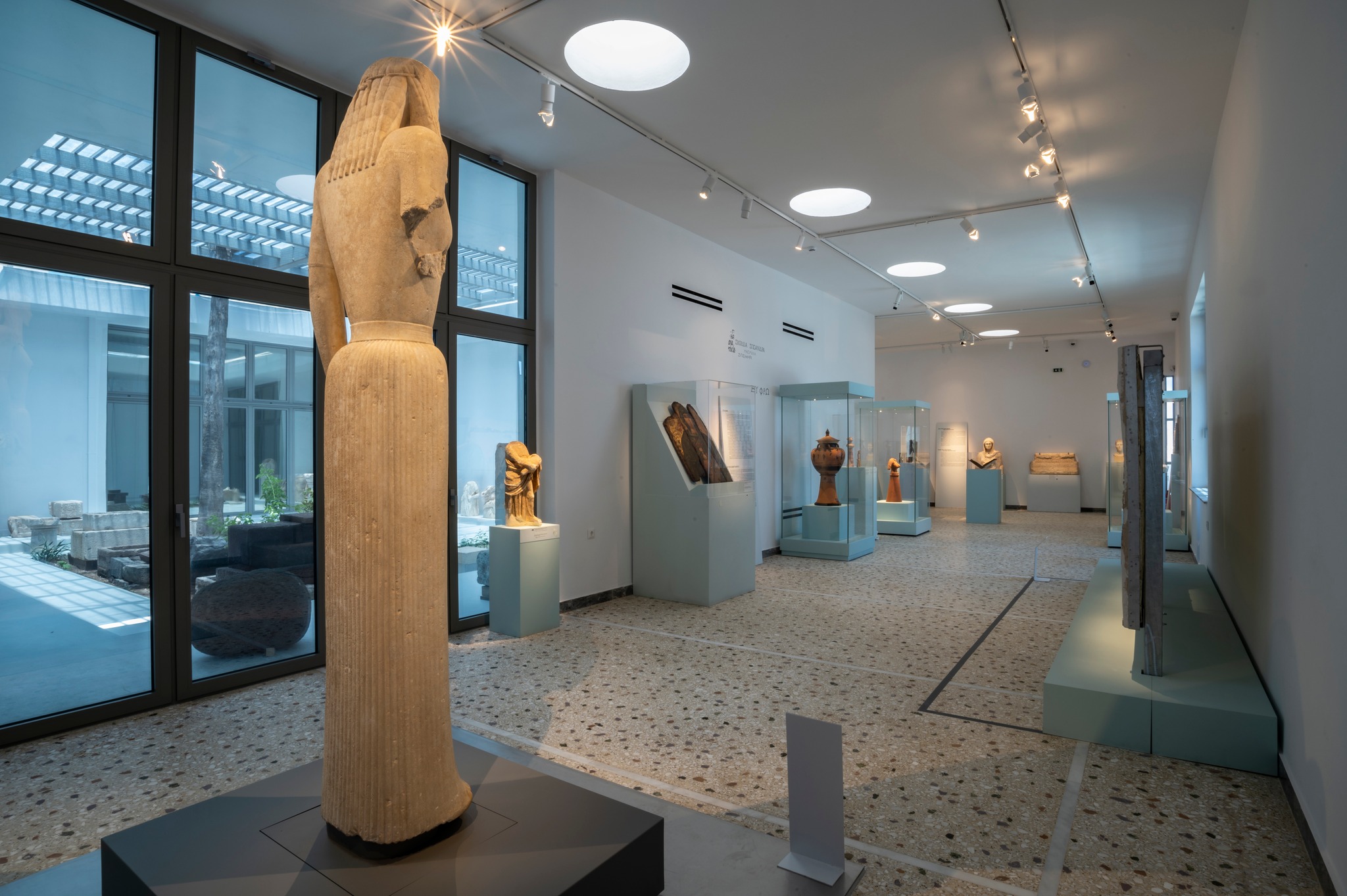


The latest jewel in Santorini’s crown – the renovated and modernized Archaeological Museum of Thera – has opened its doors to the public. The work of upgrading it to meet modern museum-building standards was combined with bringing to the fore the building’s inspired modernist design. This was the work of the architect Konstantinos Dekavallas, achieved when the structure was built immediately after the devastating earthquake of 1956.
From 21/6/2025, this Museum will be known as the home of the Kore of Thera. This colossal Archaic statue, one of the greatest works of ancient Greek sculpture, was excavated by the late archaeologist Charalambos Sigalas of Santorini. Here it is exhibited for the first time on its new, ultra-modern and seismic-resistant base. So freed from the shackles of its metal restraints and supports, the monumental sculpture is showcased in all its virtuosity and the viewer can admire the almost intact masterpiece, without distraction. This demanding project just completed is dedicated to the memory of Charalambos Sigalas. Like the new exhibition with the wall-paintings at the Museum of Prehistoric Thera, the emblematic Kore is, with no exaggeration, a reason in itself to visit Santorini.
After the doubling in size of the permanent exhibition of the Museum of Prehistoric Thera with the addition of the Theran wall-paintings four years ago, the opening of the Archaeological Museum with the Kore means that the size of the exhibitions in the island’s museums has now tripled. This historical moment for the island is combined with the temporary exhibition Cycladic Women. A co-production between the Ministry of Culture, through the Ephorate of Antiquities of Cyclades, and the Goulandris Museum of Cycladic Art is the largest pan-Cycladic exhibition ever organized for the archipelago, as well as the largest temporary exhibition ever hosted in the Cyclades. In this international-standard exhibition event, priceless exhibits from all the islands and all historical periods have been gathered in Santorini as a fitting setting to the permanent installation of the Kore of Thera at the Archaeological Museum.
photo: Andreas Santrouzanos