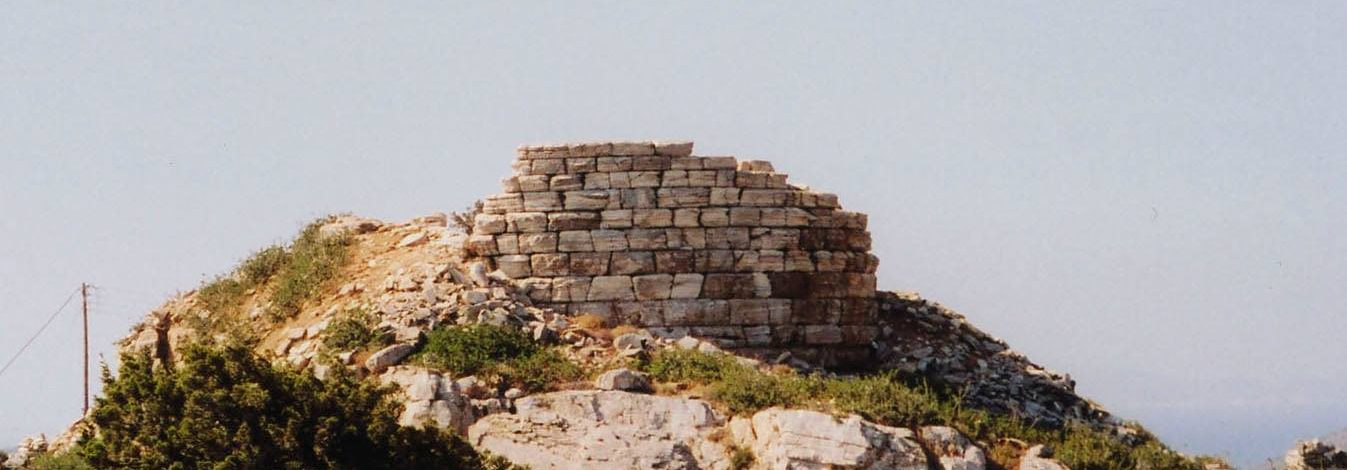


The towers are found in extraordinary abundance throughout the island’s countryside . So far 76 have been identified, i.e. more than one for every square kilometre of the island. Most though are in inaccessible and remote locations. All are circular, with an external diameter varying between 4-13.50 m, usually built from the stone locally available. They were at least two-storeyed with internal dividing walls and an internal spiral staircase attached to the inner wall-face. In many cases, there were other buildings, wells or cisterns, and even enclosures near them (‘Tower at Flambouro’ (25), late 4th – early 3rd centuries BC).
As can be concluded, mainly from the surface finds and their masonry-styles, it seems that they were being constructed gradually from the 6th to the 3rd centuries BC. Some of the oldest towers were built near mines, probably at the end of the 6th century BC, after the well-known raid of the Samian exiles on Siphnos (around 525 BC, Herodotus, Histories). In combination with the acropolises, the forts and the other towers, they made up the first systematic signalling network on the island designed for communication. Their main purpose would have been to protect the silver and gold mines and they would have functioned as warning beacons, i.e. stations for transmitting messages by fire. To give an immediate alarm about danger from the sea, key stations monitored the waves on every side. At the same time, they supervised and protected the mainly agricultural activities conducted in the countryside.
The main signalling method would have been with smoke and fire: see Thucydides, History of the Peloponnesian War; Aeneas the Tactician – 4th century BC – How to Survive a Siege; Polybius – 2nd century BC – Histories). In suitable weather conditions, a system of reflected light flashes from shiny objects – e.g. shields – might have been deployed (Herodotus, on the battle of Marathon 490 BC).
During the first phase of the creation of the network at the end of the 6th century BC, the acropolis of Agios Andreas, then in its prime, had the dominant strategic role in the chain of communication stations operating (seven towers). It is the only link that communicates both with the capital – the Castle – Asty and also with the others. Its ability to immediately transmit the news it received from all other locations on the island, either directly (…) or through an intermediate station (…), allowed both the appropriate decisions to be made quickly and the population to be informed of any necessary activity. For example: news from the silver and gold mines was transmitted from the towers in the area first to the transmission hub at Aspropyrgos and then to the most central hub at the Acropolis of Agios Andreas. From here, it was simultaneously transmitted to Asty, to the fortress of Agios Nikitas and to the Tower at the Bell Tower. The news spread almost as quickly to the fort of Prophet Elias, to Kamares and to the Tower at Lauteris from where the message finally reached the Tower at Gourna. The Asty, in order to notify the rest of the island in case of an emergency, transmitted first to the Agios Andreas hub from where the message was spread, as seen, throughout the island.
As the communication network developed further during the following periods, the acropolis became one of the most strategic points on the island. It was possible by signalling to direct information across the entire island and within a very short time. The acropolis enjoys direct visual contact with the Asty in Kastro, Prophet Elias and the fortification installation in Agios Nikitas, as well as with a further 17 towers in the northern part.