

Naxos, the largest island in the Cyclades, was one of the most productive centres of the Early Cycladic culture (3rd millennium BC). Numerous settlement sites and cemeteries have been identified, scattered across the island, especially along the eastern coast from the height of the bay of Moutsouna southwards to the natural bay of Panormos at the southeastern tip of Naxos.
Archaeological interest in the Panormos area is also evidenced by numerous funerary finds (of clay, marble and bronze objects), which come from rich cemeteries of the Early Bronze Age and which are currently housed in the archaeological collection of Apeiranthos.
The hill at Korfari ton Amygdalion is located about 100 metres northwest of the mouth of the bay of Panormos. An excavation carried out in 1963 by the then Curator of Antiquities, Prof. Ch. Doumas, on the top of the rocky hill at Korfari ton Amygdalion brought to light a fortified prehistoric acropolis of the Early Bronze Age (2500-2300 BC).
Fortified settlements are also known from other locations on Naxos, such as Spedos, Firroges, Kastraki, Kastelli and, possibly, Rizokastelia. However, the acropolis at Korfari ton Amygdalion is considered particularly important due to the systematic investigation by excavation and the documentation of the data carried out.
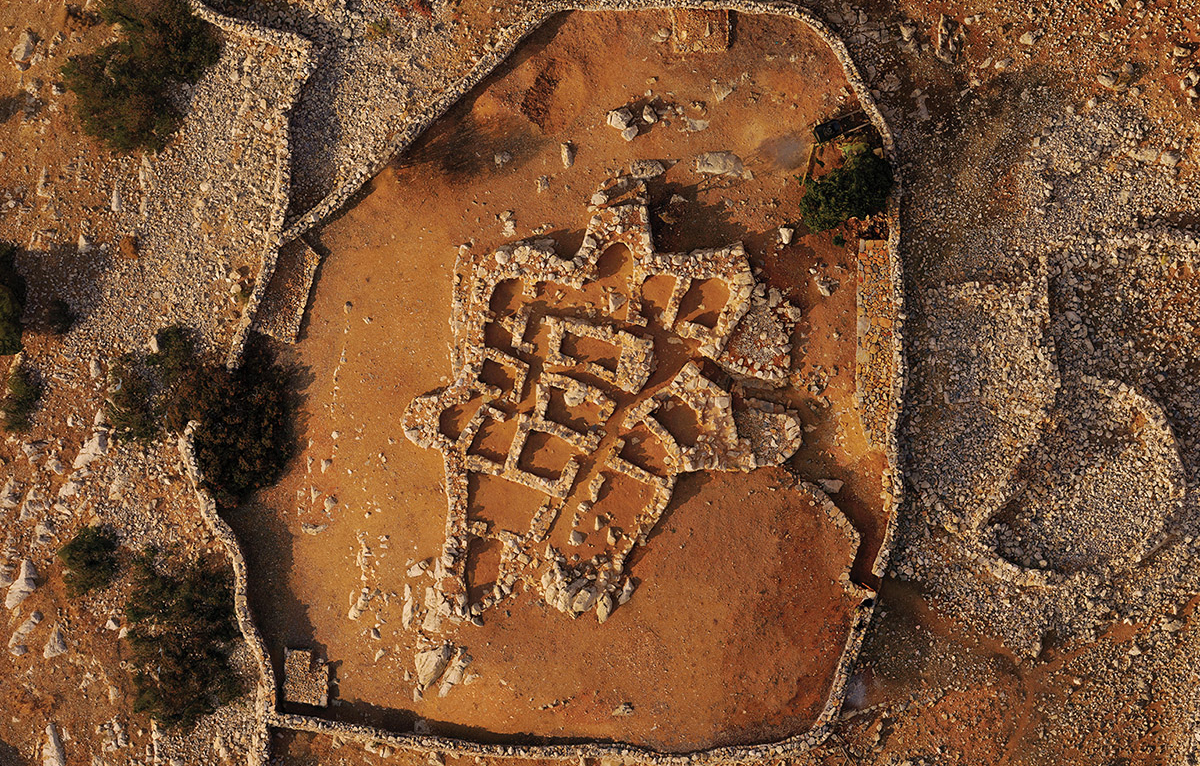
The prehistoric acropolis covers an area of 285 sq.m. The excavation brought to light twenty or so small rooms inside an elliptical wall made of large, roughly worked blocks of local origin. The defensive capacity of the wall was reinforced by five strong horseshoe-shaped towers.
The entrance to the acropolis is located at the NE end of the walled area and is flanked by two solid towers (Towers C and D).
The entire space inside the fortification is occupied by small rectangular or trapezoidal stone-built rooms, which are connected to each other through a network of narrow corridors. The surviving height of the wall-remains ranges from 0.20-0.60 m.
The end of this Naxian acropolis was violent. Intense traces of fire, a bronze spearhead and a multitude of pebbles (slingshots), found in the wider area of the entrance, are indications of the violent destruction of the fort after an enemy attack.
The rooms were used for activities mainly related to the preparation and storage of solid and liquid perishable goods in large quantities, as indicated by the numerous storage vessels and the multitude of stone tools (grinders, querns) for the processing of agricultural products.
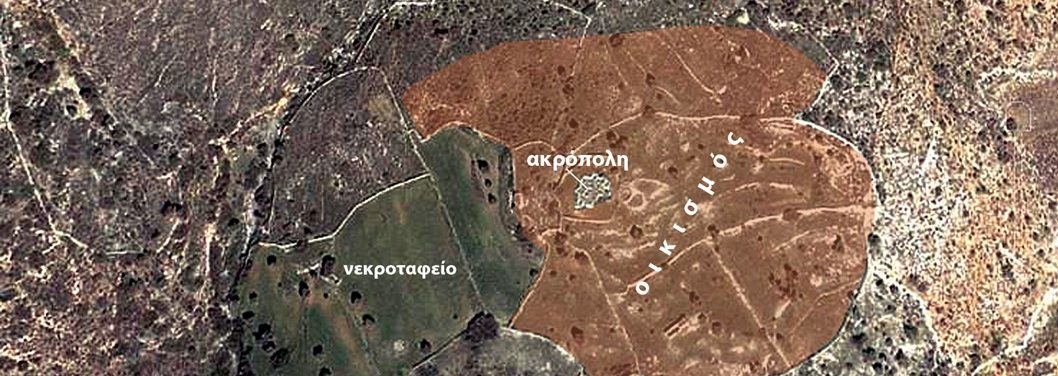
The study of both the architecture and the movable finds (ceramics, stone tools, etc.) has proven that the acropolis at Panormos has a unique architectural form not only for the Cyclades but also for the wider Greek area. The remains of the acropolis were until recently considered by researchers into the Cycladic Culture to belong to a fortified settlement. However, all the indications show that the acropolis is not a settlement so much as a single protected building with a predominantly fortress-like character. The fort on the hilltop was probably the creation of the people who lived in an as yet unexplored settlement, occupying the slopes of the hill surrounding the acropolis. In it, the inhabitants found shelter in case of danger.
The role of the shelter or defensive retreat is also linked to another functional purpose. As mentioned above, most of the vessels found inside the fort belong to large storage vessels for the preservation of large quantities of agricultural subsistence goods. Thus, it seems that the fortified installation was not only a place of protection for individuals but also for a significant quantity of their goods, vital for the survival of the entire local community. Therefore, the Naxian acropolis is a collective work of a communal nature, the equivalent of which has not yet been identified elsewhere in the entire Greek territory. The fortified complex at Korfari ton Amygdalion testifies to the existence of hierarchical communities as early as the 3rd millennium BC and represents a milestone in the evolution from small rural communities to ‘urban’ living.
The acropolis at Korfari ton Amygdalion is the only visitable, although yet unorganized, archaeological site on the entire southeast coast of Naxos, an area being developed for tourism.
Recently, the Ephoreia of Cycladic Antiquities began rescue work to consolidate the building remains of the acropolis as part of the rescue project of this important monument. The promotion of the complex and extensive archaeological site at Panormos, which in addition to the acropolis includes, as mentioned above, a contemporary settlement and a cemetery, will contribute, we believe, to increase tourist interest in the area, while also providing a stimulus to the development of the local community.