

We have very little information about the Christian period on the island of Syros. In the 6th century AD, Syros belonged to the Province of the Aegean Islands, with Rhodes as its capital. With the establishment of the Byzantine Empire, the province was renamed the Theme of the Islands. During the 5th century, when Christianity was probably introduced, the population of Syros was so limited that the circumstances were unsuited for the establishment of a metropolis locally, and so it came under the bishopric of neighbouring Delos, which in turn was subject to the metropolis of Rhodes, in keeping with the administrative division of the Byzantine state.
During the early Byzantine years, the construction of the settlement of Ano Syros began. In 1207 the settlement was captured by the Venetians and during the Latin rule, the locals embraced the Catholic faith. In 1566, Syros came under the rule of the Turks, but throughout the period of the Turkish rule it was under the protection of the Pope and the King of France. In 1617, the Turkish fleet destroyed the island. We can say that typically from the 16th to the 18th centuries, the population amounted to approximately 2500 Catholics and 150-200 Orthodox Christians.
One of the most important monuments of the island from the Middle Byzantine period is the church of Panagia ‘Episkopiani’ in Piskopio. A large number of ecclesiastical and secular buildings are located in the medieval settlement of Ano Syros.
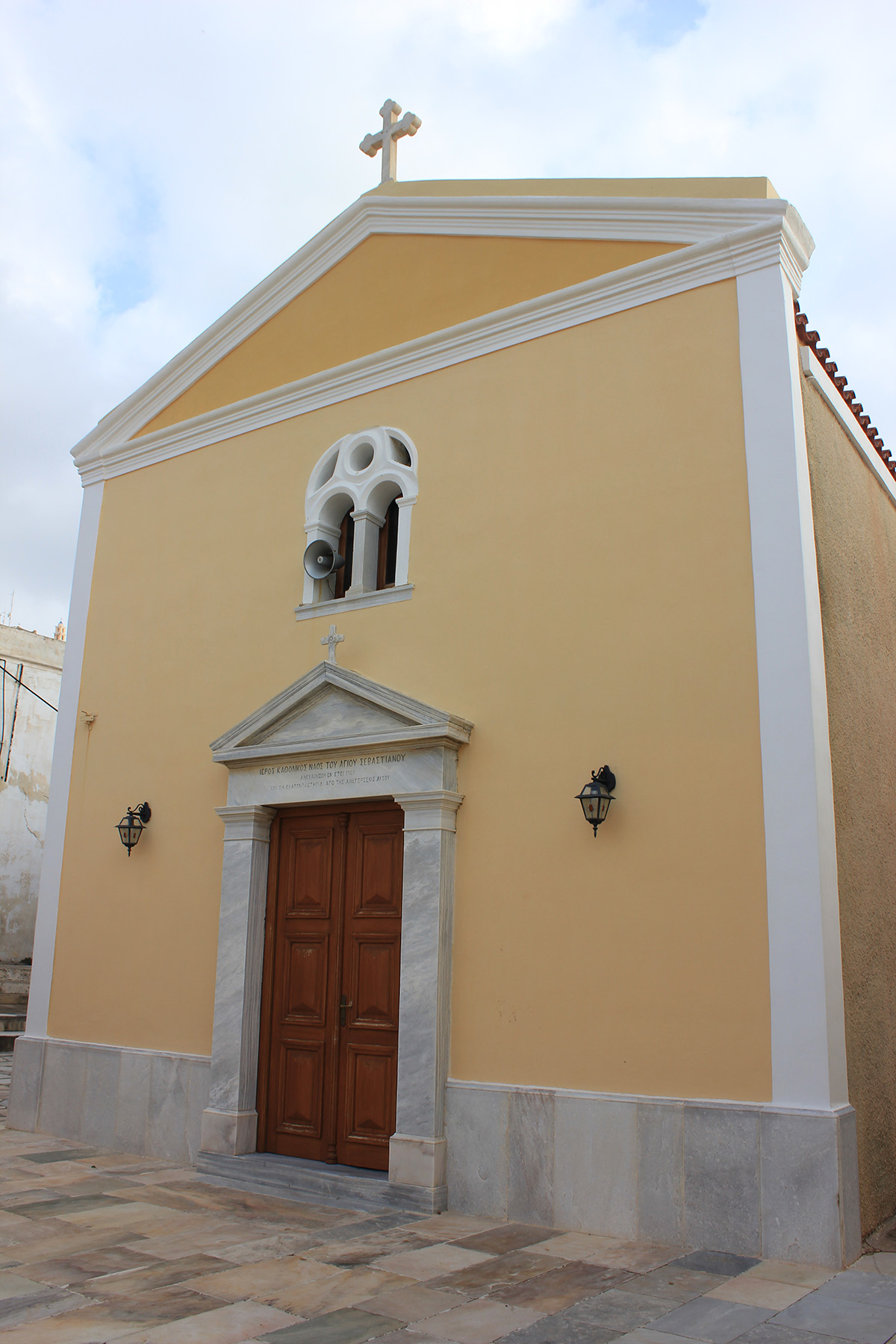
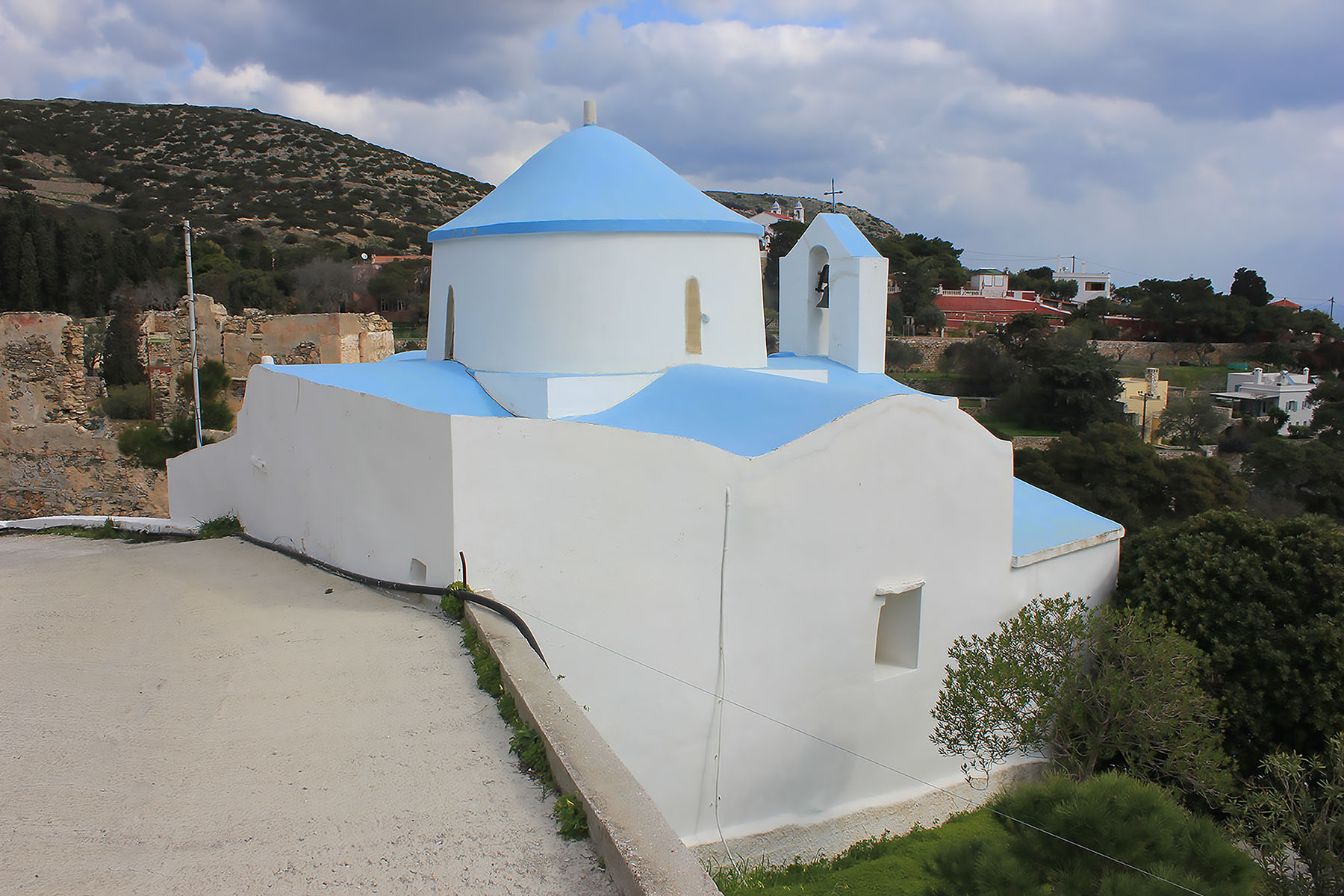
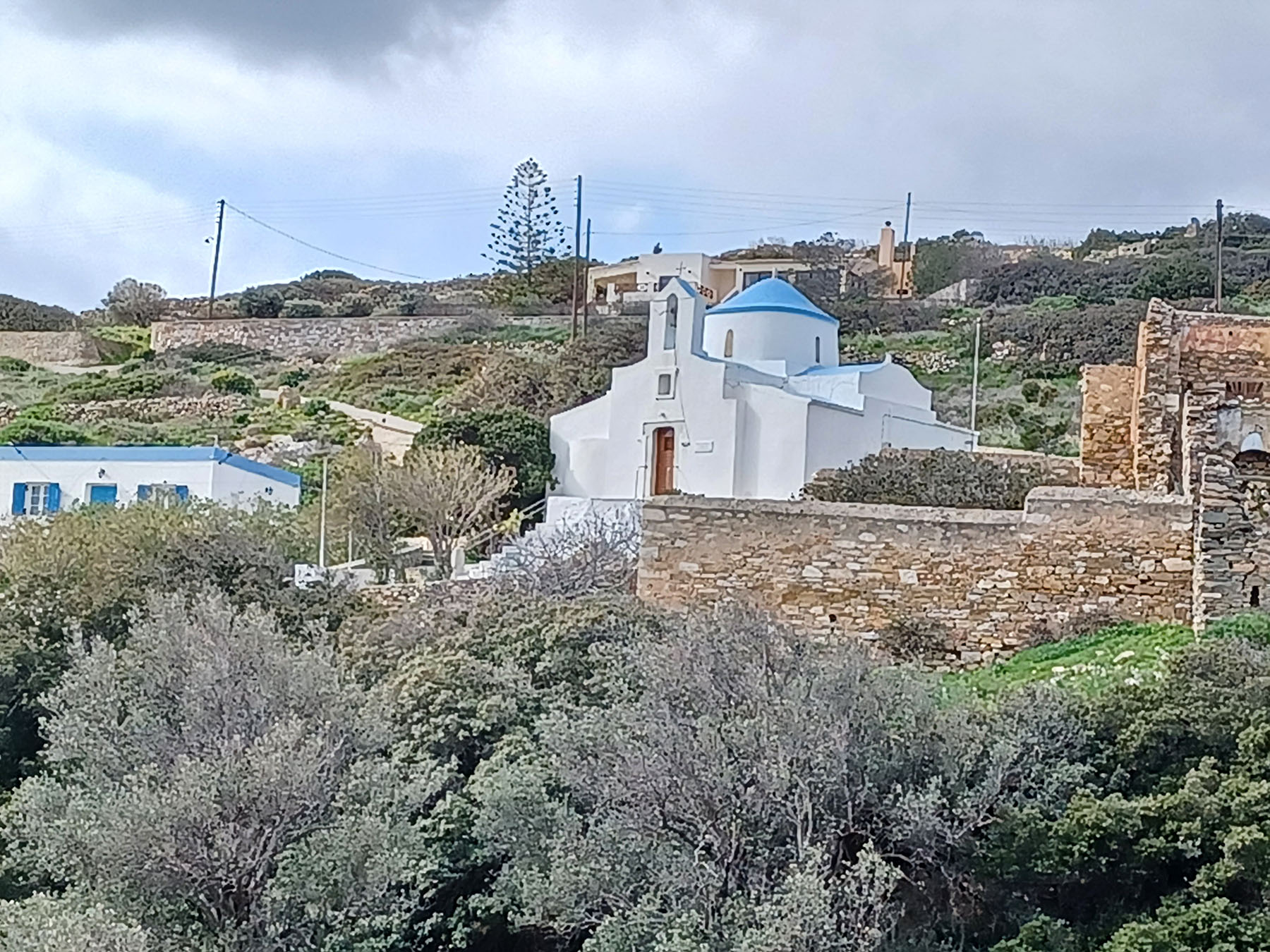
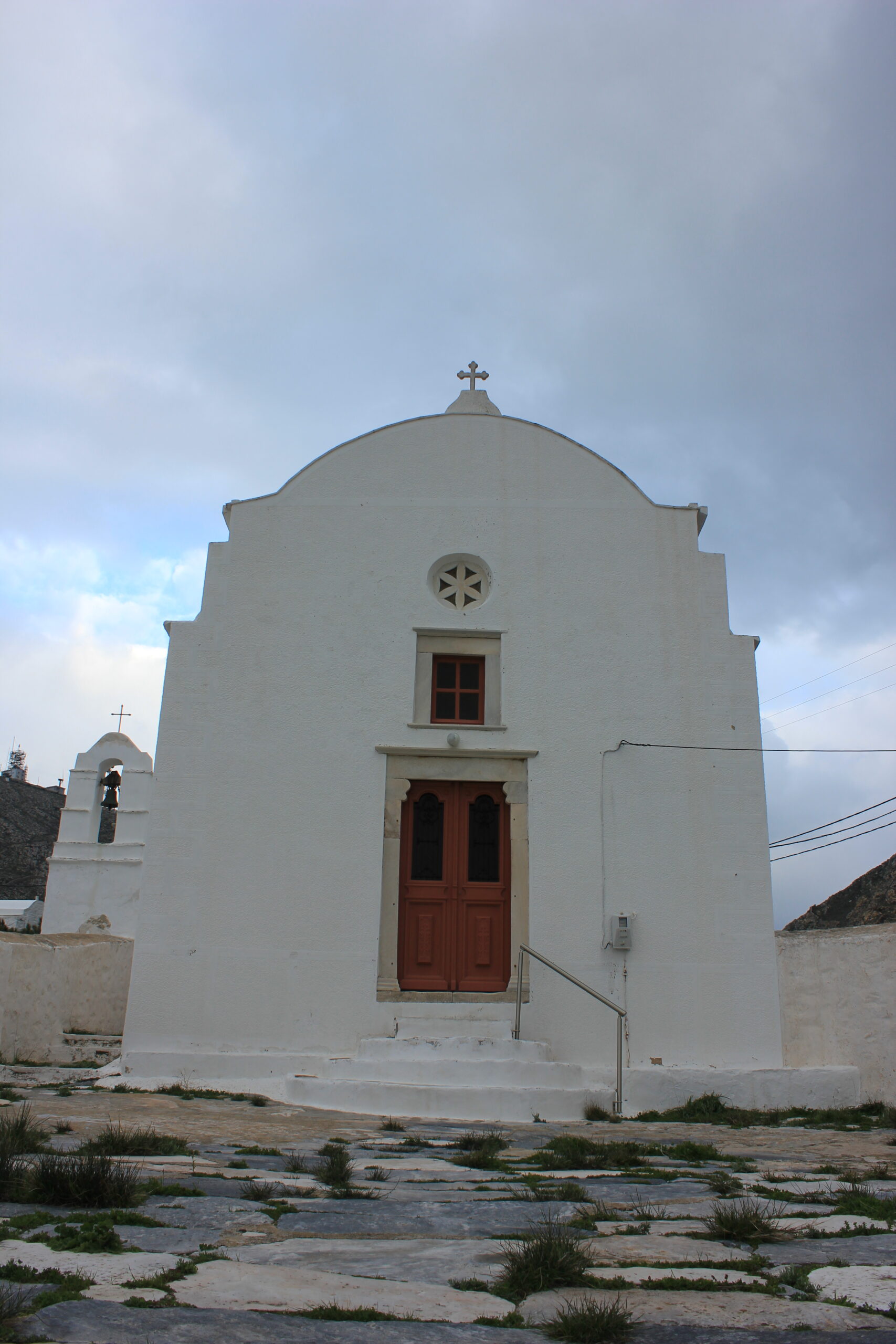
In the countryside, there are also numerous Catholic chapels dating mainly to the post-Byzantine period. They are, for the most part, simple structures, the majority single-aisled, with a flat roof or with one having a deep or shallow overhang (eaves) to it. Valuable evidence for the dating and study of the Catholic chapels and temples of Syros is provided by the reports of the Catholic Bishops or Apostolic visitors made to the authorities of the Roman Catholic Church. These contain descriptions or lists of churches (Marengo 1631, Bernardo da Parigi 1652, P. M. De Stefani 1757, and G.B. Fonton 1788).
Mainly in Ermoupolis, but also in other parts of the island, are to be found 19th-century churches, which are of particular interest, e.g. the churches of Agios Nikolaos, and in Ermoupolis those of the Assumption, of the Transfiguration, and of the Resurrection.
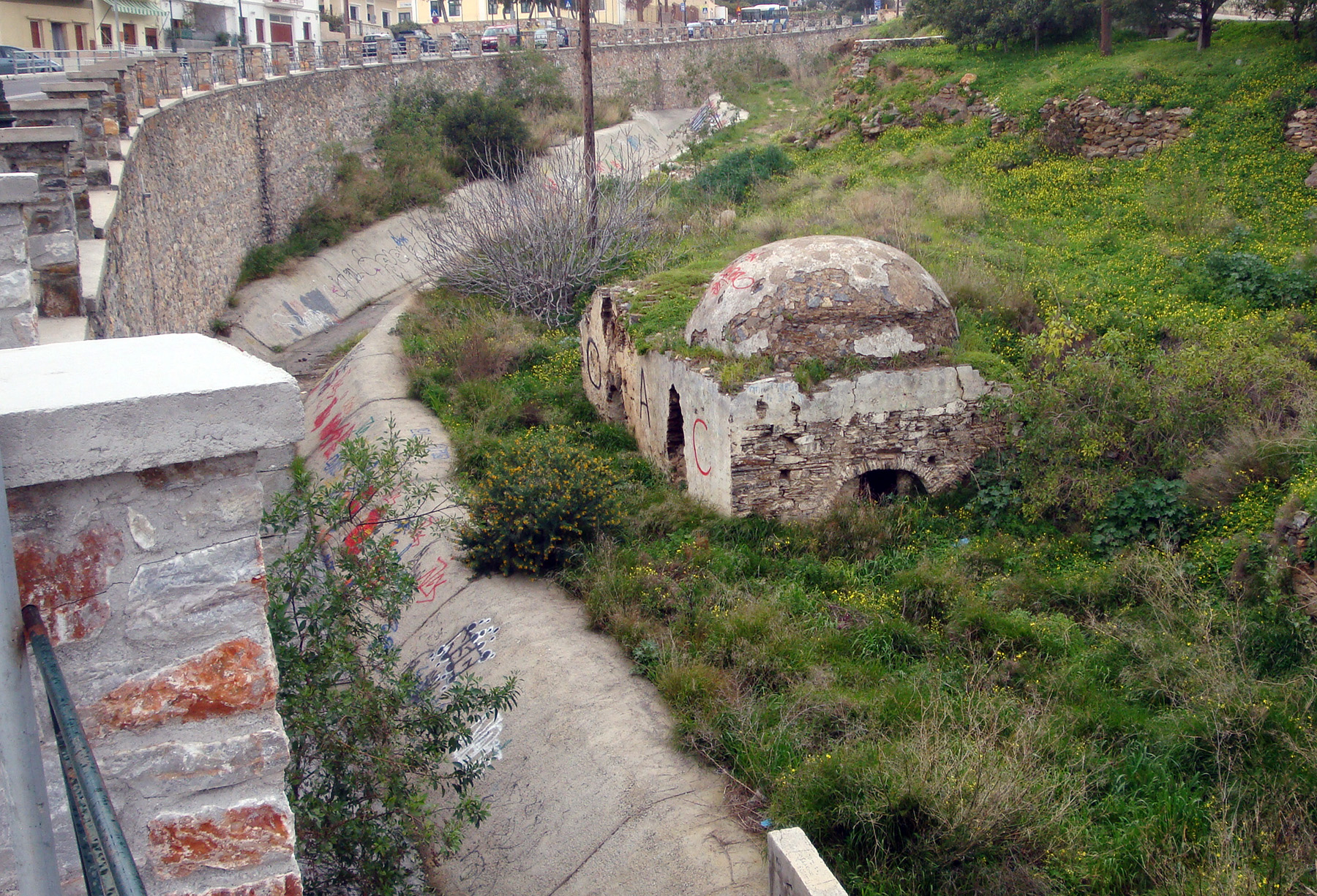
Finally, the Ottoman bathhouse (hamam) in the Lalakia stream-bed in Ermoupolis is a unique example of such a building in Syros, with remarkable architectural merit.
Ano Syros
Ano Syros enjoys a complete protective cover, arranged in many ways, as it has been characterized as a place in need of special state protection (Government Gazette 709/B/28-5-1976), as a traditional settlement (Government Gazette 594/D/13-11-1978, Government Gazette 504/D/1988 and Government Gazette 345/D/2-6-1989) and as a medieval settlement (Government Gazette 715/B/ 15-11-1990).
Built on a hill far from the sea, it acquired its current residential character mainly around the 13th century. The settlement was fortified with strong walls, in contrast to other ‘castles’ of the Cyclades, where it was the outer walls of the houses at the periphery of the settlement that constituted their fortification. Entrance to the settlement was gained through seven gates, of which only two survive today. It is a medieval settlement, with an organic layout and plan, developed on the eastern side of the hill; it includes a number of ecclesiastical and secular buildings, now of a listed status.
At the top of the hill of Ano Syros is the ecclesiastical complex of Agios Georgios, the Metropolitan Church of the Catholics of Syros. The existing church is the fifth in a series to exist in the same location, and belongs to the type of three-aisled basilica, with a pronaos/porch (five-arched arcade). It was built between 1832-1834 by Hadjisimos Nikolaos from Tenos. The interior of the church is decorated with frescoes by Joseph Vianello, Giuseppe Tami and Nikolaos Provelengios, dating from the end of the 19th century.
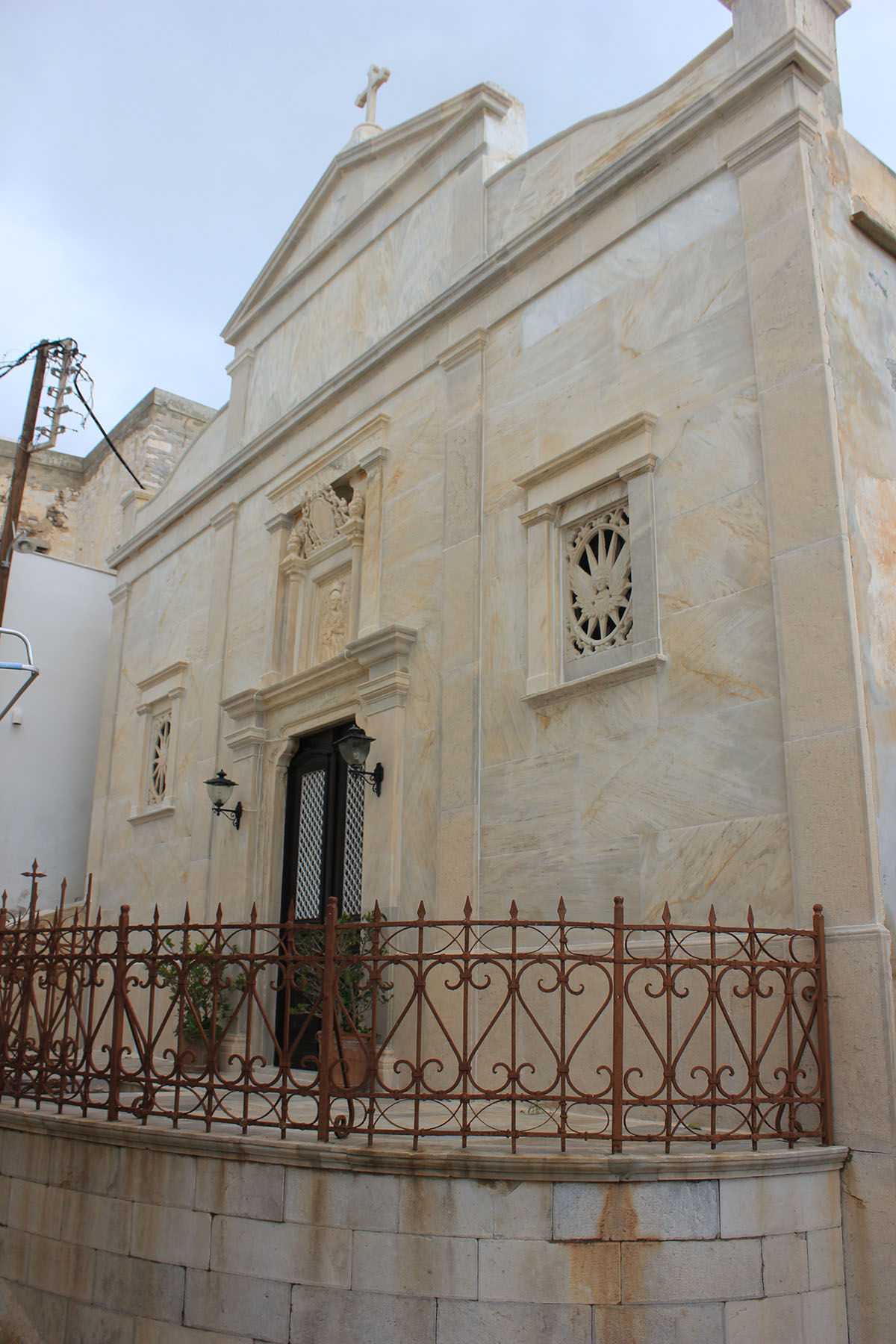
The Jesuit Monastery was founded in 1744, while the catholicon of the Monastery, based on an inscription on the lintel of the church, dates to 1640. It is a single-aisled flat-roofed church originally dedicated to Panagia Angelocheiritisti, later called the Panagia tou Carmelou (of Carmel). The marble facade of the church was constructed in 1824.
The church of Agios Ioannis is the second most important Catholic church of Ano Syros, after the cathedral of Agios Georgios. It was granted to the Capuchin monks in 1635, who then built their monastery near the church.
The Kioura tou Karlou is a single-aisled vaulted basilica, with six blind apses (three on each of its long sides). It bears a Latin founding inscription with the date of 1686. The basilica has a total of three altars. The first is dedicated to the Memory of the Nativity of the Virgin Mary, the second and third are to the Saints Vincent and Rocco. It is decorated with frescoes from the 20th century (around 1930).
The church of Agios Nicolaos the Poor is the older of the two Orthodox churches within the settlement of Ano Syros. It is a single-nave vaulted building with blind apses. At the entrance to the church above the door there is a relief lintel with the inscription: YEAR OF THE OLD CONSTRUCTION OF THE CHURCH 1686.
The Catholic church of Agios Antonios was probably standing in the mid-17th century. During the Turkish occupation it was used as a school, first with priests as teachers and after 1744 the Jesuit monks. The small church was rebuilt in 1886.
The church of Agia Triada is the second Orthodox church of Ano Syros. In its current form it is a two-aisled vaulted church. The church bears inscriptions mentioning the dates 1694 and 1878.
Church of Panagia ‘Episkopiani’
An important monument of the island is the church of Panagia ‘Episkopiani’, in Piskopio. The church belongs to the transitional cruciform inscribed type (aka Greek). The dome is supported by four walls, which separate the eastern and western arms from the vaulted corner apartments. On the eastern side, the walls are pierced by low arched doors; the western corner apartments do not communicate with the western arm and are slightly shallower than the eastern ones. The church probably dates to the 11th century and is the only known monument on the island from this period. Also of interest is the residence of the Catholic Bishop, located opposite the church, today in ruins, which has a marble surround to its door, of reused elements.
bibliography
Cl. Aslanidis – Chr. Pinatsi, Ο Ναός της Παναγίας στο Πισκοπιό της Σύρου, Bulletin of the Greek Academy of Sciences, 26 (2005), Athens, 63-72
Icon of the Assumption of the Virgin Mary by Domenikos Theotokopoulos
The icon of the Assumption of the Virgin Mary by Domenikos Theotokopoulos (El Greco, 16th century, egg tempera on wood), in the church of the same name in Ermoupolis, is also exhibited on Syros. The Assumption of the Virgin Mary is an early work by the artist and is signed (δομΗνικοc θεοτοκόπουλοc o δειξαc). It probably dates back to before 1567/8, the period during which Theotokopoulos left Crete. The icon is of great historical and artistic interest, and is considered particularly important for understanding the artistic career of Domenikos Theotokopoulos. On the one hand the painter’s explorations of the Renaissance and Mannerist movements are already apparent, but yet it documents the artist’s mature handling of the Byzantine technique.
The icon has been displayed in numerous exhibitions.
‘El Greco’, Metropolitan Museum of Art, New York (07/10 2003-11/01/2004), National Gallery, London (11/1-23/5/2004), ‘The Origins of El Greco: Icon Painting in Venetian Crete’, Onassis Cultural Center, New York (17/11/09-27/2/10), ‘Χειρ Αγγέλου. Ένας ζωγράφος εικόνων στη βενετοκρατούμενη Κρήτη / Hand of an Angel. An icon painter in Venetian-occupied Crete’, Benaki Museum (16/11/10-31/01/11), ‘Δομήνικος Θεοτοκόπουλος: από τον Χάνδακα στο Τολέδο. Στα βήματα μιας ευρωπαϊκής διαδρομής’, Leventis Municipal Museum of Nicosia in collaboration with the Benaki Museum (5/10/12-30/11/12), ‘The Greek of Toledo’, Museo Santa Cruz Toledo (14/3-14/6 2014, exhibition dates), ‘Ο Δομήνικος Θεοτοκόπουλος πριν από τον El Greco / Domenikos Theotokopoulos before El Greco’, Byzantine & Christian Museum (4/12/2014-31/3/2015), ‘Κυκλαδικά στιγμιότυπα από τα μνημεία και τους ανθρώπους της / Cycladic snapshots from its monuments and people’ Byzantine & Christian Museum (22/11/2017-10/4/2018), the exhibition ‘Paris – Athènes. Naissance de la Grèce moderne, 1675-1919 / Η Γέννηση της νεότερης Ελλάδας 1675-1919 (30/09/2021-7/02/2022) at the Louvre Museum, Paris.