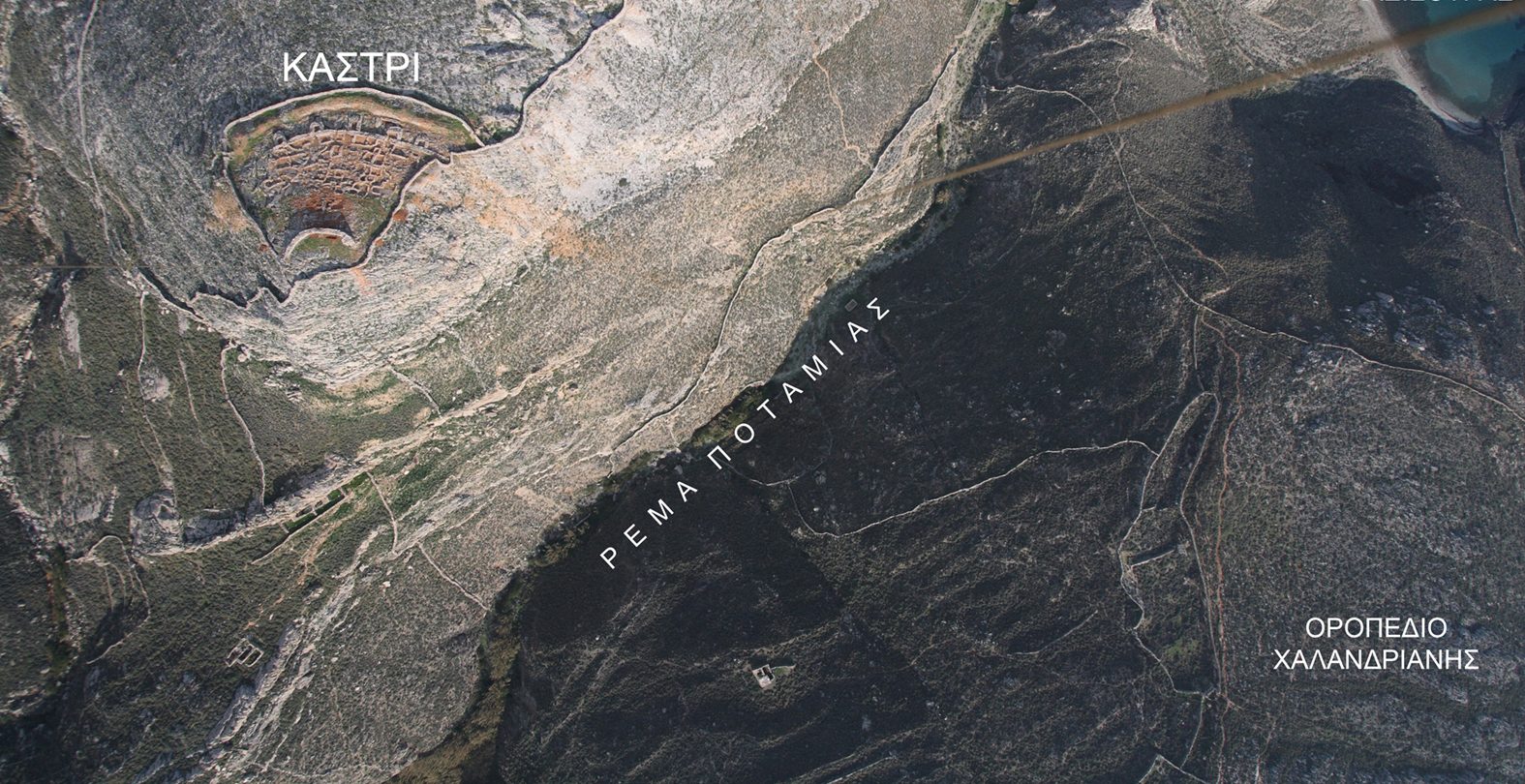


Kastri and Chalandriani are located on the northeastern coast of ‘Apano Meria’ of Syros, opposite Tenos and Andros: they are two of the most important prehistoric sites in the Aegean. The archaeological sites taken altogether include the settlement and cemetery of Chalandriani, on the Chalandri plateau, and the fortified acropolis of Kastri on the hill of that name.
At Chalandriani, under the modern settlement similarly named, remains of an Early Cycladic equivalent have been identified which, although not systematically investigated, is considered as very extensive and perhaps the most important settlement on the island. This is made evident from the material in the cemetery, the largest so far of the Early Bronze Age in the Cyclades, which consists of tombs of the Early Cycladic II period (2700-2400/2300 BC) and some later ones, contemporary with the settlement of Kastri. Approximately 700 tombs with various offerings have been excavated. Characteristic are the frying pan-shaped clay vessels with impressed and engraved decoration: on which numerous depictions of ships have survived, which show the special relationship of the settlement with the sea.
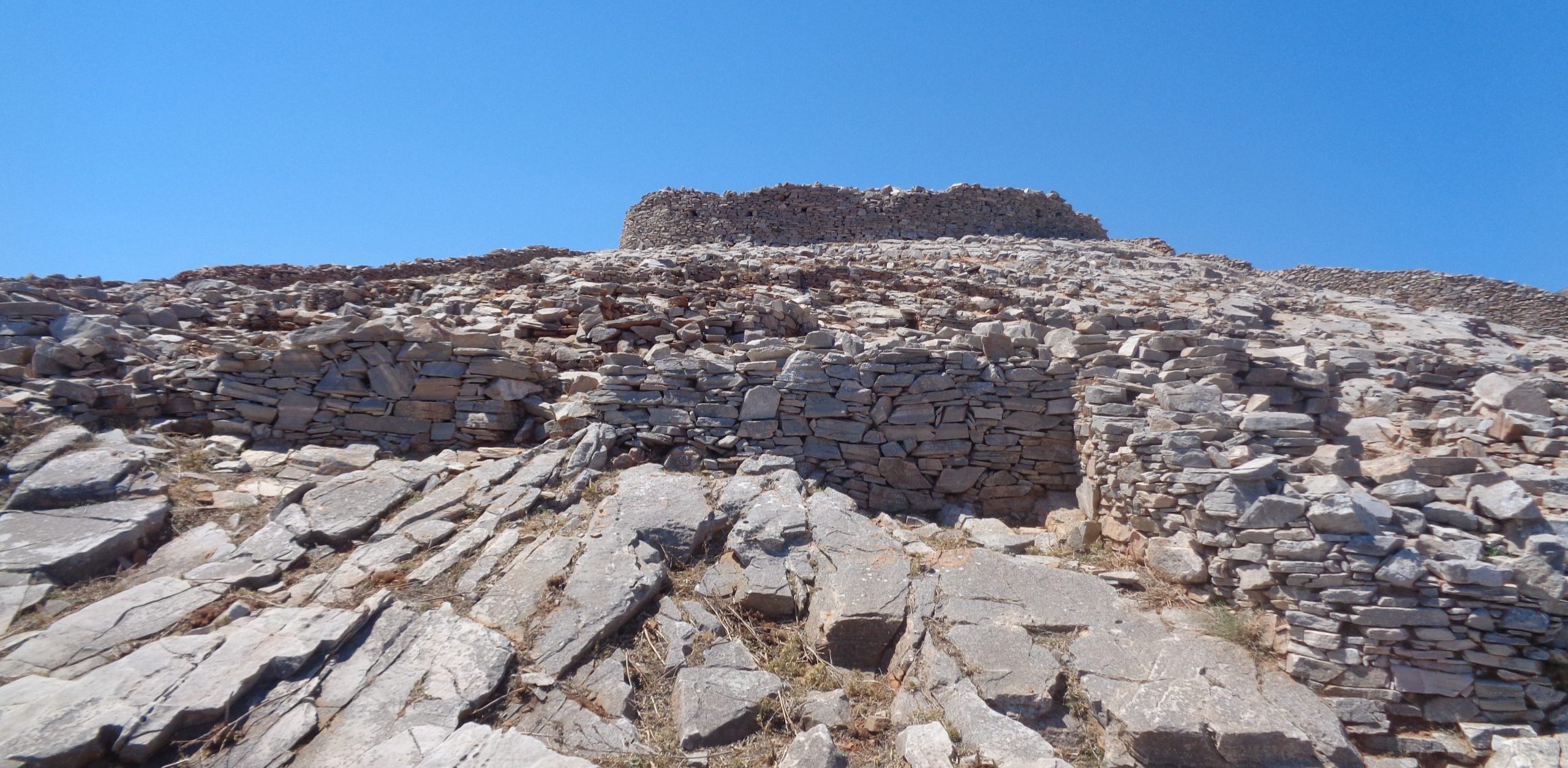
The fortified settlement of Kastri (the acropolis of Chalandriani according to Ch. Tsountas) is located on the steep hill of Kastri to the west of the Chalandri plateau, is estimated at approximately 1.25 acres and dates to the following EC IIIA period (2300 – 2200 BC), a period characterized by danger and unrest. Its fortification is characteristic: a low forward wall/rampart, the main wall with the horseshoe-shaped towers and an arched-shaped wall at the top of the hill. Its urban structure is dense-packed, with small houses rectangular or curvilinear in plan, that have one or two rooms. Between them run narrow streets that in some cases are stepped. Metallurgy seems to have played an important role in the development of the settlement. Metal objects (axes, daggers and spearheads) were found, as was an impressive silver diadem with a dotted decoration depicting human and animal figures. Clay crucibles for melting metals were also found, as well as schist and clay moulds for the manufacture of tools and weapons.
Research has been conducted in three phases: a) In the second half of the 19th century (Gr. Papadopoulos, Kl. Stefanos, R.C. Bosanquet, Chr. Tsountas); b) in the 1960s (Caskey, E.– M. Bosset, Chr. Doumas, N. Zapheiropoulos – E. Kakavogianni; and c) In the 1990s (Hekman, M. Martharis).
The systematic excavation at Kastri continues today, by the Archaeological Society through the Honorary Director of Antiquities Dr. M. Martharis.
Theodora Papangelopoulou, archaeologist EFAKYK