

The Archaeological Museum of Ios was created by the then Ephorate of Antiquities of the Cyclades in the Amoiradakeion Mansion, a building from the early 20th century, which was granted for this purpose by the Municipality of Ios. Opened on May 30, 1999, its accomplishment was co-financed by the Ministries of Culture and of the Aegean.
The museum has four exhibition halls and three more for other activities – temporary exhibitions , audiovisual media and documentation, computerization and study.
The ticket-cum-office-shop is housed in a specially designed area of room 1, to the left of the main entrance. The courtyard to the left of the Amoiradakeion is dedicated to the outdoor exhibition of ancient marble architectural members, statue pedestals and sarcophagi.
The museum hosts antiquities from the excavations and surface surveying conducted by the then Ephorate of Antiquities of the Cyclades from 1980 onwards, as well as from the Old Archaeological Collection created in 1904 by the actions of the antiquarian mayor Frangoulis Kortesis, and from donations and gifts.
The excavated material of the important prehistoric settlement at Skarkos has stimulated an organized exhibition designed to shed light on the economic and social structures of the communities that first brought the Cycladic civilization into being during the 3rd millennium BC in the Aegean and on the factors that subsequently led them to partake of the palatial lifestyle of Minoan Crete and Mycenaean Greece. The exhibition of historical material is inspired by the same spirit. Here the combination of the rich epigraphical material with the recent excavation finds from the city-state of Ios has allowed, among other things, the highlighting of aspects of life such as those of the political regime and its institutions, as well as economic and social conditions.
In the large room 1, the floor plan of the museum is displayed with a detailed table of the exhibits room by room. Then, aided by photographic material, the thematic sections – ‘The natural environment of Ios’ and ‘The history of archaeological research in Ios’ – are presented.
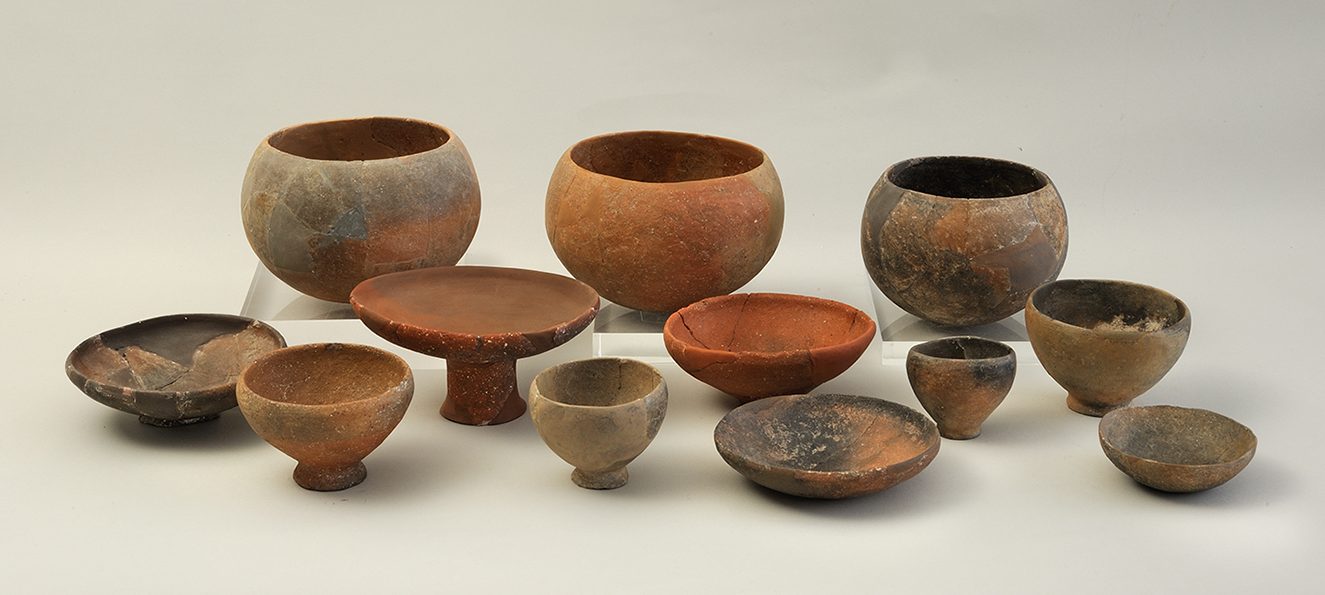
The rest of the room deals with the prehistoric settlement of Skarkos (mid-3rd millennium BC) with individual thematic sections on the location, urban planning and architecture, ceramics, figurines, economy and diet, stone art, small-scale art, communication networks and the social organization of the settlement. The display cases show the most representative finds: clay vessels and small objects, stone utensils and tools, marble schematic figurines, bone and bronze objects, as well as organic materials (carbonized seeds, animal bones and oyster shells). Particularly impressive are the large clay pithoi with their elaborate engraved decoration and the specialized cooking utensils.
The Middle and Late Bronze Ages (2nd millennium BC) are presented in the small room 2, in two thematic sections. These focus on the cultural and political developments in the Aegean of the 2nd millennium BC and on the cemetery of the late Middle and early Late Bronze Ages excavated at Skarkos that partially overlaps the Early Cycladic II settlement. The exhibits include local nippled jugs, polished imported Minoan cups, bronze weapons and jewellery.
The historical periods, from the Archaic period to Late Antiquity, are presented in five thematic sections in the contiguous rooms 3 and 4, which focus on the city-state of Ios and the historical developments in the region, on Homer’s relationship with Ios, religion, the political regime and institutions, economic and social conditions, art, urban planning and architecture. The exhibits, which come mostly from the ancient city of Ios, include an interesting collection of inscriptions from the Classical, Hellenistic and Roman periods and some sculptures, including Late Archaic funerary stelae of excellent quality.
Source: Mariza E. Marthari, The Archaeological Museum of Ios, Athens 1999


![[#Beginning of Shooting Data Section] Nikon D3 6/10/2014 10:24:02.16 Time Zone and Date: UTC+2, DST:OFF RAW (14-bit) Image Size: L (4256 x 2832), FX Lens: 60mm f/2.8D Artist: Copyright: Focal Length: 60mm Exposure Mode: Manual Metering: Matrix Shutter Speed: 1/125s Aperture: f/32 Exposure Comp.: 0EV Exposure Tuning: ISO Sensitivity: ISO 200 Optimize Image: White Balance: Auto, B2, 0 Focus Mode: Manual AF-Area Mode: Single AF Fine Tune: OFF VR: Long Exposure NR: OFF High ISO NR: OFF Color Mode: Color Space: sRGB Tone Comp.: Hue Adjustment: Saturation: Sharpening: Active D-Lighting: OFF Vignette Control: OFF Auto Distortion Control: Picture Control: [SD] STANDARD Base: [SD] STANDARD Quick Adjust: 0 Sharpening: 3 Contrast: 0 Brightness: 0 Saturation: 0 Hue: 0 Filter Effects: Toning: Map Datum: Image Authentication: OFF Dust Removal: [#End of Shooting Data Section]](https://cyclades.culture.gov.gr/wp-content/uploads/2023/12/6-30.jpg)
![[#Beginning of Shooting Data Section] Nikon D3 2/10/2014 09:04:00.16 Time Zone and Date: UTC+2, DST:OFF RAW (14-bit) Image Size: L (4256 x 2832), FX Lens: 60mm f/2.8D Artist: Copyright: Focal Length: 60mm Exposure Mode: Manual Metering: Matrix Shutter Speed: 1/125s Aperture: f/29 Exposure Comp.: 0EV Exposure Tuning: ISO Sensitivity: ISO 200 Optimize Image: White Balance: Auto, B2, 0 Focus Mode: Manual AF-Area Mode: Single AF Fine Tune: OFF VR: Long Exposure NR: OFF High ISO NR: OFF Color Mode: Color Space: sRGB Tone Comp.: Hue Adjustment: Saturation: Sharpening: Active D-Lighting: OFF Vignette Control: OFF Auto Distortion Control: Picture Control: [SD] STANDARD Base: [SD] STANDARD Quick Adjust: 0 Sharpening: 3 Contrast: 0 Brightness: 0 Saturation: 0 Hue: 0 Filter Effects: Toning: Map Datum: Image Authentication: OFF Dust Removal: [#End of Shooting Data Section]](https://cyclades.culture.gov.gr/wp-content/uploads/2023/12/10α-1.jpg)