

Ancient Ios
The Ephorate of Antiquities of the Cyclades has been carrying out archaeological research and rescue excavations on the island of Ios from the 1980s until today. The work has brought to light a large number of unknown sites with building remains and numerous finds from the prehistoric period to Late Antiquity. The Ministry of Culture, in organizing their protection, proceeded to declare and delimit seven areas as archaeological sites (Skarkos, Manganari, Agia Theodoti, Psathi – Psathonisi, Magazia, Plakotos-Psaropyrgos, Plakes-Boundari of Kyra–Leni). The excavation data of recent years, combined with the rich epigraphical material and written sources, constitute an important source of information on the residential, social, political and economic organization of the island during the Classical, Hellenistic and Roman periods. This allows us to compile the archaeological map of the island.
Ios island and city
The city was surrounded by an impressive fortification wall, made of elongated and massive pieces of slate; a large part has survived and remains visible to this day. The main gate of the city was located on the west side of the hill, at the point where the natural rock-cut staircase leading from the port to the city has been preserved to this day. From the pottery found in the foundations of the wall, we conclude that the first phase of its construction dates back to the Archaic period, with repairs and reinforcements added in the Classical and mainly in the Hellenistic period.
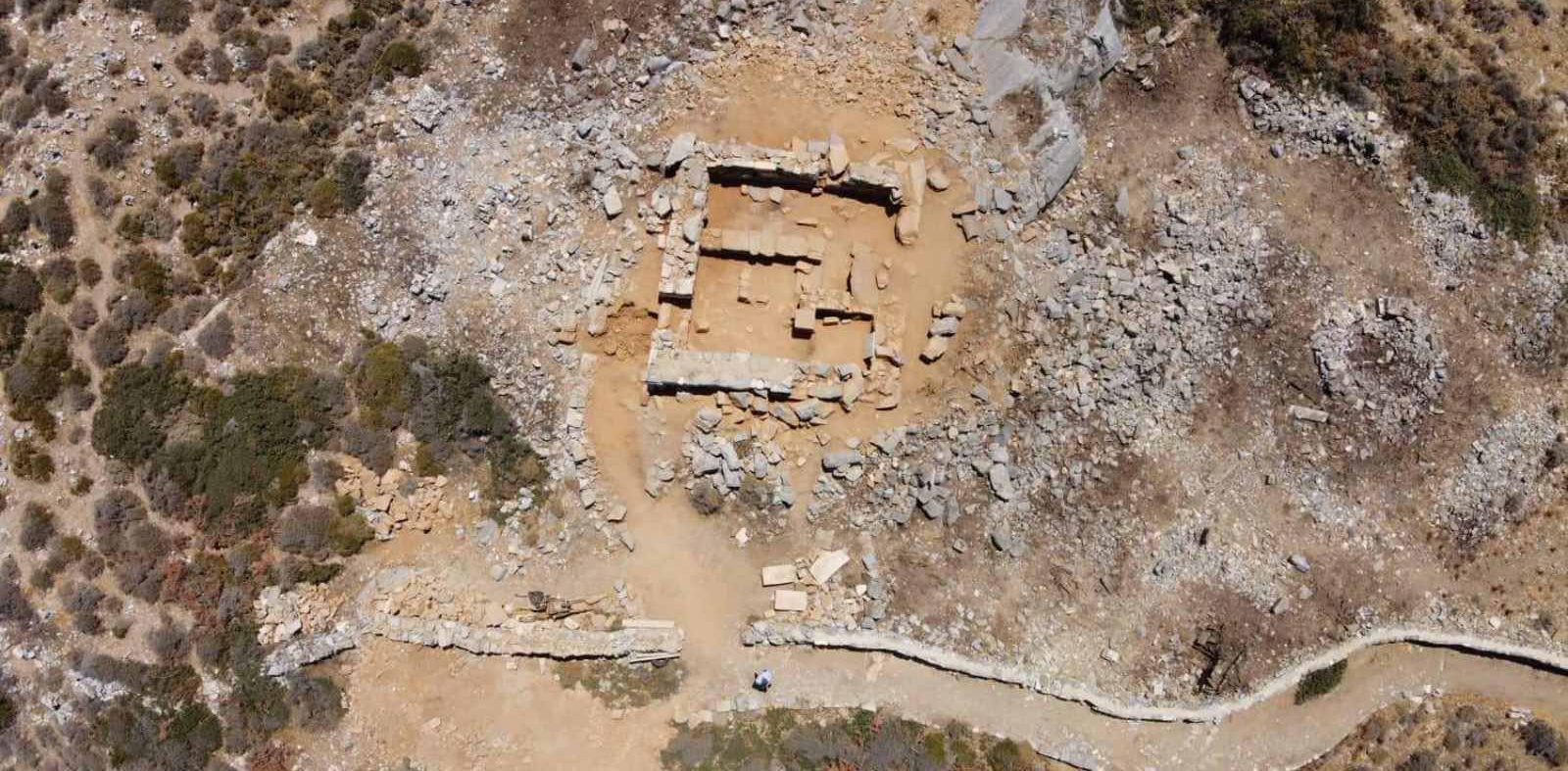
In the northwestern part of the Kastro hill, as well as on the hill of Pentanassa opposite the town, there have been discovered building remains of public and private buildings, of temple and other sacred structures, dating back to the late Classical period. Architectural remains of ancient buildings and parts of a road and sewer network from the late Roman period were uncovered in the southeastern part of the Kastro hill, leading us to conclude that the city at that time was still organized around the hill.
Evidence of the habitation in the island’s coastal areas, as well as on hills in the remains interior, is provided by the architectural remains of ancient buildings and towers. Of these, the ancient structures probably temples, stand out in the area of Psathi and Agia Theodoti, on which the chapel of Panagia in Pori and the church of Agia Theodoti were built respectively. Remains of aqueducts from the Roman period are known. Ruins of a coastal village from Roman times have been discovered at the location of Magazia in the north of the island. Ancient buildings of a rectangular plan from the late Classical period are preserved in a good state at Ellinika in Epano Kampos and at Gefyraki. Visible remains of towers from the late Classical period are preserved at Mersinia and Psaropyrgos-Plakotos.
Homer and Ios
ΟΜΗΡΟΣ ΚΑΙ ΙΟΣ
Ἴος νῆσος μητρὸς πατρίς, ἥ σε θανόντα
δέξεται. ἀλλὰ νέων παίδων αἴνιγμα φύλαξαι.
δεικνύουσι δὲ οἱ Ἰῆται καὶ Ὁμήρου μνῆμα ἐν τῇ νήσῳ καὶ ἑτέρωθι Κλυμένης, τὴν Κλυμένην μητέρα εἶναι τοῦ Ὁμήρου λέγοντες.
Παυσανίας, Ἑλλάδος περιήγησις, Φωκικά, Λοκρῶν Ὀζόλων, Χ, 24,2.
The island of Ios is the fatherland of your mother, which will receive you at your death; but be on your guard against the riddle of the young children.
The inhabitants of Ios point to Homer‘s tomb on the island, and in another part to that of Clymene, who was, they say, the mother of Homer.
Pausanias, Travels in Greece: Phocis, Ozolion Locris, X, 24,2.
The name of Homer is closely associated with the island of Ios. The city of the same name was considered one of the seven that claimed his birth. Many ancient writers refer to the death and burial of Homer on Ios. According to Pausanias, an oracle from the Delphi stated that Homer would be buried on Ios, the birthplace of his mother Clymene, and the islanders pointed out his and his mother’s graves. The research of the Ephorate of Antiquities of the Cyclades focuses, among other things, on the area of the archaeological site of Plakotos, where a fragment of an inscribed marble slab concerning Homer was found by Pasch van Krienen in 1774.
During the Classical and Hellenistic periods, the coins of Ios depicted the head of Homer with the word Homer on the obverse. Also, according to the marble inscribed slab found in the area of Agia Theodoti, a day of sacrifice existed during the month of Homereon.
Angeliki Koumna, archaeologist, Ephorate of Antiquities of Cyclades