

The hill of Skarkos is located in a privileged geographical position, in the middle of the western side of Ios, opposite Sikinos, where coexist one of the most spacious and safe natural harbours of the Cyclades and one of the largest cultivable areas of Ios, Kato Kampos.
An important archaeological site was identified and is being systematically excavated on the hill by Mariza Marthari, where a human presence was continuous at least from the Early Cycladic I period to Late Antiquity. However, the building remains that dominate the hill are those of a large, prosperous settlement from that outward-looking period of particular development in the Early Cycladic world: the Early Cycladic II period or that of the Keros-Syros culture (mid-3rd millennium BC).
This major settlement fortunately survives in an excellent state of preservation that helps to obtain a comprehensive picture of the Cycladic societies of the mid-3rd millennium BC, which were previously known mainly from finds from cemeteries, which had generally been looted. The settlement is organized around the top of the hill and has a drainage network for the removal of rainwater.
The dense residential fabric extends along two large principal streets, up to 2 m wide, which run around the top of the hill and widen at intervals to form smaller or larger open spaces. Short streets, perpendicular to these two main arteries, connect the foot to the top of the hill. The road network embraces insulae of buildings that number two to eight structures on each. To date, fifty-five buildings have come to light, most of which are impressive two-storey structures with spacious entrances, stone staircases, paved floors on the first storey, cupboards built into the walls and cists/chests made of slate.
The buildings are mainly private residences and show remarkable similarities in terms of internal layout and use of the spaces. However, one building has also been excavated, the Building of the Idols, whose main use was as a workshop for producing marble sculpted figurines and vases from the local white and blue marble.
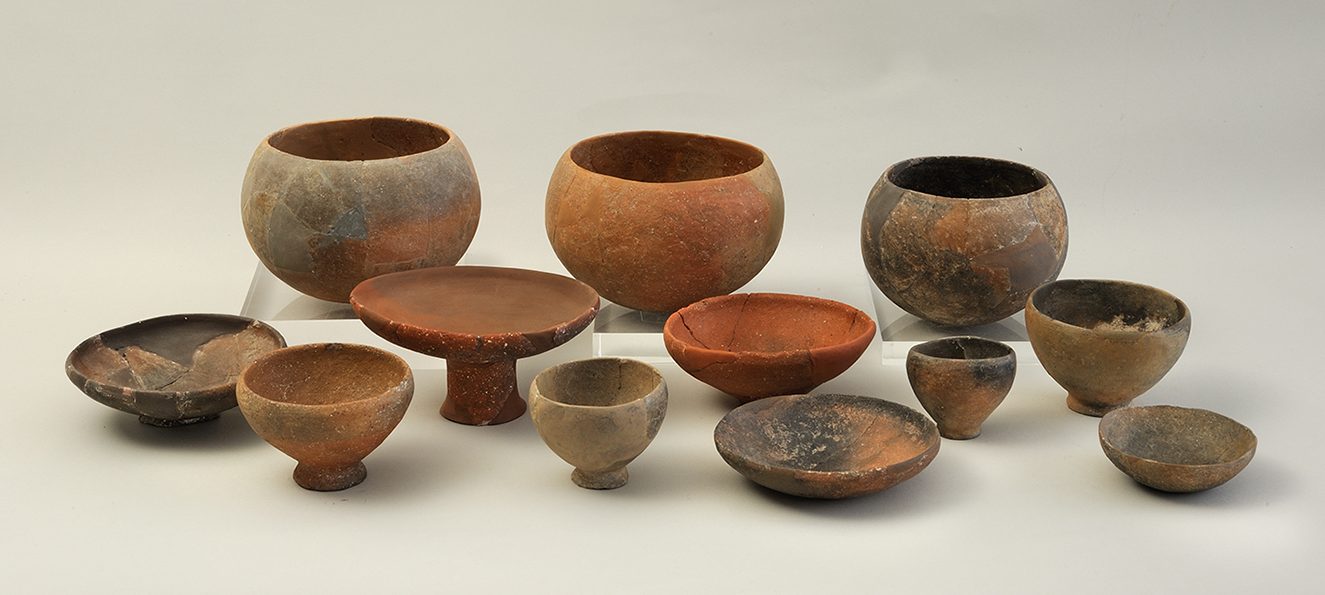
The movable finds, like the buildings, reflect a fairly advanced way of life for the southern Aegean of the 3rd millennium BC. Clay tablewares, storage and cooking vessels are abundant. Stone utensils and tools also come in a wide variety. In addition, figurines (mainly of marble) were identified, as well as metal, bone and clay objects. The movable finds from Skarkos are exhibited in the Archaeological Museum of Ios.
The bones of sheep, goats and pigs and the seeds of cereals, legumes and fruits that came to light indicate an agricultural economy. At the same time, various specialized craftsmen were active in the settlement, including masons, potters, metalworkers, craftsmen skilled in the manufacture of obsidian tools and stone implements, as well as the marble sculptors. Furthermore, the discovery at Skarkos of both raw materials and finished products, imported to Ios from other Cycladic islands, mainland Greece and other regions of the Aegean, show that the settlement also played an active role in the maritime trade of the time.
The seals, the seal-stamped vessels and the many cuboid, seal-impressed clay objects (tied like labels to bags and containers and found inside the buildings) leave no doubt that the act of sealing was a common practice at Skarkos. It seems thus that in some cases the assertion of ownership or personal identity was useful or necessary.
Of the remains of later periods, the most important are those of a burial ground of the end of the Middle and the beginning of the Late Bronze Age (mid-2nd millennium BC), which partially overlaps the earlier settlement. The burials are of two types: ones of infants and children in pithoi, and ones of adults in pit graves. The offerings are usually clay vessels (domestic and imported), such as jars, nippled jugs and cups. Rare are the bronze objects, such as the pins that held the clothing of the deceased together, weapons and personal toilet items. The Skarkos cemetery complements our knowledge of Cycladic society at the end of the Middle and the beginning of the Late Bronze Age in the field of burial customs. This knowledge was based in the past mainly on the excavation of cities, such as Akrotiri of Thera and Phylakopi of Melos, the cemeteries of which have not been investigated.
Skarkos is the only organized archaeological site in the Cyclades that presents to the public a settlement of the famed Cycladic world of the third millennium BC. Its conservation and promotion program (3rd Community Support Framework) received the First Prize for Cultural Heritage of the European Union / Europa Nostra’s highest award in the category ‘Conservation of Archaeological Sites’ (GRAND PRIZE) in 2008 ‘for the remarkable quality of the development of the site and above all for the minimal and extremely sensitive interventions, which did not alter the unique landscape’. The program was singled out from among 109 nominations from 29 countries.
Dr. Mariza Marthari, director of the Skarkos excavation


![[#Beginning of Shooting Data Section] Nikon D3 6/10/2014 10:24:02.16 Time Zone and Date: UTC+2, DST:OFF RAW (14-bit) Image Size: L (4256 x 2832), FX Lens: 60mm f/2.8D Artist: Copyright: Focal Length: 60mm Exposure Mode: Manual Metering: Matrix Shutter Speed: 1/125s Aperture: f/32 Exposure Comp.: 0EV Exposure Tuning: ISO Sensitivity: ISO 200 Optimize Image: White Balance: Auto, B2, 0 Focus Mode: Manual AF-Area Mode: Single AF Fine Tune: OFF VR: Long Exposure NR: OFF High ISO NR: OFF Color Mode: Color Space: sRGB Tone Comp.: Hue Adjustment: Saturation: Sharpening: Active D-Lighting: OFF Vignette Control: OFF Auto Distortion Control: Picture Control: [SD] STANDARD Base: [SD] STANDARD Quick Adjust: 0 Sharpening: 3 Contrast: 0 Brightness: 0 Saturation: 0 Hue: 0 Filter Effects: Toning: Map Datum: Image Authentication: OFF Dust Removal: [#End of Shooting Data Section]](https://cyclades.culture.gov.gr/wp-content/uploads/2023/12/6-30.jpg)


![[#Beginning of Shooting Data Section] Nikon D3 2/10/2014 09:04:00.16 Time Zone and Date: UTC+2, DST:OFF RAW (14-bit) Image Size: L (4256 x 2832), FX Lens: 60mm f/2.8D Artist: Copyright: Focal Length: 60mm Exposure Mode: Manual Metering: Matrix Shutter Speed: 1/125s Aperture: f/29 Exposure Comp.: 0EV Exposure Tuning: ISO Sensitivity: ISO 200 Optimize Image: White Balance: Auto, B2, 0 Focus Mode: Manual AF-Area Mode: Single AF Fine Tune: OFF VR: Long Exposure NR: OFF High ISO NR: OFF Color Mode: Color Space: sRGB Tone Comp.: Hue Adjustment: Saturation: Sharpening: Active D-Lighting: OFF Vignette Control: OFF Auto Distortion Control: Picture Control: [SD] STANDARD Base: [SD] STANDARD Quick Adjust: 0 Sharpening: 3 Contrast: 0 Brightness: 0 Saturation: 0 Hue: 0 Filter Effects: Toning: Map Datum: Image Authentication: OFF Dust Removal: [#End of Shooting Data Section]](https://cyclades.culture.gov.gr/wp-content/uploads/2023/12/10α-1.jpg)


