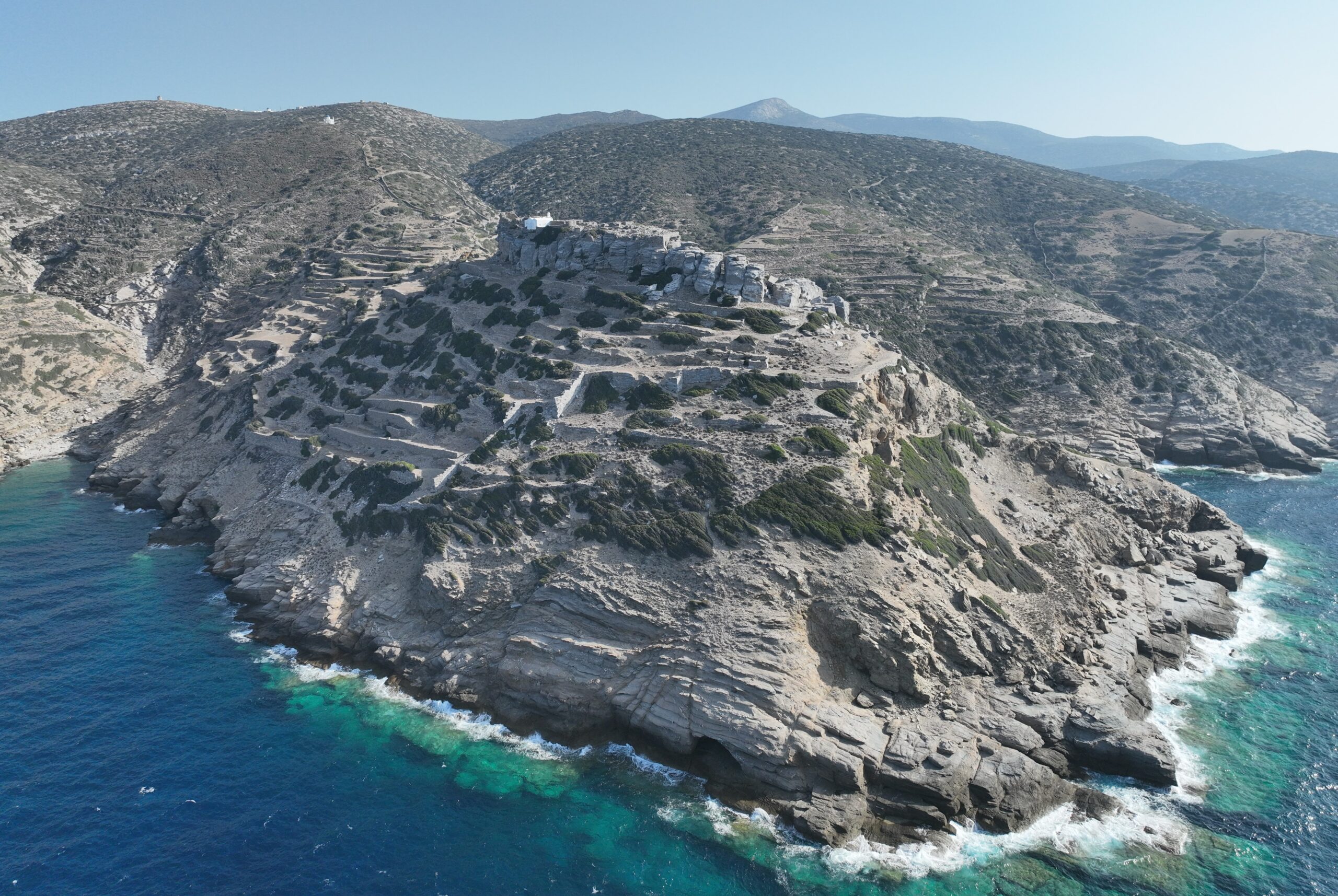


With its three ancient cities, Amorgos still has much to offer to archaeological research. Thus, the history of the island can be enriched through documented information, but also the wealth of monuments the country possesses increased by finds of particular historical and archaeological importance. The large number of towers to be found scattered throughout the island landscape is one source of significant future information. Another consists of the archaeological evidence forthcoming from the investigation of the territory of the ancient cities – and especially that of ancient Arkesini.
The history of the city is already appreciated, since a large number of inscriptions and bronze coins, along with the much more impressive building remains, gives an indication – not yet complete – of its urban layout, among other things. The image is enough to reveal the importance and significance of the archaeological site, but the requirements of a clear documentation require extensive excavation activity, obviously a long-term matter.
Parts of the fortifications are visible today, as well as the monumental double gate. However, public buildings mentioned in the inscriptions, namely the Agora, the Theatre, temple buildings and sanctuaries, cannot be identified without the aforementioned excavation research. The statues and reliefs from the area of the ancient city, transferred and available to the public interested in the past in the Amorgos Archaeological Collection, also hold great promise: they include figures of children from the 3rd and 2nd centuries BC and a funerary relief of the same date. Also relevant are the most important sculptures from Amorgos moved several decades ago to the National Archaeological Museum. Extensive research in the area could also provide knowledge about the as yet unidentified cemetery of the ancient city, and offer a perspective to the ruins identified by Prof. Lila Marangou as roadside burial monuments of the late 4th century BC, sited on the downhill slope to the south-west of the extensive settlement.
Bibliography Marangou, L. I. (2002). Αμοργός Ι – Η Μινώα. Athens: the Archaeological Society