

The artistic output of Paros during antiquity is represented by elegant works of vase painting and sculpture. The exceptional quality and unique transparency of Parian marble gave momentum to the development of a pioneering school of sculpture already active in the early Archaic years. Parian ‘lychnite’ was sought after for the making of sculptures and temples in the great sanctuaries of Delos, Delphi, Olympia, and on the Acropolis of Athens. It became a gift from the Gods in the hands of pioneering Parian sculptors in the creation of unparalleled works. The activity of the island’s workshops flourished in the 6th and 5th centuries BC. Well-known sculptors from Paros include Aristion, Thrasymides, Platthis, Clenis, Phidias’ student Agoracritus, while Pliny also mentions the painters Arcesilas and Nicanoras.
The systematic quarrying of Pentelic marble in Attica and the economic decline of the cities of Ionia, with which Paros had close relations, resulted in the gradual decline in the activity of the Parian workshops after the mid-5th century BC. Even so, in the 4th century BC, the Parian sculptor Scopas, who worked on the temple of Athena Aleia in Tegea in the Peloponnese and on the Mausoleum at Halicarnassus, became famous for his architectural sculptures.
Artistic production continued unabated on Paros until the Roman period, as is evidenced by the marble funerary monuments and marble busts. Today, in addition to the island’s archaeological museum, the works of the Parian workshops adorn the largest museums in the world and are part of a great civilization.
The Archaeological Museum of Paros was built in the 1950s, part of the activities of the Ephor of Antiquities N. Zapheiropoulos. It has three halls, a large courtyard and a covered arcade. The museum’s exhibits represent all periods of the history of ancient Paros; a tour of them is a powerful journey for the senses into the past. The visitor is invited to begin from room 1, to the right of the courtyard, proceeding via the small room 2 to the covered portico, and thence to room 3, and to complete his visit by walking around the courtyard.
Room 1 (Parian sculpture)
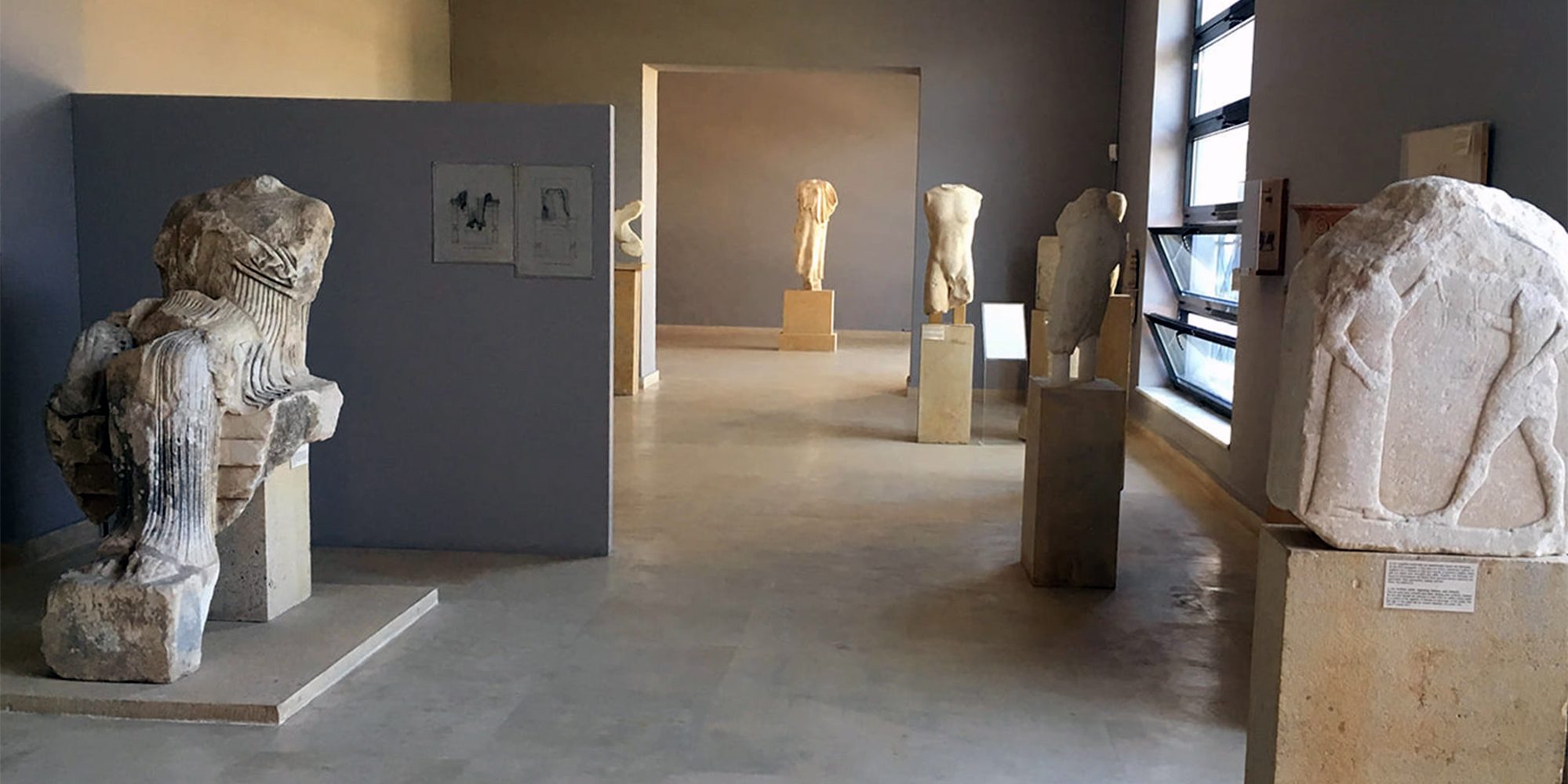
The most important exhibit of the room is the statue of Gorgo (A 1585) that welcomes the visitor at the entrance. The unique sculpture is almost entirely preserved and was probably the centre-piece of a pediment of an Archaic temple (mid-6th century BC). The winged deity is represented in motion, with her wings folded behind her. The details of her face and clothing are impressive. Around Gorgo, are exhibited funerary stelae from the 6th and 5th centuries BC, Archaic inscriptions and parts of Archaic korai and kouroi.
Continuing the tour of the room, we come across the two relief slabs (A 785, A 759) from the frieze of the monument of the lyric poet Archilochus. They date back to around 500 BC. A masterpiece of Parian sculpture is the statue of a seated goddess (A 162), perhaps of Artemis, from 490-480 BC. The trunks of the Archaic kouroi stand out, especially the partly-worked example and the kouros with the inscribed base. The body of a marble sphinx (A 194) and parts of the large palmette (A 1356) were the acroteria of the temple of the sanctuary of Delian Apollo.
In addition to the sculptures, two large clay amphorae from a Parian workshop of the 7th century BC are exhibited in the same room. A unique find is the marble disc (A 1188) with a painted depiction of a discus thrower from the 5th century BC on it.
At the back of the room, the masterly statue of a Nike of 480/470 BC (A 245) dominates. The work is identified with a trophy erected in memory of the victory of the Parians against the Athenians. Around Nike are various reliefs and stelae from the ancient cemetery, a Hellenistic statue of a deity, as well as the exceptional marble relief of a female figure (A 1290) attributed to the Parian sculptor Agoracritus and originating from the Thesmophorion.
Room 2 (Despotiko)
This small room exhibits the numerous finds from the Archaic sanctuary of Apollo on the uninhabited island of Despotiko, west of Antiparos. The display cases are a donation from the Goulandris Museum of Cycladic Art. Of particular interest are the heads of the marble kouroi and the clay statuette that is identified as the earliest cult idol of the sanctuary.
Room 3
This room exhibits objects both in display cases and free-standing. Exhibited are the finds from the Neolithic settlement on the islet of Saliagos, between Paros and Antiparos, dating from the end of the 5th millennium BC; finds from the prehistoric settlement that developed at Kastro at Parikia, from the second half of the 3rd to the end of the 2nd millennia BC; objects from the 3rd millennium BC that come from cemeteries and settlements on Paros – marble vessels, such as bowls, vases, small jars.
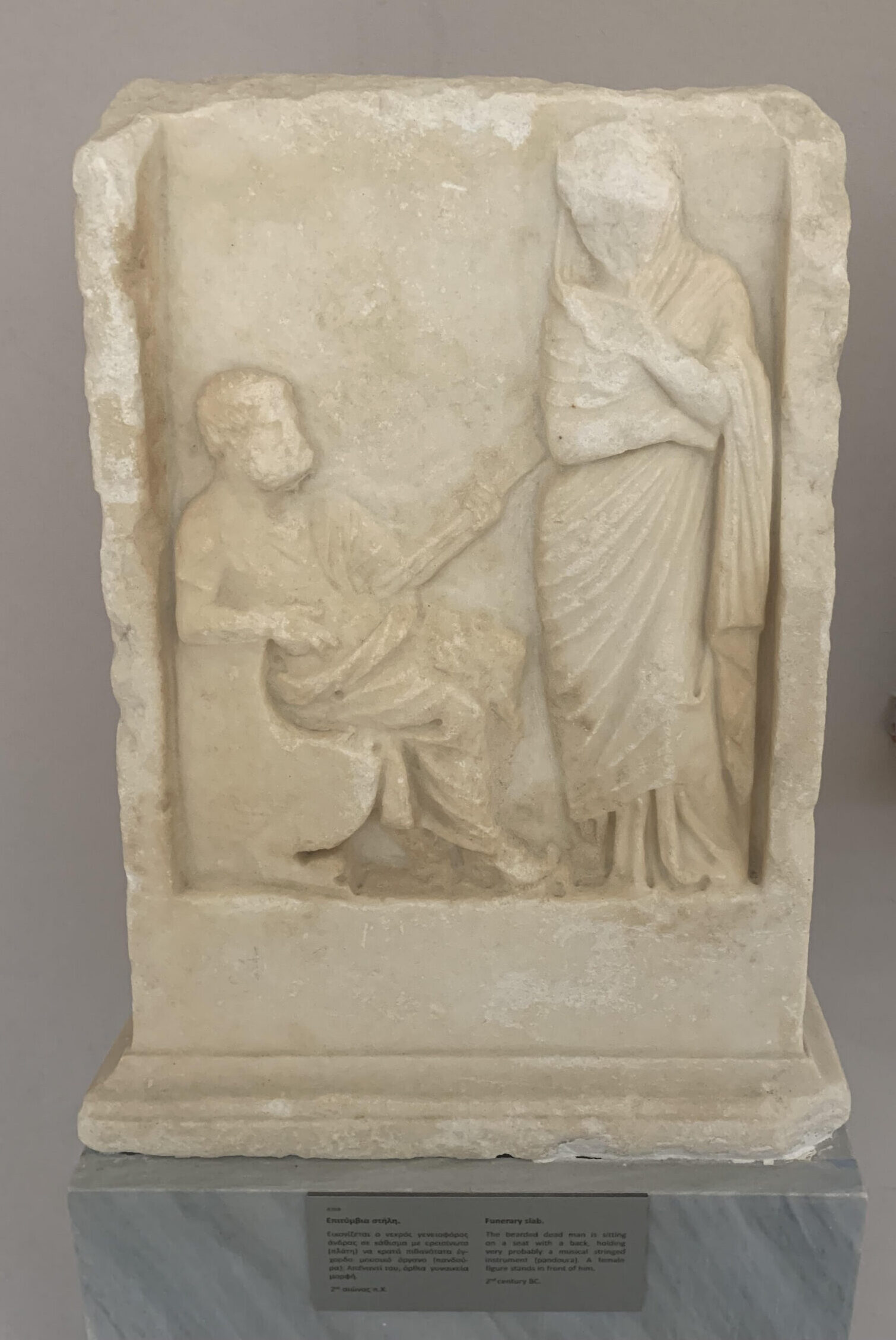
Finds are on display from the Mycenaean acropolis of Koukounaries dating to the 12th century BC; from the excavations at Delion, the sanctuary to Apollo and Artemis – such as animal figurines, clay reliefs, heads of human figurines, seal stones, bronze and ivory jewellery, faience and copper objects from Egypt and Phoenicia. Shown too are clay vessels of the Classical period imported from Attica and found in the cemetery of ancient Paros at the ‘Vitzi’ site, as well as bronze mirrors, gold jewellery, from the 5th-4th centuries BC and glassware from the 1st century AD. Funerary stelae date from the 5th to the 3rd centuries BC.
The PARIAN CHRONICLE is an important inscription (A 26) that includes a chronological table of important events from the time of the mythical king of Athens Cecrops (in 1582 BC) up to 264/3 BC, when the eponymous archon in Athens was Diognetus. It is thus dated to the middle of the 3rd century BC. The inscription mentions not only historical events but also important Greek writers. The Parian Chronicle is preserved on three marble plaques. The other two are in the Museum.
In the centre of the hall are two statues – the Kora, imposing works of the Archaic era with influences from Ionia as well as other small sculptures – like the heads of kouroi and korai.
The Covered arcade
Architectural elements from temples, inscriptions and sculptures from sacred and public buildings of ancient Paros are exhibited. The centre of the space is dominated by the colossal cult statue of Delian Artemis, which is 3.50 m high with its base. The bodies of two horses (A 778 and A 1185) of the Archaic era come from the decoration of the pediment of a temple. In the atrium looms large the Ionic capital (A 733), of the 6th century BC, which comes from the funerary monument in honour of Archilochus; it has a newer inscription of the 4th century BC cut into it. On the walls around the capital are exhibited eight inscriptions, which refer to the life and work of Archilochus.
Courtyard
In the atrium, the open courtyard of the Museum, are on display funerary stelae from various periods, marble architectural elements, sarcophagi, marble cremation-urns and statues. The anthropomorphic sarcophagi of the end of the Archaic period are characteristic products; they belong to the so-called Phoenician type and are unique finds in the Greek world. The mosaic floor depicting the labours of Hercules comes from the Gymnasium of ancient Paros, which was located on the site where the church of Katapoliani was rebuilt; the original dates back to around 300 AD