

Saliagos is today a small islet between the islands of Paros and Antiparos and the islets of Margines and Revmatonisi. During the Late Neolithic period (which is when the settlement discovered on it is dated, and when the sea level was several metres lower), it formed a low peninsula with a maximum height of 5 m above the waves, sited in the northern part of the isthmus that connected the two islands (Paros and Antiparos). It therefore appears, according to underwater geomorphological research, that during that period Paros constituted, together with Antiparos, Saliagos and Despotiko, a large single island, the so-called ‘Greater Paros’. The location was reasonably important for exercising control of the sea routes in the region.
Archaeological data
The island was visited in 1959 by N. Zapheiropoulos, who identified the remains of a prehistoric settlement. The systematic excavation of the islet was carried out by C. Renfrew and J.D. Evans of the British School of Archaeology during the years 1964-1965. According to the publication of the British School, on the surface of the islet, largely bare of soil, large concentrations of obsidian were visible. In the southern part there was a sufficient quantity of soil, reaching a depth of at least 2 m. There, houses with a square plan were excavated, with stone or brick walls, built on stone foundations. The houses had a light superstructure; the settlement was surrounded by a wall. Underwater research has shown that the settlement extended beyond the boundaries of the present-day islet. Since the burial places of the inhabitants have not been identified, our knowledge of the culture of the time comes exclusively from the residential remains. In addition to the prehistoric material, a disturbed tomb was found in the main excavation area, which, from its pottery (an intact lamp), dates to Roman times.
Movable finds
The excavations at Saliagos brought to light a multitude of movable finds (pottery, figurines, stone tools, remains of food, etc.). Noteworthy is the complete absence of metal, common at other sites of the same period.
Ceramics
Open vessels predominate, mainly bowls on flat bases or a high foot. The latter, known as fruit bowls/stands are a popular and characteristic shape at the settlement and must be products of a local workshop. The characteristic style of the Saliagos ceramics is the white linear decoration on a dark background, which is applied to the surface of the vessel after firing and is therefore almost invisible now. A variety of decorative motifs exist: straight lines, wide bands, zigzags, overlapping angles (chevrons), triangles, squares, rhomboids, etc. This decoration shows affinities with motifs from the Dodecanese and the islands of the eastern Aegean. On the other hand, ceramics with a αλοιφωτή decoration are widespread throughout the southern Balkans, and connect the island area with mainland Greece. Ointment decoration is mainly interpreted as of ritual significance, by which handling the added ointment is vulnerable to frequent use.
Figurine manufacture
An interesting set of figurines came to light during the excavations of Saliagos. Of the marble pieces, the most famous is the ‘seated lady’ or ‘fat lady’ of Saliagos, whose secure stratigraphical origin places the plastically-rendered form at the beginnings of the Cycladic sculptural tradition. A plank-shaped figurine of the violin-shaped type was also found, as were other stylized marble figurines. Also found were the torso and parts of the legs of clay figurines, as well as a few human-shaped pendants of bone.
Stone working
The large quantity of obsidian that came to light during the research of the British School is worth noting: apart from fragments, 1176 well-processed obsidian tools were found as well as 45 from other volcanic stones. The obsidian comes mainly from Melos, which indicates the use of boats to fetch it and the knowledge of navigation by the people of this era.
Economy – occupations of the inhabitants
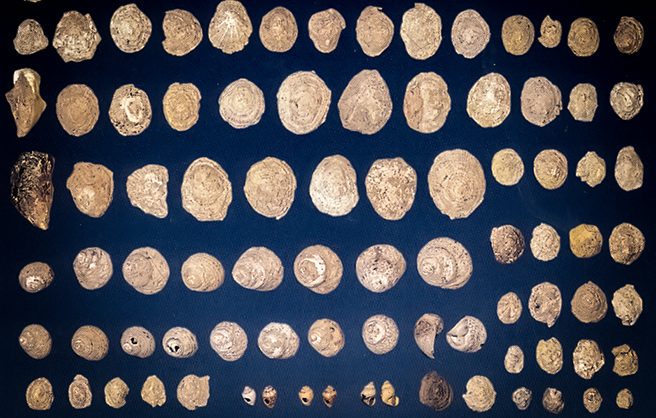
The inhabitants of Saliagos during the Neolithic period were mainly engaged in fishing, but also in livestock farming (sheep/goats, cattle, pigs), as well as the limited cultivation of cereals, mainly barley. They also worked at making pottery, basketry and knapping obsidian for the manufacture of tools. During the research on the islet, there were collected 21,886 shells originating from 19 species of gastropods (snails), cephalopods (cuttlefish), echinoderms (urchins) and arthropods (crabs). The recovery of the shells in rubbish areas or in sets is a strong indication that they are the remains of meals. Approximately 3000 fish bones were also collected, with tuna being the dominant species. Some bones belong to large fish and indicate a skill and knowledge of deep-sea fishing. Based on the mobile finds fishing was done with nets and spears.
- D. Evans, C. Renfrew, Excavations at Saliagos near Antiparos, 1968.