

With the establishment of Constantinople as the capital of the Roman Empire in 330 AD, the geographical location of Paros, the third largest island (at approximately 196 sq.km) of the Cyclades in the centre of the Aegean, contributed to its geopolitical upgrade and economic prosperity during the Early Byzantine period.
Administratively, it belonged until the mid-6th century to the Province of the Islands, while in 536 it was incorporated into the quaestura exercitus (the administrative unit created by Justinian, so that Caria, the Aegean islands and Cyprus could contribute to the maintenance of the army of the Danubian provinces of Scythia Minor and Moesia Secunda).
Paros was an episcopal seat already in the 4th century belonging to the Metropolis of Rhodes. Testimony to the spread of the Christian religion in Early Byzantine Paros is the basilica of Katapoliani (or Ekatontapyliani), one of the most important Byzantine monuments in Greece, along with two other basilicas, the basilica of the ‘Three Churches’ outside Paroikia and the basilica of Agios Georgios in Voutakos. These monuments preserve excellent examples of sculpture and frescoes (Katapoliani) from the period.
Katapoliani
Panagia Katapoliani is undoubtedly the most important Byzantine monumental complex of the Archipelago and one of its best-known Orthodox pilgrimage sites.
It consists of the central large cruciform domed basilica dedicated to the Assumption of the Virgin Mary. The rows of marble colonnades, of white marble with greyish veins, combined with the multi-coloured vaults made of poros-limestone, are impressive. Inside, the walls of the church were covered with marble panelling, mosaics and frescoes. Important founding inscriptions have been preserved in the church, from which we understand that Bishop Hylasios had a significant role in the construction of Katapoliani. The impressive synthronon, the ciborium in the Holy Sanctuary as well as the iconostasis, together with surviving parts of the marble pulpit, testify to the richness of the architectural decoration the monument enjoyed.
On the northeastern side of the Panagia basilica is the chapel of Agios Nikolaos, itself a three-aisled basilica on the ground floor level, combined with the cruciform inscribed form up at the level of the balconies (‘of mixed type’), with a chapel to the Agioi Anargyroi on the southeast as well as the so-called Baptistery on the south. The latter is again a three-aisled basilica with a dome and narthex, while a cruciform basin-font survives in front of the apse. The poros-limestone of the domes and the sculptural decoration, often ancient spolia, dominate the interior.
The restoration and excavation works carried out in Katapoliani by A. Orlandos (1959-1964) restored the original form of the complex and revealed the western atrium. The large cruciform basilica was attributed to the era of Justinian, around the middle of the 6th century. Modern research by the Ephorate of Antiquities of the Cyclades and other scholars tends to revise the dating to the 7th or even the 8th centuries.
It was probably built on an earlier three-aisled basilica, itself based on the mosaic floor of a secular building, perhaps a gymnasium, of the early 4th century. Tradition attributes the construction of the church of the Theotokos to imperial sponsorship and the quality of its decoration and construction confirm this view. Marble architectural members and fragments of wall paintings from the early Byzantine to the post-Byzantine period are preserved in the complex.
The church is part of a newer enclosure and a complex of two-story cells with chapels, whose construction phases date to the 17th and 18th centuries.
The grounds and cells of Ekatontapyliani currently house two interesting collections. Early Christian sculptures and inscriptions from all the basilicas of Paros constitute a significant corpus of their kind in the Cyclades.
Finally, recent excavations by the Ephorate of Antiquities of the Cyclades to the east of the complex have brought to light new evidence for the history of the monument based on architectural and ceramic finds.
Basilica of the ‘Three Churches’.
The basilica of the ‘Three Churches’ is located east of Paroikia, approximately a kilometre northeast of Katapoliani on the road leading to Naoussa. It took its name from three post-Byzantine churches built on this site using material from the basilica itself and other ancient buildings. During the excavations of Orlandos in 1960-1961, when the three churches had almost been entirely removed from the site, the early Byzantine three-aisled basilica with a narthex was uncovered (among the architectural findings was an Ionic capital bearing an inscription associated with the Parian poet of the 7th century BC, Archilochus).
The impressive pulpit, with a double staircase and a circular balcony, similar to that of the Katapoliana and decorated with peacocks, crosses and other geometric motifs, deserves mention as indicative of the particularly rich sculptural decoration of the church.
Based on its sculptural decoration, the church was dated by Orlandos in the first half of the 6th century. Modern research, however, tends to revise this dating to the 8th century.
Coastal settlements and Parian pottery workshops
According to the evidence both known before and based on the most recent excavations of the Ephorate of Antiquities of the Cyclades, settlements of Late Roman–Early Byzantine date existed around the basilicas of Katapoliani, the ‘Three Churches’ and Agios Georgios Voutakos, as well as around two additional basilicas where later were erected the Byzantine churches of Evangelistria in Episkopiana to the southwest of Paroikia, and a ruined anonymous church in Protoria southwest of Naoussa. A settlement is also known in the southeast of the island surrounding the 13th century church of Agios Georgios Thalassitis in Piso Livadi, where burials from the late 6th to early 7th centuries were found. The excavations carried out by the Ephorate of Antiquities of the Cyclades in recent years enrich this picture.
The excavation at Katapoliani brought to light pottery dating mainly from the mid-4th to approximately the mid-late 7th centuries. The imports of amphorae and red-painted vessels from Asia Minor, Cyprus, Palestine and North Africa show that Paros was connected to the rest of the empire, via maritime trade and possibly pilgrimage routes. The monumental complex was also a consumer, if not a producer, of local agricultural and ceramic products of Paroikia and the island in general, as evidenced by the Parian amphorae found. Parian amphorae of the early Byzantine period were also recovered in excavations in the chapel of Evangelistria with the church of Agios Konstantinos (17th century), on the hill of the castle of Paroikia, near the modern port.
If not of equal importance, but still very important at this time was the second port of the island, Naoussa. Here and significant for the economic history of the island is the discovery of two large-scale and well-preserved ceramic kilns at the site of Laggeri, which produced two types of amphorae during the late Roman/Early Byzantine period (Parian type 1 and Parian type 2), a rare find in the Early Byzantine Aegean. This mass production of Parian amphorae establishes that Paros, which belonged to the quaestura after 536 until the end of the 7th century, was an important supplier of agricultural products to the imperial army. In addition, similar examples of Parian amphorae have been identified on Naxos, Thera and Despotiko. Finally, based on the archaeological data it is clear that the workshops of Laggeri were abandoned after the 7th or early 8th centuries: the site was not inhabited throughout the rest of the Byzantine period.
Based on historical and archaeological evidence to date, the heyday of early Byzantine Paros continued until approximately the middle of the 8th century. During the mid-Byzantine period, which lasted approximately until the establishment of the Duchy of the Aegean by the Venetian Marco I Sanudo in 1207, Paros experienced periods of unrest and desolation due to pirate raids but also earthquakes, the eruption of the volcano of Thera, etc.
For this period, important information is drawn from the 9th century life of the Venerable Theoktiste of Lesvos, written by Niketas Magistros in the 10th century: Theoktiste escaped from a pirate ship that had anchored in Paros on its way from Lesvos to North Africa, managed to find her way from Naoussa to Paroikia through the forest that had covered the abandoned island and lived for 35 years in the deserted Katapoliani, where she finally died. Her life was narrated by the ascetic Symeon to Niketas Magistros in the 10th century when they met on the deserted island of Paros, in the abandoned church of the Virgin Mary.
Although the image of mid-Byzantine Paros from this rare and valuable written source is perhaps exaggerated, it must nevertheless reflect reality to a significant extent, as it is in agreement with the relatively numerous surviving evidence, architectural and artistic, of the period on the island. On the other hand, structures such as Agios Ioannis Theologos in Kato Marathi confirm that the island was not totally deserted.
Agios Ioannis Theologos in Kato Marathi
The small church is located in Kato Marathi, west of the village of Kostos. It belongs to a variant of the type of single-aisled cruciform inscribed domed church – which abounds in the Aegean. According to typological similarities it is dated between the 11th and 13th centuries.
———————————————————
Following the Fourth Crusade, after 1207 (or according to more recent research, 1210 or 1213/14), Paros belonged to the Duchy of the Aegean founded by Marco I Sanudo of Venice and ruled by the Sanudo, Crispi and Sommaripa families. During this period, three castles were built, in Paroikia, Kefalos and Naoussa. The end of this period came in 1537, when Paros was conquered by the Ottoman Hayreddin Barbarossa, who captured the castle of Kefalos, which had been the seat of the Sommaripa rulers since 1460.
Of the few known Byzantine churches on Paros, with the exception of Agios Ioannis Theologos in Kato Marathi (11th-13th centuries), most date from the 13th century and were built on the sites of probably older early Byzantine installations (the anonymous church in Protoria, Agios Georgios Thalassitis in Piso Livadi, Evangelistria in Episkopiana).
Agios Georgios Thalassitis
Located in Piso Livadi, near Marpissa, it is a small single-aisled church, vaulted on the inside, with a gabled roof on the outside and four small windows, which provide light to its interior. The church preserves some of the rare examples of Byzantine painting on Paros, which have been attributed to a provincial style of the second half of the 13th century. The frescoes once covered all the walls. Today, in the niche of the Holy Sanctuary there are traces of a depiction of Christ. On the long walls of the church, the frescoes are set out in two zones against a deep blue background. The upper zone had busts of saints, while the lower, better preserved zone depicted, among others, the saints Lawrence, Demetrius, Theodore and George, with the Archangel Michael.
Castles
Castle of Paroikia
According to the research of Dimitris Athanasoulis, the castle of Paroikia was constructed in the second half of the 7th century, part of the building programs of the Byzantine emperors in the Archipelago with the aim of repelling the deadly Arab threat.
The ancient acropolis of Paros was ringed about with strong walls, which are partially preserved due to the collapse on the sea’s-side. The eastern linear enclosure is preserved, which is reinforced in the middle with a small triangular tower and at the northern end with a large, five-sided tower that rose well above the perimeter. The tower controlled the adjacent gate to the acropolis. The ground floor, which houses a post-Byzantine church, would initially have had a use connected to the gate. The faces of the fortifications are built from ancient architectural members made of white Parian marble. Their positioning is systematically carried out, to achieve an impressive result. The very white marble walls are intended to give an emblematic character to the fortification, which serves to materially express the power of the empire. We can imagine the impression that would strike a person entering the port first by the sparkling acropolis on the hill on one side and then the white settlement of Katapoliani (built at the same time as the castle) on the other. In the Venetian period, a semicircular bastion was added and the urban fabric developed inside and outside the enclosure. Also, many post-Byzantine churches were built inside the castle: some incorporated part of or were in contact with its five-sided tower (Panagia tou Stavrou (1514), Agia Anna, Agia Ekaterini).
Naoussa Castle
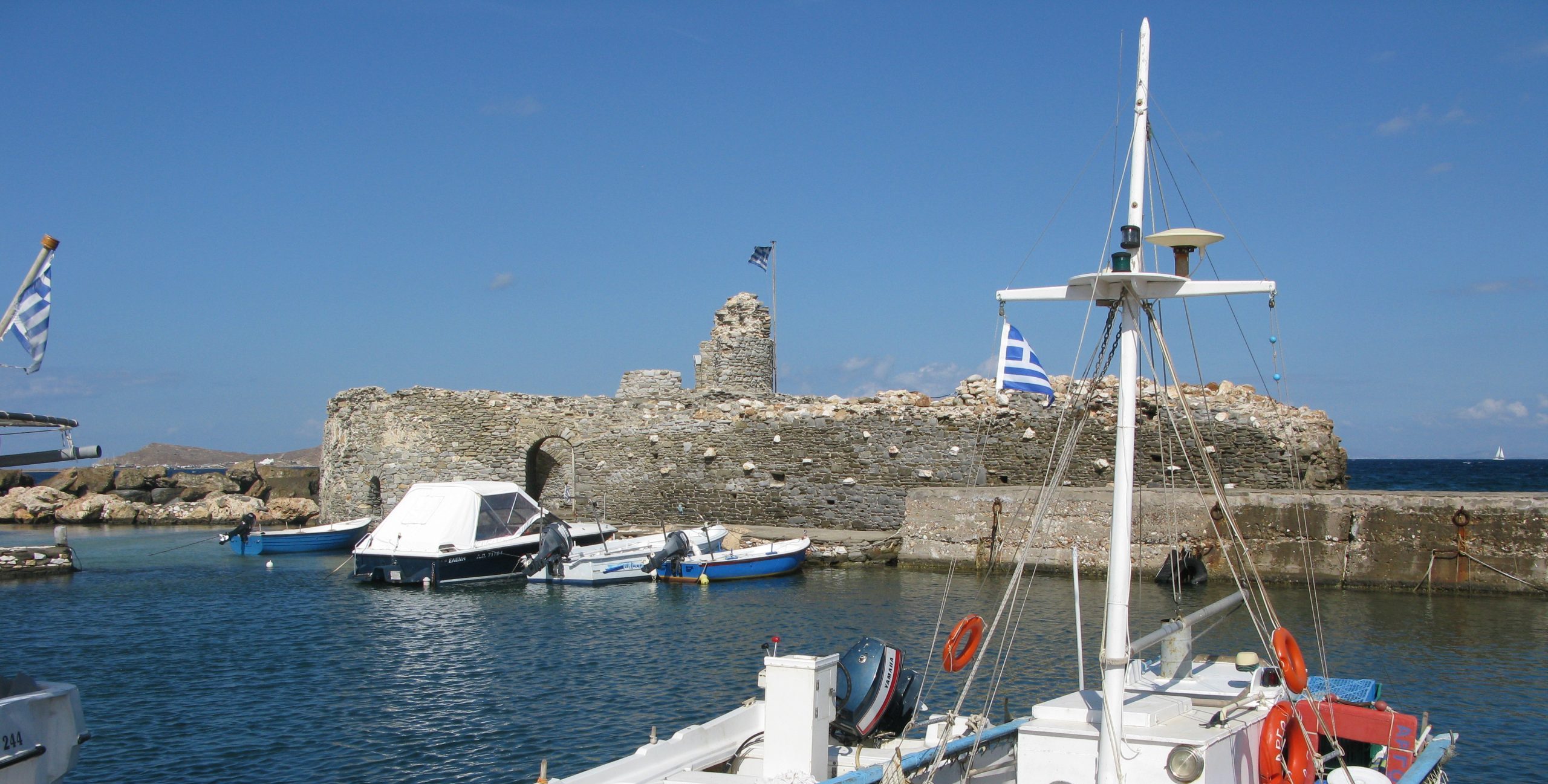
The castle of Naoussa was built between the 14th/15th centuries. Three gates survive from the fortified settlement. The circular tower at the entrance to the harbour was built in the early 16th century.
Kefalos
The top of the Kefalos hill, in southeastern Paros, is today occupied by the post-Byzantine monastery of Agios Antonios. The Venetian castle was built around 1500 by the governor of Paros, Nicolo I Sommaripa (1462-1505), as his base in a pre-existing fortified settlement, the first phase of which could even date as early as the late 13th century. Ruins of the castle and the fortified settlement survive at the foot of the hill, where two rows of defensive walls can be distinguished. Among the ruins of the castle walls are houses and small ruined churches, the best preserved being the small single-nave vaulted church of the Annunciation (1410). The capture of the castle of Kefalos in 1537 by the Ottoman Hayreddin Barbarossa, though defended by Cecilia Venieri and her husband Bernardo Sagredo, marks the end of the Venetian era on the island.
Although the Ottoman occupation begins in 1537, the Frankish reign of power actually ended only in 1579, with the end of the rule of Joseph Nasi (1566-1579), who was given the administration of the Duchy by Sultan Selim II. From then until the Greek Revolution, Paros was under Ottoman control with a brief period during 1770-1774, when Naoussa became the naval base of the Russian fleet during the Russo-Turkish War.
The Metropolis of Paronaxia was re-established on Naxos in 1553 and its flourishing was expressed, among other things, by the foundation of many monasteries, churches and chapels, mainly single-aisled, throughout the island after the 17th century, as well as the presence of a large number of icons of the Cretan School, a fact attributed to the privileges granted to the islands by the Achtiname/Covenant of Sultan Murad III (1580). Among the privileges was the right to build new churches or to repair older ones. The contribution of the Mavrogenis family, first in the person of Nikolaos Mavrogenis, prince of Wallachia, was decisive in this 18th century floruit.
Antiparos Castle
Founded by its rulers, Giovanni Lorentano and Maria Sommaripa, between 1440 and 1446, this developed into a small fortified settlement typical of the Aegean islands. With the recent research of the Ephorate of Antiquities of the Cyclades under the direction of Dimitris Athanasoulis, it can be seen that initially a strong cylindrical tower with a low circular enclosure was built. Later, the tower was lowered and a sloping reinforcement (scarp) was added to its base. In a third phase, the rectangular enclosure was designed with houses developed inside it. The houses are built with three levels and set along the sides of the square in one continuous arrangement. Later, houses were built around the base of the cylindrical central Tower. The only entrance to the settlement was on the ground floor of a house in the south wing. Developing, the settlement expanded outside the south wing in the form of a rectangular surround called ‘Xopyrga’ or ‘Xopyrgo’. The churches of the Castle also belong to the later phases of the settlement. Within the boundaries of the original core of the Castle of Antiparos are the churches of Christ (single-aisled, domed), of John the Baptist, or Forerunner (single-aisled, vaulted) and of Agios Antonios (single-aisled, flat-roofed).
Despotiko
The recent study of the pottery of the coastal early Byzantine settlement revealed in the Mandra of Despotiko, showed that the pottery found in Despotiko was imported (perhaps sometimes via Paros) from known production centres such as North Africa, Asia Minor, Cyprus and the Aegean coast but also from Paros itself as evidenced by the Parian amphorae recovered. This pottery constitutes evidence for dating the settlement between the 4th and at least the late 7th century/early 8th century. In other words, the same ‘pattern’ of abandonment is observed here that is also met with in the coastal settlements of Paros during the same period, i.e. in the late 7th to early 8th centuries. Furthermore, it is a historical ‘repetition’ of what had happened in ancient times, with the gradual abandonment of the ‘outside the walls’ Parian sanctuary of Apollo, as a result of the decline that Paros experienced after the Persian wars. Similarly, early Byzantine Paros, due to its geographical proximity and significant prosperity, could have been the local power that overawed the neighbouring small islands to its west. It could have founded and utilized the coastal settlement of Despotiko, as a dependent and intermediate commercial station/port out to the west. This port could serve both local, coastal business and long-distance trade. With the gradual weakening of Paros, the settlement in Despotiko also fell into decay.