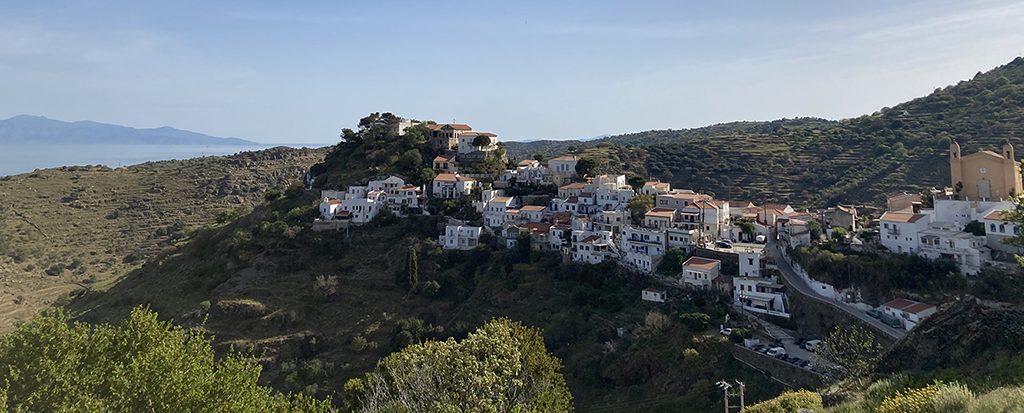


Kea, one of the largest islands of the Archipelago, is only 16 nautical miles from Lavrio, thus forming a natural bridge between the Cyclades and Attica. The island is characterized by the small fertile valleys formed between its mountain masses, while even today it has springs and streams that, especially during the winter months, provide abundant water. Its coast has an indented outline with small bays, with the one exception in the large bay of Agios Nikolaos, at Korisia, which was one of the main factors in the development of the island ever since prehistoric times.
As a predominantly agricultural island, as eloquently attested by the countless terraces for cultivation, built in the same way since prehistoric times until today, the economy of Kea is focused on the exploitation of acorns, viticulture, livestock farming and beekeeping. However, its subsoil is also particularly rich, as it has deposits of iron and lead as well as milt, a valuable mineral used, among other things, in shipbuilding and in medicines.
According to the literary sources, in ancient times the island was called Ydroussa and Keos, Ydroussa and Keos, the latter after the eponymous hero from Nafpaktos. Over the centuries, its name has known various variations: Kios, Cia, Cea and Kea, while its current name Tzia is a phonetic evolution of the original name.
According to mythological tradition, the first inhabitants of the island were nymphs who were forced to abandon it, being pursued by Sirius, who caused a long period of drought and heat, resulting in the springs drying up and the crops being lost. The desperate inhabitants sought the help of the hero Aristaeus, son of Apollo, who settled on the island and prayed to the gods, building an altar on the highest peak in honour of Sirius and Zeus Ikmaius. His prayers were heard and Zeus sent the annual winds – the meltemi – that lasted forty days and cooled the people.
From the archaeological data to date, it appears that Kea was first inhabited in the 4th millennium BC, when are dated a small settlement and cemetery identified at the site of Kefala. In the Early Cycladic period, the very important settlement of Agia Irini was founded, which was continuously inhabited until the Mycenaean period. Even after its abandonment, its Sanctuary remained in use until the Roman period.
During the early historical period, not one, but four cities were founded and developed, which correspond more or less to the current main settlements: Korisia, Ioulida, Poiessa and Karthaia. During the Hellenistic period, as evidenced by epigraphic evidence, Korisia and Poiessa were incorporated into the two eastern cities, with Karthaia itself being abandoned in the 6th/7th centuries AD. Ioulida continues to be the main city of the island, with an unbroken record of habitation from antiquity to the present day.
During the 5th century BC, the Keans were the only Cycladic people, according to Herodotus, who participated both in the naval battles of Artemisium and Salamis and in the land battle of Plataea. In 478 BC, Kea joined the First Athenian League and remained firmly under Athenian influence – with some short breaks – until the end of the 4th century BC; in the next, Hellenistic period, it joined the Koinon of the Islanders. During the Roman era, it was granted as a gift to the Athenians by Mark Antony and kept this status until 212 AD, when by decree of Caracalla all the inhabitants of the empire acquired Roman citizenship.