

The history of Karthaia
In Kea, four city-states developed in antiquity: Ioulida, Karthaia, Korisia and Poiessa. On the south-east coast of the island in the bay of Poles, in a natural environment almost untouched by modern interventions, are located the extensive remains of ancient Karthaia.
The earliest finds in the area date to the Middle Cycladic period, though no settlement remains from this early period are documented to date. The first core of Karthaia’s habitation was formed in the Geometric period, probably on the rocky mass of ‘Koulas’. Gradually, the city developed, reaching a period of prosperity during the 6th and 5th centuries BC. It appears independent and autonomous: surrounded by strong fortifications, building imposing public structures and minting its own silver coins with an amphora on the obverse. The first surviving mention of the name Karthaia is found in Pindar’s Fourth Paian (5th century BC), where Karthaia is referred to by him as a ‘narrow ridge of land’.
The Karthaians, along with the rest of the Keans, took part in the Persian Wars. They participated in the First Athenian Alliance as early as 478 BC and are mentioned in tax lists from 451 BC. In the Peloponnesian War (431-404 BC) they fought on the side of the Athenians.
After the end of the war and until 394 BC the island was under Spartan control. In the years that followed, the four cities of Kea formed a confederation, each maintaining its own coinage and passing its own resolutions. At this time, a coalition was formed with the neighbouring islands under the leadership of Eretria.
Karthaia was a member of the Second Athenian League, within the framework of which it monopolized the export of miltos (red ochre) (a mineral with various uses, including shipbuilding) to the Athenians. In the Battle of Chaeronea (338 BC), it sided with the Athenians.
During the period of the Diadochoi it was a member of the Koinon of the Islands (314 BC) and remained under the rule of the Antigonids until 288 BC. It subsequently came under the control of the Ptolemies, who dominated the seas at least until the Chremonidian War (267/6-262/1 BC), when Kea functioned as a naval base.
In the 3rd century BC, piracy also seems to have affected Karthaia. To deal with the phenomenon, the Keans, who appear to have once again united in a coalition, came to agreements with the Aetolian League.
Around 200 BC, Poiessa, the weakest city on the island, seems to have been absorbed by Karthaia. From 200 to 168 BC, Kea came under the control of the Rhodians. Subsequently, relations with the Athenians, who supervised the island with a epimelete (curator), intensified.
The centuries that followed are dark in terms of historical development and events; however, habitation at Karthaia continued intensively until the 7th century AD at least. The ‘Koulas’ was fortified with reused marble blocks, the ancient temples gradually fell into ruin, their place was taken by early Christian tombs. The oldest known basilica of the island was built at Vathypotamos, while early Christian engravings were found in a rock-shelter in the area. The new religion was established, but Karthaia ceased to exist as a city, as its last inhabitants abandoned it.
From the late 17th century, the imposing remains of Karthaia began to attract foreign travellers to this isolated part of the island. Initially, the site was identified with Ioulida, but in 1811 the Dane Brøndsted, who conducted over a number of days an investigation of the site, determined that it was Karthaia, based on inscriptions.
Systematic archaeological research at the site began in 1902 by the French Archaeological School. The research continued in the 1960s by the Greek Archaeological Service and in 1987-1995 by the University of Athens and the National Research Foundation. Finally, in the periods 2002-2008 and 2011-2015, the Committee for the Conservation and Promotion of Ancient Karthaia of Kea in the Ministry of Culture proceeded with the promotion and restoration of the most important monuments of the acropolis within the framework of two European programs. The Conservation and Promotion Project of Karthaia was awarded the European Union Prize for Cultural Heritage / Europa Nostra Award 2017.
The monuments of ancient Karthaia
On the terrace closest to the sea is the hecatompedon Doric temple of Pythian Apollo (c. 530 BC). It is a prostyle temple, hexastyle in parastasis (measuring 16.00 x 31.15 m, with a height of 8.00 m). Literary and epigraphic sources demonstrate that it was the main place of worship of the city. In the pronaos and in the ‘square’ in front of the temple, many bases and pedestals of votive offerings have survived, as well as a series of bases for resolutions of the Council and the Demos of Karthaia.
On the upper terrace is a Doric temple (c. 500 BC), hypothetically attributed to Athena. It is a peripteral temple, with 6×11 columns (measuring 12.00 x 23.20 m, with a height of 8.70 m) and is the oldest-known Doric peripteral temple in the Cyclades. Its pediments and akroteria were decorated with statuary compositions (e.g. an Amazonomachy, today in the Archaeological Museum of Kea in Ioulida). On the stylobate, inscriptions of the ‘kaloi’ can be distinguished.
A monumental Propylon defines to the south the entrance to the terrace of the temple of ‘Athena’ (mid-5th century BC). It is a Doric, amphidistyle structure in parastas (5.30 x 5.30 m, and with a height of 6.00 m). A platform led to the Propylon from the west, while an imposing staircase from the east made it possible to communicate between the terraces of the two temples.
On the terrace of the temple of ‘Athena’ is also located the ‘building D’ (c. 300 BC) of unclear function. It is a Doric, prostyle, four-columned in parastasis public building (10.40 x 15.40 m, with a height 6.80 m). It owes its conventional name to the letter D, with which the Dane Brøndsted labelled it in the first sketch of the site, in 1811. The terrace itself is formed by two impressive retaining walls, built with blocks of imposing dimensions. On the largest of them (6.30 by 1.80 m) is an inscription from the 5th century BC. with four male names: Oralios, Enkairos, Scheneretos, Eudimos.
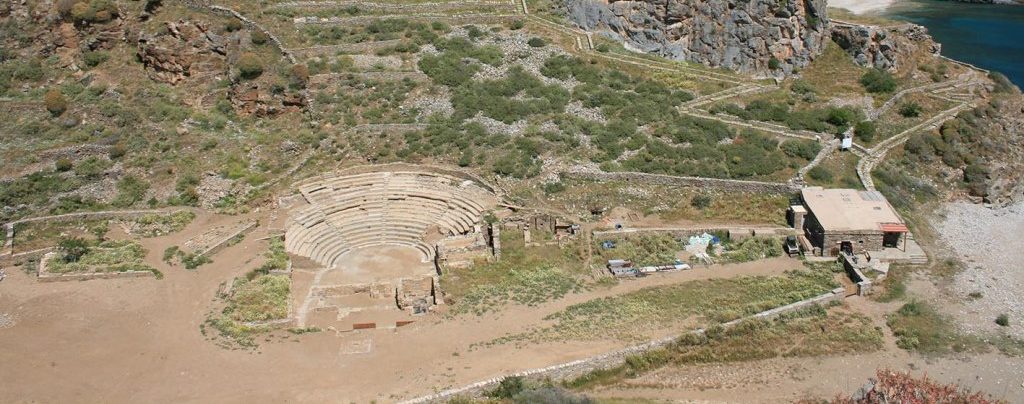
Low on the western slope of the acropolis is the stone-built theatre of the ancient city, with a capacity of approximately 900 people, which was fully excavated during the period 2011-2015. It dates to the mid-4th century BC, occupies an area of approximately 800 sq.m and has a cavea, a circular orchestra and a stage with a proscenium.
Next to and partly over parts of the theatre, an extensive complex of baths with wells, tanks and rooms for hot, lukewarm and cold baths was developed during Roman times.
In the double bay of Karthaia, the ancient breakwater (approx. 35 x 160 m) can be seen submerged today, extending to the islet and formed by boulders, slabs and cobbles.
The acropolis of Karthaia is surrounded by walls over 2 km long, dating from the 6th–4th centuries BC. They have gates and towers and are preserved in relatively good condition. At the top of the Karthaia hill range, where the 20th century rural chapel of Panagia Myrtidiotissa stands today, the remains of a small ancient temple (4.80 x 6.62 m) were visible until 1921. Houses were spread out on the slopes of the hills, as evidenced by parts of walls, thresholds, cisterns and useful objects.
Disabled: No provision.
Access to the Archaeological Site: Access to Karthaia is either by four traditional paved paths, integrated into a hiking tourism network with its special signage (Ag. Symeon, Kato Meria, Stavroudaki, Chavouna) or by a short path from the bay of Kaliskia. Approach by sea is also possible.
Information:https://destinationkea.com/politismos/monopatia/ (paths 3, 5, 6, 7).
Bibliography:
Mendoni, L. G. Αρχαιολογικές έρευνες στην Κέα: Αρχαία Καρθαία. Αρχαιογνωσία 4 (1985–1986) [1989]: 149–187.
Manthos, K. Αρχαιολογία της νήσου Κέας. Introduction, transcription and commentary by L. G. Mendoni. Athens, 1991.
Simantoni-Bournia, E., L. G. Mendoni, and T. M. Panagou. Καρθαία. Ἐλαχύνωτον στέρνον χθονός. Athens, 2009.
Simantoni-Bournia, E., T. Panagou, and D. Mavrokordatou. Το θέατρο της αρχαίας Καρθαίας στην Κέα: Ανασκαφή, στερέωση, ανάδειξη. Athens, 2017.