

The Melians, being a colony of the Spartans, did not want to obey the Athenians, as the other islanders did… Thucydides, V.84.2
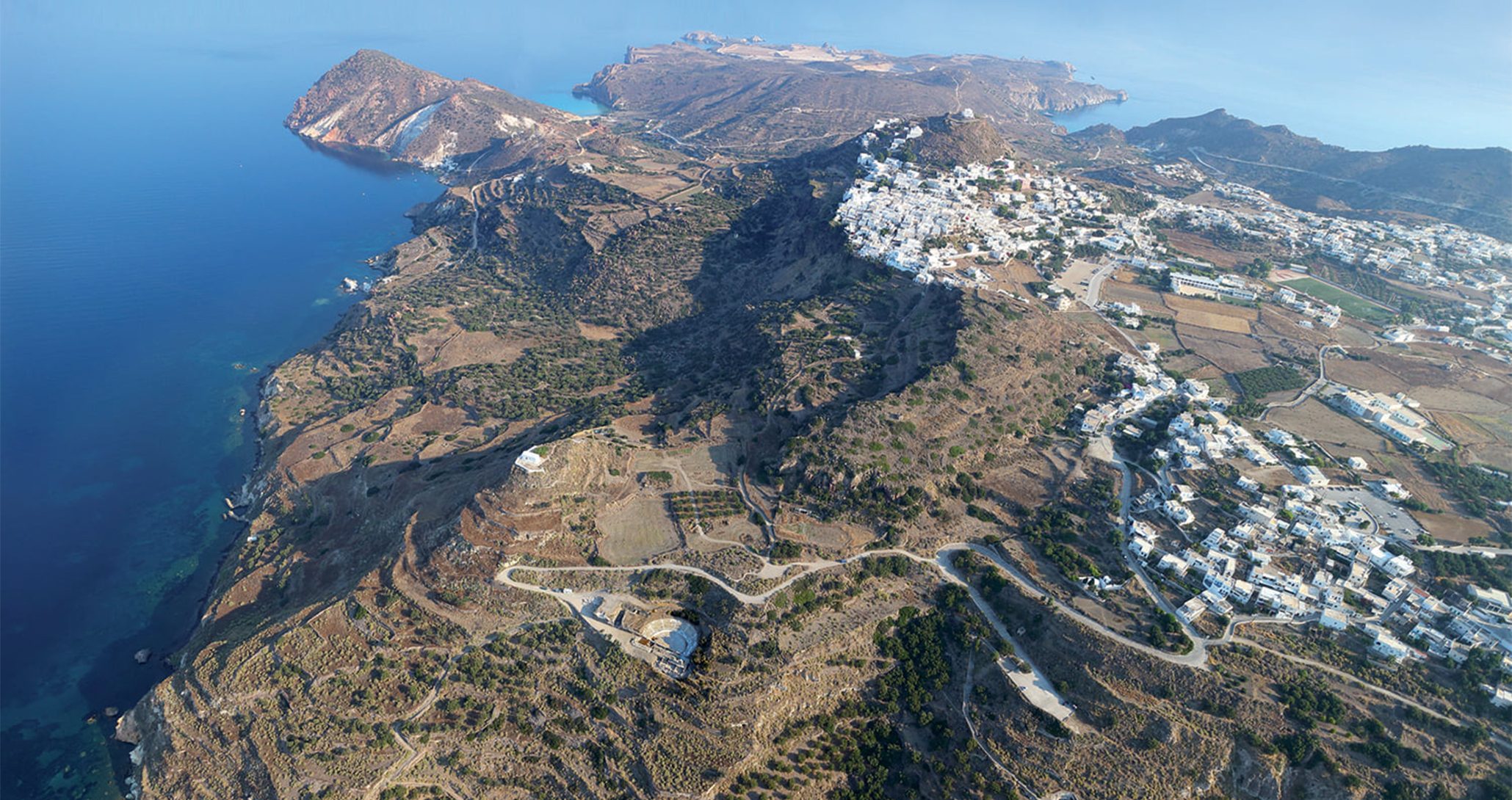
The residential and administrative centre of Melos during historical times was the ancient city of the same name, Melos, which was founded by Dorians of Laconia. It lay in a strategically important position – dominating and overseeing – on the eastern side of the narrow entrance to the large bay of the island.
With a continuous habitation from at least the 9th/8th century BC to the 6th/7th century AD, the city experienced great periods of prosperity and success during its more than a thousand-year life. A dramatic turning point in its history was its destruction by the Athenians in 416 BC and the establishment of an Athenian cleruchy, until the repatriation of its surviving inhabitants at the beginning of the 4th century BC.
The ruins of the ancient city, its harbour-area and its cemeteries are spread over a large area, on the hills of Pyrgiantes and Prophet Elias and in the valleys of Tramythia and Klima. Architectural remains and movable finds have led to the belief that the agora, the centre of public life, was located on the plateau between the two hills. Parts of the once strong and imposing walls, which fortified the city by enclosing the two hills, are today visible in many places, some still standing to a great height. Outside the walls, to the east of the city, extends the necropolis, where are to be found the Catacombs, the underground cemetery of the first Christians.
The picture we have today of ancient Melos is fragmentary, as no systematic archaeological research has been carried out, except for a few excavations that have brought to light isolated remains from the later periods of its life, in the Roman (1st-4th centuries AD) and the early Byzantine years (4th-7th centuries AD). The various smaller finds from the area – most chance finds or the result of clandestine excavations – include important works of sculpture, ceramics and items of small-scale art, many of which adorn museums and collections abroad.
The ancient city and its port were not inhabited after they were abandoned. The later settlements that were founded in the area – first the Castle (mid-13th/early 14th centuries AD) and much later (in the second half of the 18th century) Plaka and Tripiti – were outside its walls. At the seaside village of Klima, the characteristic mooring places of the fishermen (called wires) defined the coastline in the bay that was once a port, but is now largely filled in by the alluvium of the valley or submerged beneath the waves. Naturally, the ruins constituted an easy and inexhaustible source of building material for the newer inhabitants. Houses and churches were built with well-worked stones, all kinds of marble provided the raw material for the production of lime, underground burial chambers were converted into barns, stables, cellars, warehouses or cisterns. A large part of the area was transformed into arable fields and pastures.
The systematic search for building material still brings to light a multitude of finds as well as richly endowed tombs. The presence of many foreigners in the busy port of Melos creates a market for sought-after antiquities, boosts the spread of their fame and encourages antiquities smuggling.