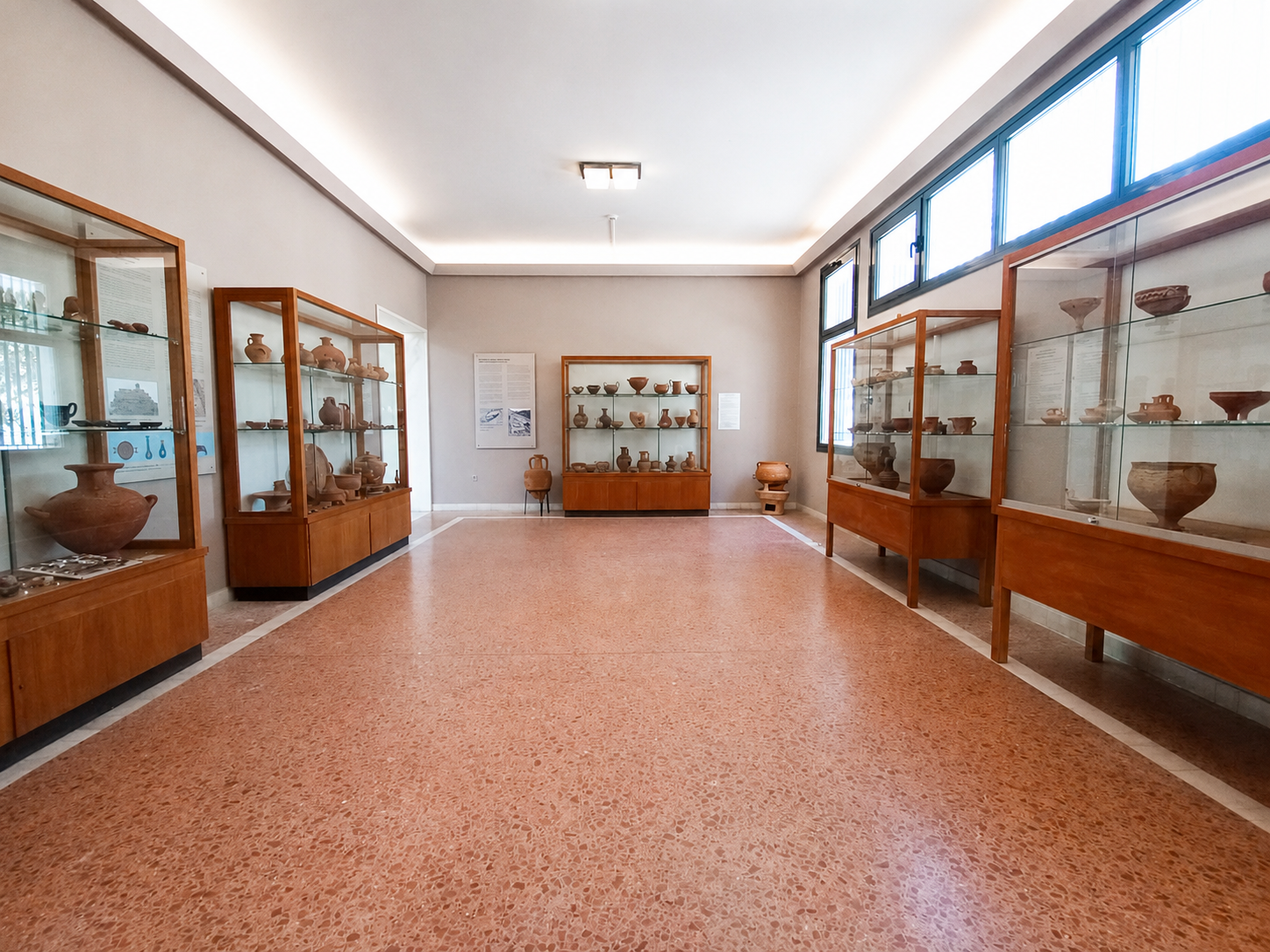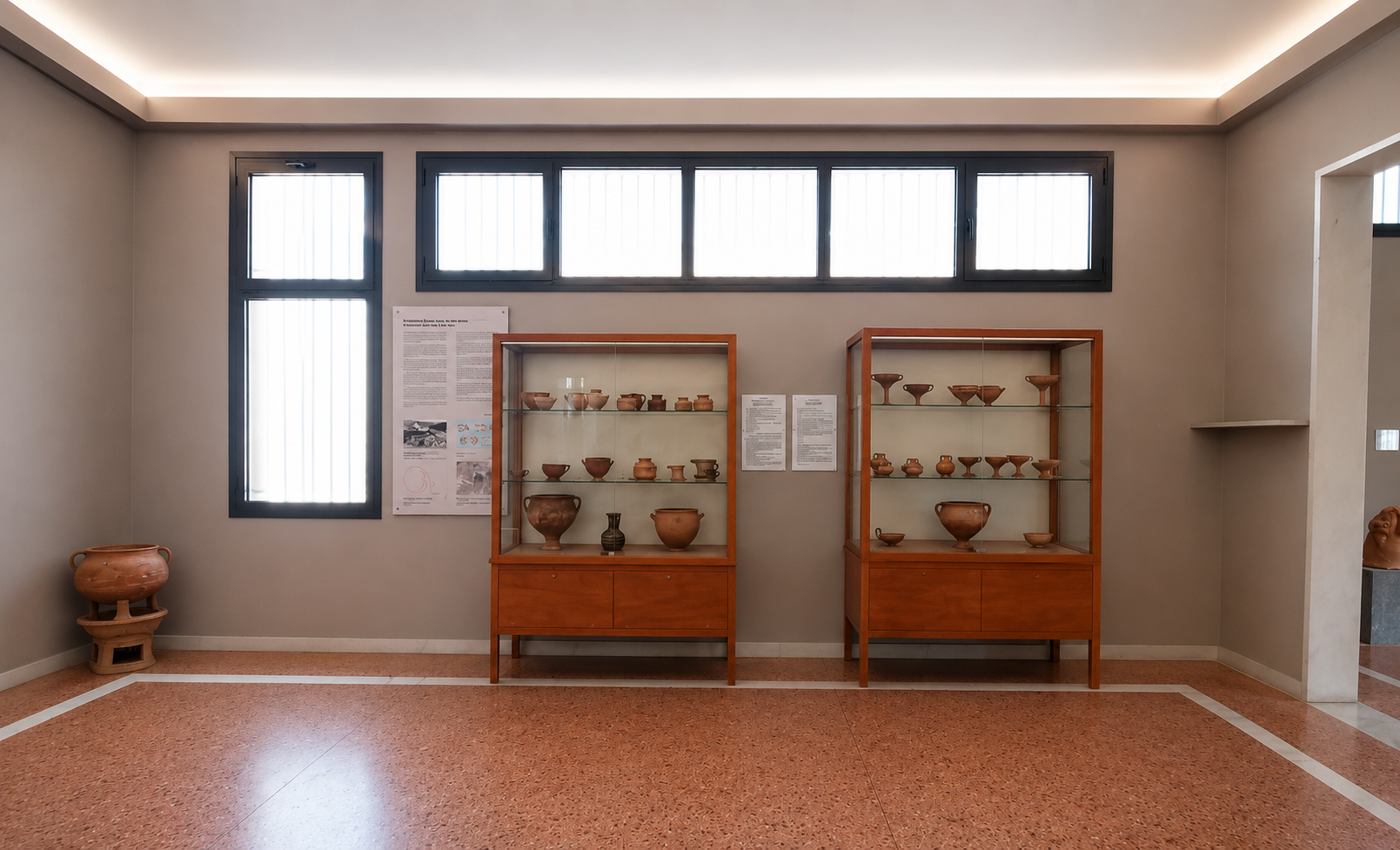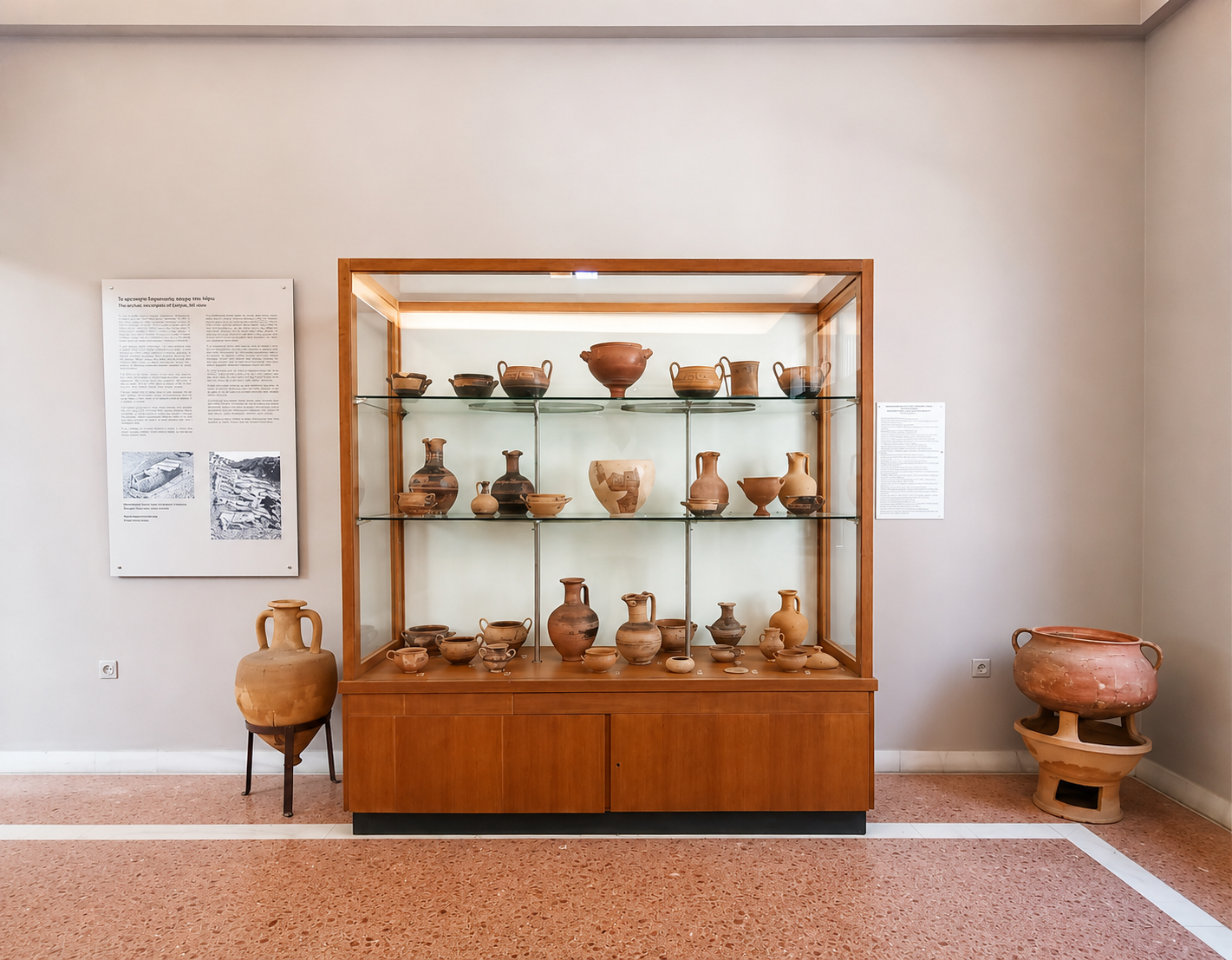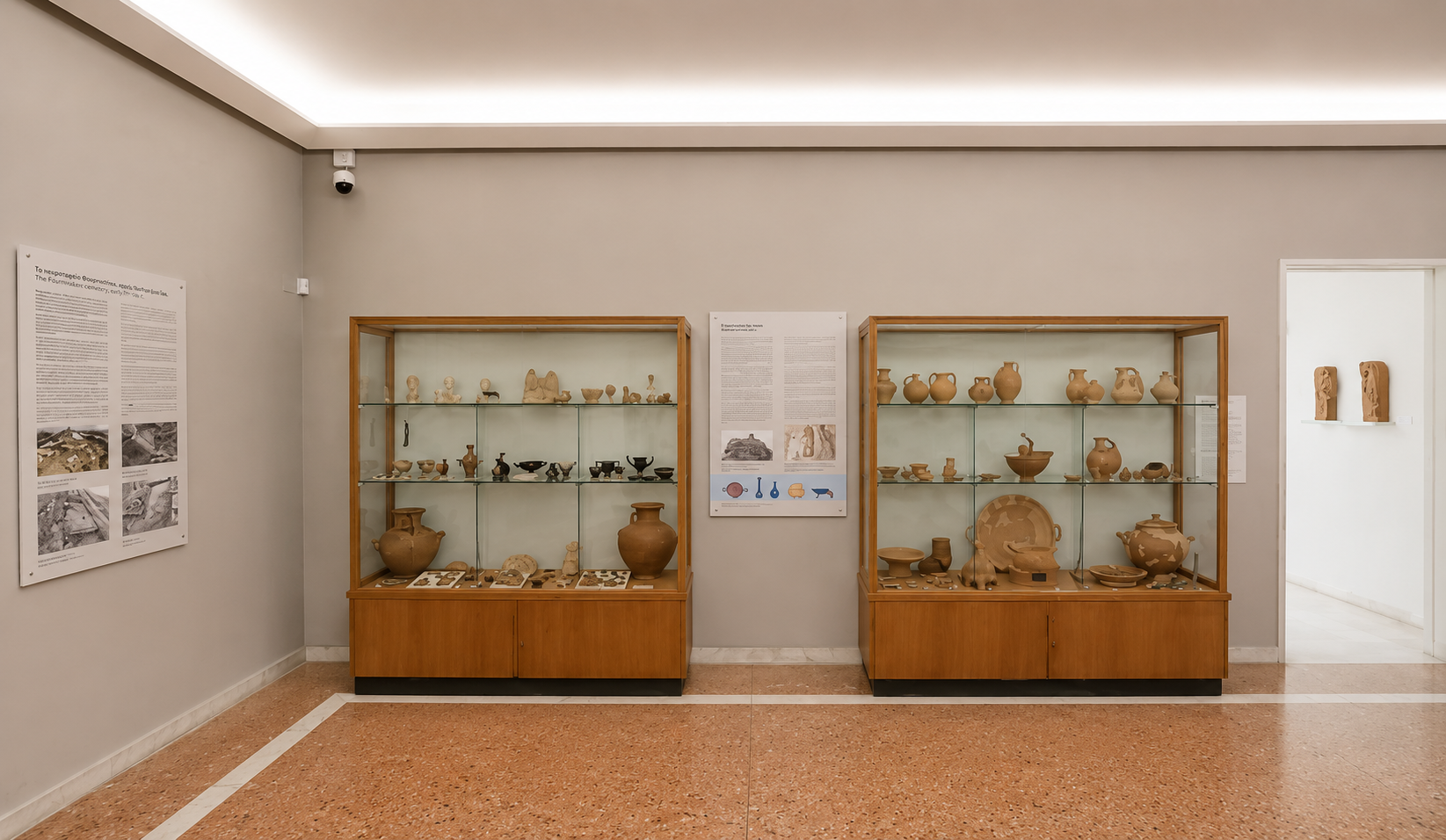


The cultural heritage of Tenos is revealed by the characteristic finds in the island’s Archaeological Museum. Among them, items from the Sanctuary of Poseidon and Amphitrite in Kionia stand out, such as marble dolphins and seahorses from the Temple to those deities. A marble metope with a pair of opposed dolphins in relief is from the Altar of the Sanctuary. Also shown is a marble sundial of the famous astronomer of antiquity Andronikos from Kyrros in Macedonia. In ‘Building D’ of the Sanctuary, a marble cuirassed statue of the Roman emperor Claudius was found, a marble male figure in a himation of a member of the Roman imperial family of the Julio-Claudians and, finally, a marble bust of Agrippina the Elder.
From the Chora of Tenos come the well-known marble torso of a male figure with a himation and a marble headless female statue from the Roman period of the Herculaneum type (4th century BC)Also of particular interest is a clay head of a bearded man, representing a daimon or a barbarian, from the area of Evangelistria.
From Livada is a funerary stele of a young man (athlete and/or hunter) made of Parian marble. Another of marble showing a male figure wearing a himation is known from Xobourgo: it probably comes from the cemetery at Vardalakos. As does yet another of a male figure with a himation and a walking stick, a fine example of an island production of the Classical period.
Even a brief review of the cultural heritage of Tenos must include the most characteristic creations of local artists during the second half of the 8th and throughout the 7th century BC: namely those vases, monumental in size and known as pithamphorae with their relief decoration. A large number of such were found in the Thesmophorion, drawing attention to Xobourgo as the main production centre of this particular sort of pottery, which soon developed into examples of high art. The Tenos workshop, one of the most important in the Aegean, was the central point for the dissemination of these characteristic products of the local ceramic tradition to other islands of the Cyclades and further afield too, into Attica, Boeotia and Euboea.
Already in the 8th century BC, we have figurative representations of people, animals (horses, goats) and hybrid mythical beings (centaurs). In the following 7th century BC, Tenian relief pottery flourished as it shifted towards the depiction of narrative mythological and epic themes, many of which make their first physical appearance here in Greece.
The work of potters with great technical skill and creative imagination, the Tenian pithamphorae are distinguished for their original iconographical richness. Among the works of the Tenian workshop, some from the 7th century BC stand out for their special character. On the pithamphora of the ‘Birth’, we find the earliest, probably, known depiction of the birth of Athena from the head of Zeus. Another has the representation of the ‘Great Goddess of Nature’ (‘Potnia Theron’), the patron goddess of women and wild animals is depicted. On part of of the neck we have perhaps the oldest depiction of Theseus, facing the Minotaur, who in the Tenian vases is depicted with the body of a bull and a human horned head. The pithamphora of the ‘Dance’ is believed to depict the Athenian hero Theseus with Ariadne, daughter of the mythical king of Crete Minos. The dance in question is being executed by men and women: possibly it is the ceremonial dance (geranos/crane dance), which Theseus performed on Delos together with the Athenian youths (seven young men and seven young women), whom the hero saved by killing the Minotaur in the Labyrinth. Finally, other fragments from a large pithamphora depict the fall of Troy (Ilios Persis), with the depiction of the Trojan Horse and shocking scenes from the final battle in the city of Troy, the enslavement of civilians and the fate of the dead, whose bodies are being devoured by flesh-eating vultures.