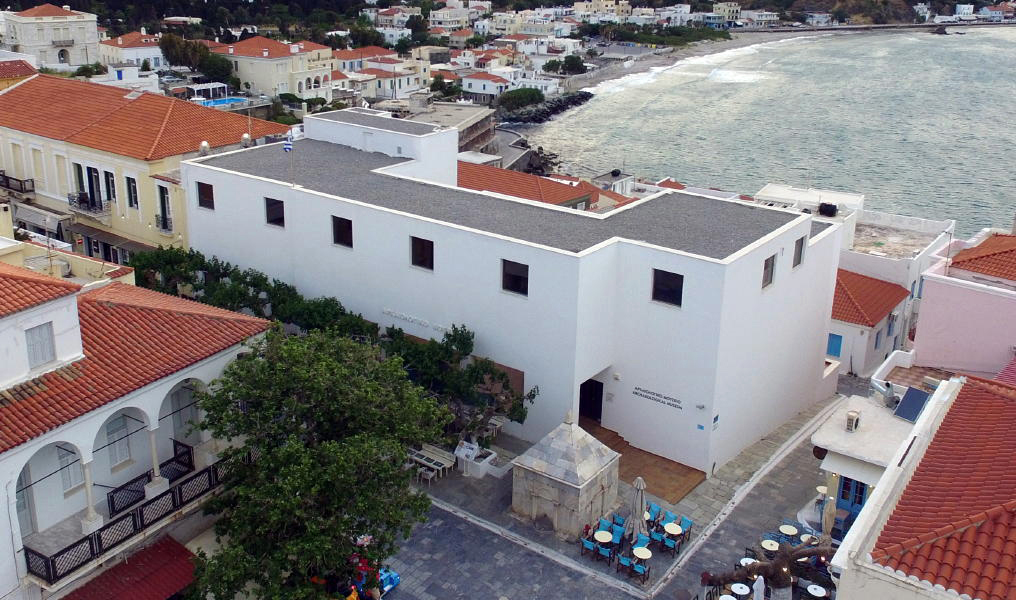


In Kairi Square in Chora, Andros is to be found the Archaeological Museum, which has been operating since 1981 in the building donated to the Ministry of Culture by the Basil and Eliza Goulandris Foundation. In front of the Museum is the marble fountain Kampani, a public fountain from 1818.
On the first floor of the Museum, are presented the finds from the ancient city of Zagora, from the Geometric (900-700 BC) and Archaic (700-480 BC) periods. Helpful models represent the ancient city, its town wall, houses and sanctuary. Based on archaeological data, they allow one to visualize both the settlement in its environs and some selected structures. Large relief pithoi, finely crafted local and imported ceramics, bronze and bone objects, loom weights and obsidian blades testify to the lifestyle and activities of the inhabitants of Zagora, the organization of their society and their religious beliefs and practices. A fragment of a black-figure krater depicting Peleus and Thetis shows that the sanctuary was in use until at least the end of the 6th century BC. Important finds are some scarabs, in that they reveal the island had relations with Egypt.
On the ground floor of the Museum one can discover the ancient sculpture of Andros, as well as carvings from the Byzantine and Venetian periods. Two kouroi, the head of a kore and a copy of a statue of a kore (the original is in Copenhagen) are works typical of Archaic sculpture from Andros. Pieces from the Classical period are represented by funerary and votive reliefs as well as parts of statues, but most of the exhibits date to the Hellenistic and Roman periods, and come mainly from Palaiopolis. The most impressive work is the famous Hermes of Andros, a Roman copy of a statuary type from the 4th century BC, attributed to Praxiteles and found together with a female statue (surviving headless) of the type of the Large Herculaneum Woman type. Numerous inscriptions provide information about the religion, political organization and history of the island, while statuettes, vases and lamps from Palaiopolis are also on display.
On the ground floor too, one can also admire architectural elements with relief decoration from the Byzantine churches of Andros: capitals, architectural elements of the Holy Step (iconostasis and altar) from churches, as well as reliefs. Exhibits from the Venetian period (16th century) complete the panorama of archaeological findings of medieval Andros: coats of arms, reliefs, as well as works from churches of the time, such as for example from the church of Agios Nikolaos of Mesaria, from the 17th century.
The museum exhibits one of the best surviving copies of the Charter of Rigas Feraios found in Greece, an engraving from 1979. The Charter currently forms the central point of the exhibition put on by the Ephorate of Antiquities of the Cyclades for the 200th anniversary of the Revolution of 1821. This is presented in the Archaeological Museum of Mykonos, entitled “The Archipelago in Flames”.